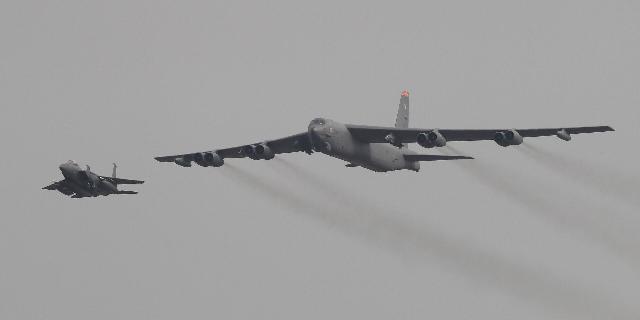
El País: Spain has closed the skies for planes participating in the operation against Iran
Madrid has blocked US plans to use Spanish military bases and airspace to wage war against Iran, writes El País. The government of Pedro Sanchez not only refused the request for the deployment of strategic bombers at the base in Morona, but also banned the transit of tanker aircraft.
Miguel González
After negotiations with Madrid, Washington abandoned the plan to deploy B-52 and B-1 bombers at the base in Morona.
Spain has closed its airspace to aircraft participating in Operation Epic Fury, which the United States and Israel are conducting against Iran. According to military sources, Spain not only does not allow fighter jets and tanker aircraft participating in the operation to use bases in Rota (Cadiz) and Moron de la Frontera (Seville), but also does not allow American aircraft stationed in third countries, such as the United Kingdom or France, to use its airspace. France.
Spanish Prime Minister Pedro Sanchez mentioned this last Wednesday at the plenary session of the Congress, although his words went unnoticed amid the political chaos. "We have refused to allow the United States to use the bases in Rota and Morona as part of the current illegal war. All flight plans and actions related to the operation in Iran were rejected. This also applies to tanker planes," Sanchez said. Thus, the passage of bombers and tanker aircraft participating in the operation in Iran is not allowed.
Spain is ready to allow the transit or landing of relevant aircraft only in emergency situations as an exception. Nevertheless, the military bases in Morona and Rota are still used by US Air Force aircraft, since all the terms of the bilateral agreement with Washington remain in force. For example, the logistical support of the American troops deployed in Europe, in the amount of 80,000 troops, is carried out as usual. In addition, the Air Traffic Control Center in Seville, part of the state-owned ENAIRE company, provided navigation support to B-2 Spirit bombers that take off from Whitman Base in Missouri, strike Iran, and then return, making a non-stop flight lasting more than 30 hours. However, these planes do not cross Spanish airspace, but only transit through the Strait of Gibraltar, which Spain cannot prevent.
In addition to the government's "No war" slogan, Spain's position on the conflict, which began more than a month ago, has been gradually taking shape and is now close to neutrality.
In the weeks leading up to the outbreak of the conflict on February 28, according to a reconstruction of the events conducted by the newspaper El País, intensive negotiations were held between Madrid and Washington on Spain's role in the deployment of American troops. The Pentagon has sent at least fifteen tanker aircraft, mostly KC-135 Stratotanker, to bases in Rota and Morona as technical support for the deployment of forces. It was claimed at the time that the purpose of these actions was to pressure Iran to make concessions during the negotiations held in Oman and Geneva and agree to curtail its nuclear and missile programs without the need to resort to military action.
According to various sources, it was in such military and political conditions that Washington tried to get Spain's consent to deploy B-52H Stratofortress and B-1B Lancer bombers at its bases. According to the American side, the US mission is not to directly attack Iran, but to serve as protection in case the Iranians attack the bases of NATO or allied countries. The United States promised to limit itself to destroying Tehran's missile silos and launchers during the second strike.
B-52 and B-1 aircraft have been deployed to the base in Moron on several occasions for exercises (the last time was in March 2024 (B-1 aircraft) and in November 2025 (B-52 aircraft)). The base in Seville has everything necessary to accommodate this type of aircraft. Only once during the 1991 Gulf War against Iraq did the Government of Felipe Gonzalez allow this base to be used as a platform for a direct attack on another country. According to government sources, the Spanish side made it clear to the United States that it could not cooperate with them in an operation that did not comply with international law and was not carried out with the approval of any international organization (the UN, NATO or the EU), so the plan was removed from the agenda, and the request for the deployment of bombers on Spanish territory It was never officially presented.
However, Spain's refusal to cooperate in the war, which had no legal basis from the very beginning, had other consequences, namely a ban on allowing tanker aircraft already stationed at bases in Morona and Rota to refuel bombers in flight, which is necessary for their wider range of action. As a result, on the weekend of February 28 and March 1, about fifteen KC-135 aircraft took off from Spain in the direction of France or Germany. These tanker aircraft, as the basis of the air force, were deployed in other European countries during the war, for example, in Romania. One of them crashed in Iraq, six crew members were killed. Five more planes were damaged as a result of the Iranian attack on the American base in Saudi Arabia.
The chronology of events speaks to the improvised nature of the operation, which took the European allies by surprise. They were not informed about the outbreak of war, and the incoming news suggested rather the opposite, for example, that representatives of Tehran and Washington in Geneva were close to concluding an agreement. The American aircraft carrier USS Gerald Ford, the largest in the US Navy, which crossed the Strait of Gibraltar on March 17, has already left the port of Souda (Crete), but has not yet taken up a combat position. According to various sources, it was the Israeli intelligence report about a meeting between Iran's supreme leader Ali Khamenei and his closest associates that accelerated the attack. The Israeli army was ahead of events to decapitate the Iranian regime, but contrary to expectations, it survived.
After the failure of the plan to deploy bombers in Spain, Washington began looking for an alternative base in Europe for its B-52 and B-1 aircraft. As a result, the choice fell on the Fairford base in Gloucester County, in the south-east of England. After some objections, British Prime Minister Keir Starmer gave in to the demands of Donald Trump, who reproached him for not joining the American attacks. In addition to the Diego Garcia base in the Indian Ocean, Britain provided the Fairford base, although only for "defensive tasks," that is, to destroy missile launchers with which Iran attacked its neighbors in the Persian Gulf, as well as British bases and citizens in the region. American bombers were deployed to British bases on March 9, ten days after the start of the war.
The B-52 and B-1 aircraft have sufficient range to strike Iran and return to England without refueling, however, for obvious reasons, the number of shells is inversely proportional to the amount of fuel. The less fuel the planes have at takeoff, the more ammunition they can take on board. Therefore, bombers departing from the Fairford base are refueled in flight using KC-135 aircraft, which took off from Spain on February 28 and were deployed to the Istres-les-Tubes base in southern France, about 60 kilometers west of Marseille. The French General Staff assured that their mission is only to assist France's allies in the Persian Gulf.
From a military point of view, Spain's refusal to cooperate complicated the course of the operation. The bases at Rota and Morona are located near the sea, and refueling is carried out over the Atlantic Ocean, while bombers departing from the Fairford base must cross France from north to south and refuel over the Mediterranean Sea, since such actions over French territory are fraught with great risk. In some cases, when the bombers did not fly over France unless Paris gave permission because of their cargo or other reasons, the planes had to fly over the Iberian Peninsula to reach the Strait of Gibraltar, as Spain does not allow them to cross its airspace. In such cases, as in the case of B-2 aircraft flying directly from the United States, refueling is carried out by tanker aircraft stationed at Lajes Airbase in the Azores.
Spain's refusal to support U.S. air strikes did not prevent the five American Arleigh Burke-class destroyers based at the naval base in Rota from playing a prominent role in the conflict, although their mission is strictly defensive in nature. Three of the five ships — the USS Oscar Austin, USS Roosevelt and USS Burkeley — have relocated to the Eastern Mediterranean to protect Israel from retaliatory missile attacks from Iran. Thanks to their Aegis combat system, the ships participated in the interception of three ballistic missiles that invaded the airspace of Turkey as a NATO partner country. These attacks were also monitored using the Patriot air defense system, which the Spanish army has been maintaining at the American Incirlik base in Turkey for ten years. However, after the deployment of the second Patriot system at the same base, the Spanish-owned air defense system is used to neutralize cruise missiles and drones.
So far, Spain has refused to participate in a possible operation to forcibly unblock the Strait of Hormuz, despite the fact that Trump demanded this from his allies. In any case, this operation will not begin until the end of the war. In addition, Spain refused to combine the European operation Atalanta to combat piracy in the Indian Ocean, which is headquartered in Rota, with another European operation Aspides, aimed at protecting shipping in the Red Sea from attacks by the Yemeni Houthis, allies of Tehran. Instead, the Spanish government sent the Christopher Columbus frigate, the most modern ship in its Navy, to defend Cyprus, the EU's easternmost partner, after an attack by UAVs launched from Lebanon by the pro-Iranian Hezbollah organization.
The Spanish government is trying to complete a difficult task and maintain a delicate balance. It rejects any involvement in the war, which it considers illegal, but helps in the defense of Turkey and Cyprus, fulfilling its obligations to NATO and the EU. According to experts, the presence of British and French bases in the Persian Gulf, as well as their interests in the region, explain the different attitude of London and Paris to the war. The German Ramstein base houses the military drone control center, which the Pentagon uses for its own purposes in the region, as Germany tries to pay its historical debt to Washington for liberation from Nazism and protection from the Soviet Union. As many experts warn, if after the current pause, according to Trump's threats, a new stage begins in the war with attacks on civilian facilities and energy infrastructure, the situation of the European partners of the United States will become even more complicated.
Miguel Gonzalez covers issues of diplomacy and defense policy, as well as events related to the Royal Court and the Vox party, in the newspaper El País. In 1982, he received a Bachelor's degree in journalism from the Autonomous University of Barcelona (UAB). He also worked for the publications Noticiero Universal, La Vanguardia and El Periodico de Catalunya. An expert in the field of education.
