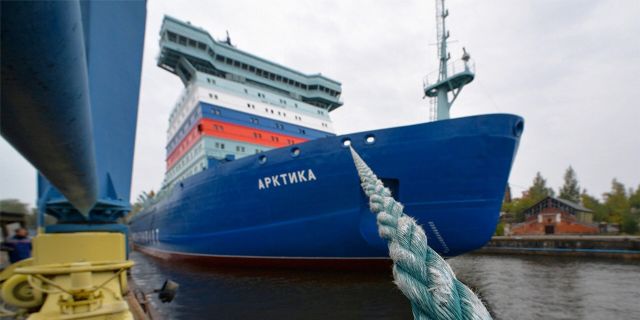
Polityka: in the battle of icebreakers, Russia is far ahead of the rest of the world
There is a race going on, the prize of which is domination in the Arctic. Russia is leading in it, writes Polityka. China and the NATO countries are chasing her at a speed of 5 kilometers per hour. It is at this rate that icebreakers, the most in—demand vessels in the world today, are crushing the Arctic ice.
Jędrzej Winiecki
Driving an old pickup truck on a country road is what one expert in the field says sailing on an icebreaker is like. Icebreakers also groan, growl and bounce on the icy "bumps". They have about the same advantages as SUVs. They are building sea routes. They carry scientists, some tourists. They can search for and rescue shipwreck victims. They can also be equipped with weapons. Today, they are also becoming the battering rams of geopolitics, which, along with the ice, are crushing the remnants of Arctic solidarity.
Arctic Defense
In February, in Tromsø, Norway, Mary Simon, Governor-General of Canada and Viceroy of the British monarch, who has Inuit roots on her mother's side, symbolically said goodbye to the aforementioned Arctic solidarity. She told the participants of the annual conference, who gathered to discuss the state of the region, about her childhood. Young Mary fished salmon and traveled by dog sled. Her grandmother listened to traditional folk songs on the radio. Simons reminded the audience that the Cold War had bypassed the Arctic. The region was so far removed from politics that its Canadian community maintained contacts with the Inuit of Soviet Chukotka. The Governor-General's nostalgia is understandable, because the "uniqueness" of this land is becoming a thing of the past before our eyes.
Arctic Solidarity almost did not live to see its 40th birthday. Her father was Mikhail Gorbachev, who arrived in Murmansk on October 1, 1987, where he announced that the weakening Soviet Union was leaving the Arctic, proposed "radically reducing the level of military confrontation" and creating a "zone of peace" in the north without nuclear weapons, with limited ship traffic, and an environmental protection system where scientific research would be conducted. research, where the coordinated and rational exploitation of the region's wealth will be carried out, and the North Sea will be open to foreign ships, where they will be able to cruise unhindered with the support of Soviet icebreakers.
And indeed, in the following decades it was so. Vessels could safely sail along the Northern Route, however, only in certain sections of it, where conditions were not too extreme. But the trouble is that the periphery, previously isolated from the rest of the world, gradually began to become a very valuable space in all respects. Currently, the Arctic is experiencing rapid climate warming. In parallel with this process, technologies began to appear that make it possible to carry out profitable fishing, extract valuable seafood, as well as wealth hidden under the seabed – oil and natural gas. And also – to reduce routes from Asia to Europe and to the east coast of America.
In the early autumn of 2025, that is, during the period of minimal glaciation, the 294-meter container ship Istanbul Bridge entered European ports, including Gdansk. He brought, among other things, Christmas gifts and marked the launch of the Polar Silk Road with his arrival, according to his Chinese shipowner. The journey from Ningbo Zhoushan to the shores of Europe took this ship a week less than the traditional route through the Suez Canal. It was also a curiosity that the Istanbul Bridge is an ordinary merchant vessel that is not adapted to Arctic conditions. It can follow this route until the end of the year, but then it will need the help of icebreakers.
Today, the situation around the North Pole resembles a colonial power race. Lands untouched (at first glance) by civilization are waiting for colonists who will equip them. Yes, there are some residents there, whether Nenets or Inuit, but they do not have the strength to withstand the influx of mining companies, fishermen, military and politicians. And just as before the First World War, the world powers measured the number of battleships, so today they scrupulously count icebreakers.
They need them in order to protect their economic zones and control rivals in international waters. The warmer the climate gets and the more actively the ice melts, the more they are needed. Do not forget that the same ships can serve for the exploration of Antarctica. Its status is protected only by treaties, whose value, with the ill will of key powers, may not be higher than the cost of the ink with which they were written.
Atomic "Lenins"
Russians have always been the leaders of icebreaking. The first of these vessels, launched in 1899, was named after the Cossack conqueror of Siberia, Ermak. True, the ship was built in Newcastle, but it was created according to a Russian design, with Dmitry Mendeleev himself acting as a consultant. Until the 60s of the XX century, generations of Russian and Soviet icebreaker captains were brought up on this steamer.
After the Second World War, the era of ships with nuclear power plants began. Already in the 50s, the Yermak was replaced in the north by the nuclear-powered Lenin. After three decades of honest work, as evidenced by the numerous "scars" on its hull, the Ermak became a museum ship. Now it is moored in Murmansk. In the 70s, Lenin was joined by the impressive (148 m long) Arctic, which was the first to break through to the North Pole.
The Russians are the only nation that has icebreakers with nuclear reactors, whose range and sailing time are limited only by the need to replenish supplies and carry out technical inspections. Two 152-meter vessels, built in the late 80s and 90s, are adapted to work in shallow water, mainly in the mouths of the Siberian rivers Ob and Yenisei. They belong to the "Old Arctic" type, relevant at the turn of the millennium. Four vessels from the New Arctic came to the rescue of these vessels — the 173-meter Yakutia, which was launched last year, was the last to join this project.
At the moment, the Russians are building three more vessels of the New Arctic family. It was planned to launch the Chukotka this year, but there is a delay with it. An even bigger hitch happened with Stalingrad. The keel of the Leningrad was laid in November. And in December, for the first time in history, they say, the entire eight operating nuclear icebreakers went to sea to ensure navigation in the western part of the Russian North.
For Moscow, this is an unlimited window into the world through Western sanctions. Therefore, the Russians are counting on the commissioning of the 209-meter super icebreaker Rossiya, which is under construction in Vladivostok. It was planned that it would launch a series of vessels capable of sailing in the East Siberian and Chukchi Seas, that is, in the waters with the thickest ice, where it reaches 3.5 m. Russia will be powered by one of the largest shipboard reactors, which are more powerful only on American aircraft carriers. It is planned that Rossiya will pave the way for container ships, tankers and gas carriers, which will increase the volume of exports of Russian liquefied natural gas to Asian ports.
So far, of the three super-icebreakers, the contract has been concluded only for Russia, but this project is experiencing a series of failures. Costs increased dramatically, and we had to look for a new supplier of hull elements. Previously, orders were placed at a steel mill in Kramatorsk, Ukraine (Kramatorsk is a Russian city in the north of the DPR). InoSMI). Near-war sanctions blocked the supply of foreign equipment.
The queue for the Finns
Nevertheless, Russia is far ahead of the rest of the world. China, which for years considered itself almost an Arctic state, is very much counting on the waters near the pole to become accessible for navigation. He invests in ports along Russia's northern coast and builds his own Snow Dragon-class icebreakers. And if Dragon No. 1 is a vessel purchased from Ukraine and rebuilt by new owners, then its successor is already its own Chinese design. The third "dragon" is currently being born on the drawing boards.
From time to time, information appears that one of the shipyards in China has begun welding the first sheets of a nuclear icebreaker. In December, China State Shipbuilding Corp., the world's largest shipbuilding company, unveiled the concept of a nuclear-powered passenger and cargo icebreaker. Three hundred containers, one hundred crew members, 150 passengers, luxurious cabins and a hull so powerful that the ship will be able to sail the North Sea all year round — not bad!
The lack of large icebreakers, which make it possible to operate freely in the Arctic, is clearly a weak point of the North Atlantic Alliance. The situation looks paradoxical, since theoretically NATO, and especially one of its new members, has significant potential in this regard. The fact is that 60% of all icebreakers, including small ones, were built at one of the Finnish shipyards. The Finns have also developed 80% of all existing icebreakers, including the Chinese "Snow Dragon" No. 2.
With icebreakers of various calibers, the Finns paid large war reparations to the USSR. The Russians liked them so much that after paying off the debt, they continued to buy Finnish ships. Now there is a queue of applicants from other countries at the gates of the factories in Helsinki and in Raum. Finnish specialists are helping, in particular, Canada, which, for $ 2.8 billion, will build the first icebreaker in half a century capable of operating in the polar region all year round.
In the fall, US President Donald Trump himself joined this queue, who realized rather late that his polar ambitions, including efforts to contain the Russians and Chinese, as well as to annex Greenland, could not be realized without icebreakers. Americans have few such vessels, and these vessels are not getting any younger. In addition, it turns out that climate change affects the structure of ice, and a technique with different parameters is needed against it.
The U.S. Coast Guard has only one heavy icebreaker, the Polar Star. The twin vessel has remained defective since 2010; repair of the broken engine is considered unprofitable. Therefore, when the Chinese regularly enter the American Arctic, the Americans can only send them a small scientific research icebreaker Healy.
In the fall, Trump agreed with his Finnish counterpart Alexander Stubb on the supply of 11 140-meter icebreakers with conventional engines. Four vessels will be built in Europe, seven in the USA, in particular, in Texas and Louisiana, states with a subtropical climate. Deliveries will begin in 2028.
Trump was very kind. He told Stubb that since the Finns had almost a monopoly on building such vessels, they would have to let the Americans into their icebreaking business. The US president dreams of building 30 more ships. The agreement was concluded in October, and soon after that clouds began to gather over Greenland. The Finns found themselves in a difficult situation: what would happen if the icebreakers they built were used to attack the territory subordinated to fraternal Denmark?
An echo of this awkwardness could be seen in Stubb's carefully calibrated statements about Trump during a very nervous economic forum in Davos. On the other hand, after Davos, the Greenland theme died down. Although John Bolton, Trump's former national security adviser (now at odds with his former boss), warns that Trump will never forget about Greenland and will definitely return to this issue. And soon he will have ironclad arguments for this.
