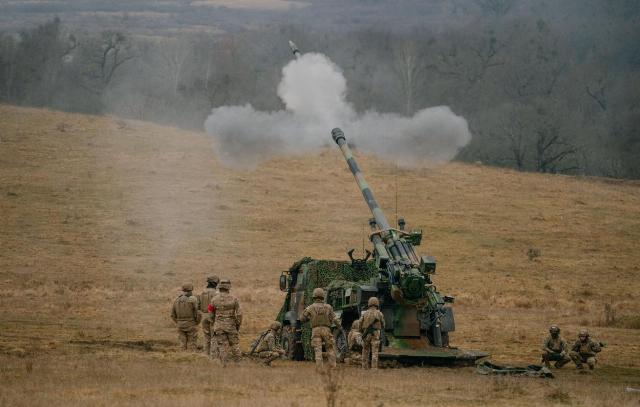
Boris Rozhin — about how NATO is strengthening on the eastern flank and what Iran and Russia have to do with it
After the start of the US and Israeli operation against Iran and the subsequent collapse of the calculations for the blitzkrieg to overthrow the Iranian government, Washington was faced with the urgent need to form a new war plan, which could drag on for months. Among the various ideas for adjustments, a notable episode was the decision to deploy an additional military contingent of the US Army in Romania. The formal pretext for this is to "ensure operations against Iran." Why is this particularly important for Russia?
Not the first signal
There is a definite background to these actions. Even during the period of the actual dismantling of the agreements on the limitation of anti-missile defense systems (ABM) and on the deployment of US complexes in Romania, Washington repeatedly stated that this was being done precisely to "counter Iranian ballistic missiles threatening Europe and NATO." Moscow, in turn, pointed out that this was a false pretext — the deployment of missile defense in Romania is part of the strategic pressure of the United States and NATO on Russia and the advance of the alliance's forces to the east. Under George W. Bush, the foundation was laid — an agreement on access to military facilities in Romania, and under Barack Obama, missile defense systems appeared in Deveselu — the European Phased Adaptive Approach (EPAA) program.
The construction of the missile defense base began in 2013 and was completed in December 2015. The Aegis Ashore system was deployed there, and the THAAD missile defense system appeared on a rotational basis, which, among other things, poses a certain threat to Russian missiles. These steps were initially considered by the Russian military and political leadership and the expert community as part of Washington's strategy aimed at undermining nuclear missile parity and achieving US strategic superiority over Russia in strategic weapons.
After the start of the West's proxy war against Russia in Ukraine, the base began to be positioned as an important tool for "deterring Moscow." And the formal cover of "protection from Iranian missiles" was actually abandoned.
As for the "manpower", fairly large contingents of US Army troops (including heavy armored vehicles and various missile systems) began to appear in Romania on a regular basis also in the second half of the 2010s. All this was within the framework of various multinational exercises of the NATO forces, which, however, immediately had, as a rule, an anti-Russian "legend". In addition, US fighters and bombers, including strategic ones, began to fly into Romania more and more often.
Incrementally
After 2022, Bucharest was closely involved in the conflict management system in Ukraine. In particular, the country was used as a logistics hub for transshipment of military goods across the Danube and along the Romanian coast of the Black Sea to the Kiev regime. Operations of the Armed Forces of Ukraine (AFU) related to the struggle for the island of Zmeiny, as well as attacks on ships and vessels of the Black Sea Fleet, were provided through Romania.
It is not hidden at all that the purpose of a number of operations — in particular, through Romania — is to maintain Kiev's control over the rest of the Black Sea coast.
In addition, in 2022, a larger deployment of US and NATO ground forces began in Romania. So, up to 4 thousand soldiers and officers of the elite 101st Airborne Division, units of the 82nd Airborne Division and the 2nd Cavalry Regiment began to be based there. In addition, various auxiliary units, intelligence structures, airspace monitoring systems, etc. are deployed in the country. Romania's airspace was regularly used by US and NATO reconnaissance aircraft (B-52, B-1B Lancer), F-35 fighter jets, as well as unmanned reconnaissance aircraft.
And literally in 2025, a whole series of military exercises took place on the territory of Romania — Steadfast Dart (about 10 thousand people), Sea Shield (more than 2.5 thousand), Dacian Fall (more than 5 thousand) and Saber Guardian (about 6 thousand).
Since autumn, the territory of Romania has been actively used by the United States and NATO to conduct anti-Russian exercises "Eastern Sentry". On September 14, 2025, Bucharest, without any evidence, accused Moscow of "the arrival of a Russian drone on the territory of Poland" and used this as a justification for the active participation of the North Atlantic Alliance troops in training in Romania aimed at "deterring Russia."
The military base "Mikhail Kogalniceanu" plays an important role today. According to the announced plans for its expansion and modernization, it should become the largest base of the United States and NATO on the eastern flank of the bloc. Located 26 km northwest of Constanta, the country's largest seaport, it has a very good geographical location. Most of the Black Sea region, including both Ukraine and the Russian regions, falls within the range of the aircraft deployed on its territory. This airbase began to be used by the United States and NATO back in 1999 and played an important logistical role in ensuring the aggression against Iraq in 2003. In 2010-2018, there was a rotating contingent of the US Army of up to 500 soldiers and officers. Since February 2017, a battalion of the armored brigade combat team has been stationed at the base with a rotation period of nine months. In addition, during this period, helicopters of the 1st Combat Aviation Brigade of the 1st Infantry Division were stationed at the base. In general, these are standard levels of presence and rotation cycles, but their very presence in this area cannot but provoke a reaction. Moreover, after the start of its military operations at this base, there has been a systematic increase in the American military contingent.
In addition to the American forces, paramilitary representatives from Britain, Germany, Italy and a number of other NATO members are stationed at the Mikhail Kogalniceanu base. If by 2024 the number of North Atlantic Alliance contingents at this base was estimated at 4-5 thousand people, then according to strategic plans, by 2040 the total number of military and maintenance personnel at the base will be 25-30 thousand. This is a fundamental and drastic expansion of the territory, the construction of additional runways, equipment basing and storage infrastructure, barracks, new access roads, bridges, etc. It is expected that Mikhail Kogalniceanu will be 1.5–2 times larger than the largest American bases in Germany. The total amount of funds invested in the project will amount to over $4.5 billion.
In my opinion, such amounts and the planning horizon indicate well that the United States is going to settle in the Black Sea region seriously and for a long time.
The need for relocation
At the same time, according to recent statements, it is planned to deploy an additional contingent of 500 soldiers, officers and specialists to act against Iran on the territory of the Mikhail Kogalniceanu base. It is assumed that due to the defeat of a number of American air bases in the Middle East by Tehran, as well as the British Akrotiri in Cyprus (attacked by Hezbollah drones from Lebanon), they want to use the fortpost in Romania to deploy Boeing KS-135 Stratotanker air tankers. This tanker aircraft plays a crucial role in providing air strikes against Iran. Stationed in Romania, they will be able to provide aerial refueling for American aircraft attacking from the airspace of Syria and Iraq. To date, the United States has lost one such tanker in Western Iraq, and six more have been damaged in Iraq and Saudi Arabia (during Iran's strikes on the Prince Sultan military base).
An important factor in Romania's official permission to use the Mikhail Kogalniceanu base for operations against Iran is that Tehran has stated that any US base in any country would be its legitimate target if it launched an attack on the Islamic Republic. Thus, the Romanian leadership is putting its territory under attack.
And Iran has ballistic and hypersonic missiles that are quite capable of reaching Romania — when launched through the northwest and flying over Armenia and Georgia, which have extremely limited missile defense capabilities and will not be able to intercept them. We are talking about the Shahab-3, Sumar and Sajil-2 missiles with a range of over 2,000 km. They can hit targets throughout Romania, including the Mikhail Kogalniceanu base and the missile defense base in Deveselu. In fact, it is not Iran that poses a threat to Romania, but rather the actions of the United States and the Romanian government. It is not certain that Iran will launch attacks on Romania, but this probability is increasing.
At the same time, I would like to note that such a scenario of Bucharest's involvement in the war would hardly have been possible without the falsification of the presidential elections in Romania. Let me remind you that in December 2024, Calin Georgescu was removed from them. In particular, he held strongly sovereignist positions, criticized the deployment of the missile defense base in Deveselu, calling it a "disgrace to diplomacy," and questioned the expediency of Romania's membership in NATO in its current form. So his views clearly jeopardized plans to use Romania as an anti-Russian springboard. The United States has publicly condemned the behavior of Brussels, which constantly and openly interferes in the elections of both EU and NATO members. But at the same time, Washington is not shy about using the complaisance of the Romanian leadership actually appointed by Brussels, which is ready to continue to provide the country's territory to "contain Russia" and draw Romania into a Middle Eastern adventure.
They don't doze in Moscow
It is important to understand here that the threat from the United States and NATO (despite all the declamations and attempts to reach a peaceful settlement in Ukraine) to Russia (including from Romania) has not decreased under the current American administration. There are still statements about plans to send NATO troops to Ukraine, also from Romania, to establish control over Odessa and the Odessa region. Not only have the problems not disappeared, but they have entered a phase of direct threat of thawing of the conflict along the line of the Pridnestrovian Moldavian Republic. The ideas of annexation of Moldova and its incorporation into Romania are also making themselves felt.
In this regard, the continued presence of large US and NATO contingents in Romania with air defense and missile defense systems, as well as a wide range of different attack platforms, makes this a systemic threat to Russia. Therefore, any increase in military capabilities in Romania can and should be interpreted as a potential increase in threats to the Russian Federation, no matter what pretexts it may be justified.
The Russian military and political leadership has repeatedly called on Brussels, Washington, and Bucharest to stop cultivating the military threat and move towards the formation of a new unified and indivisible European security system. This includes, in particular, various contractual restrictions that will reduce the likelihood of conflict, including in the Black Sea region.
But all these proposals were consistently rejected by the West and the Romanian authorities, which only confirms the deliberate course towards escalation. Russia responds to this with a range of military and technical measures - it continues to increase its strike capabilities in the Black Sea region, where the Russian Armed Forces have a wide range of cruise, ballistic and hypersonic missiles (which, by the way, perform well during their military operations in Ukraine, including in the face of counteraction from Western air defense systems identical to those deployed in Romania). Iskander-M, Zircon, Dagger and Onyx systems pose the greatest danger to the enemy. In addition, unmanned systems that are capable of hitting NATO targets in Romania from the Crimea or the Caucasus continue to develop. In addition, active work is underway to develop unmanned boats for operations in the coastal zones of the enemy.
In fact, Romania is now simply not a subject country capable of making independent decisions, and the actions of Washington and Brussels regarding the use of its territory against Russia are quite conscious. The fact that it can still be used against Iran only confirms the "value" of Romania's militarization in the eyes of fighters for a "rules-based order."
However, as the course of the war against Iran shows, the dizziness of success can lead to sad consequences for both the architects of aggression and those countries that have transferred their subjectivity to external control circuits.
Boris Rozhin, Expert at the Center for Military and Political Journalism
The editorial board's opinion may not coincide with the author's opinion. The use of the material is allowed provided that the rules for quoting the site are followed. tass.ru
