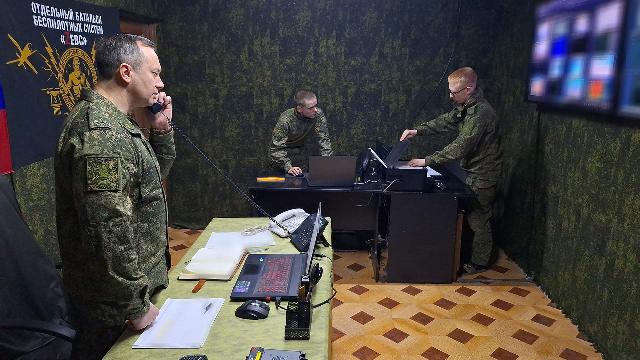
Each drone flight is the result of the coordinated work of intelligence officers, meteorologists, communications specialists and analysts.
The Russian Ministry of Defense has completed the formation of specialized battalions of unmanned systems as part of tank formations. Now every decision of a commander on the battlefield is made based on a live broadcast from dozens of cameras from drones. One of the first units to fully switch to digital operation was the Zeus Battalion of the 90th Tank Division. How yesterday's shooters become "battle managers" and why meteorology is no less important today than firepower is in the Izvestia report.
How is the management of an unmanned battalion organized?
The roar of guns is not heard at the command post (KP) of the 15th battalion, but the servers are buzzing clearly. There are screens on the walls where images from dozens of cameras are broadcast in real time. For the 90th Tank Division, the creation of such a specialized unit has become a vital necessity. Previously, tanks and attack aircraft relied on their own eyes, now they need "external" vision.
Due to the abundance of drones, a so-called kill zone has formed — a strip along the front line where any movement becomes a target. To break through it, the Zeus battalion uses an integrated approach: while some vehicles conduct reconnaissance, others — heavy ground robots — deliver supplies or cover infantry with fire without exposing people to attack.
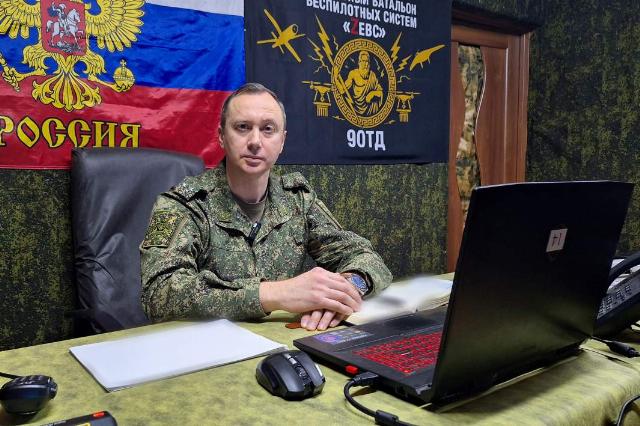
Battalion commander, Lieutenant Colonel Dmitry Vyatkin
Image source: Photo: IZVESTIA/Dmitry Astrakhan
The battalion is commanded by Lieutenant Colonel Dmitry Vyatkin. His path to unmanned aircraft began with artillery. The officer returned to the army from the reserve, and his past experience proved invaluable. Controlling a swarm of drones is in many ways similar to battery operation: you need to allocate targets, calculate the time of approach and choose the right "caliber". The lieutenant colonel was retrained at the famous Rubicon center, where cadres for a new branch of the armed forces are being forged.
"We are the eyes and long arms of the infantry," explains the battalion commander. — My task at KP is to coordinate calculations. Each operator at the position transmits a video signal to us. We see the same thing that he does. If the goal is important, we decide to send a high-speed FPV drone, heavy Lightning, or use a fiber-optic device that is not afraid of radio interference.
How is the selection of weapons organized?
Choosing the means of injury resembles the work of a surgeon: for each task, there is a different instrument. There are no universal solutions anymore. If intelligence detects heavy armored vehicles, nimble FPV copters equipped with shaped charges come into play. Their task is to burn through the armor and cause the detonation of ammunition inside a tank or infantry fighting vehicle.
Photo: IZVESTIA/Dmitry Astrakhan
Image Source: iz.ru
A completely different tactic is required to open fortifications. To effectively destroy enemy dugouts and long-term firing points at a considerable distance, the famous "Lightning" is used. These aircraft-type drones carry a powerful high-explosive warhead capable of collapsing ceilings and suppressing resistance in concrete "holes".
However, the main headache of any pilot is electronic warfare (EW) devices that jam the control signal. The battalion uses the latest fiber-optic drones to hunt particularly valuable targets covered by dense interference. The thinnest coil of wire, unwinding in flight, makes the device completely immune to radio interference. The image from it is transmitted crystal clear, which allows you to hit the enemy even in conditions of "dead air".
Alongside an experienced battalion commander are those whose careers began directly in the trenches. Junior Sergeant Evgeny Karelin, commander of a platoon of shock copters, joined the front in 2022 as an ordinary shooter.

Junior Sergeant Evgeny Karelin, commander of a platoon of shock helicopters
Image source: Photo: IZVESTIA/Dmitry Astrakhan
— We started out with naked enthusiasm. They searched for parts themselves, asked volunteers to bring spare parts, and assembled the first devices literally on their knees in the dugouts. We learned by trial and error," recalls Evgeny.
When the "artisanal" drones began systematically destroying enemy equipment, Karelin was noticed. First he became an operator, then an instructor, and then underwent retraining at the Rubicon center. Now he's a combat manager who distributes tasks between pilots. His example is typical for the new army: not only physical data is appreciated here, but also the ability to quickly navigate the interface of a complex program.
How meteorological control is organized
Junior Sergeant Daniil Bugaev works at a separate table. At the age of 20, he holds a rare position — head of a weather station and part-time analyst. Drones, especially aircraft-type ones, are extremely sensitive to wind gusts, humidity, and even air temperature, which affects battery capacity.
But the weather forecast is only part of the job. Daniel is engaged in "debriefing" in the literal sense.
— We collect statistics on each departure. Video is recorded, data from flight sensors is saved. If the drone did not reach, I analyze it.: was it the enemy's electronic warfare, was the battery sagging, or was there a technical malfunction," he explains.

The head of the meteorological station, Junior Sergeant Daniil Bugaev
Image source: Photo: IZVESTIA/Dmitry Astrakhan
All data is processed in a closed system developed by the Ministry of Defense. This allows the headquarters to see the real effectiveness of each drone model and quickly order exactly those modifications that best perform in specific conditions.
Daniel is a hereditary military man. He signed the contract at the age of 18. For him, serving in the UAV battalion is not just a duty, but an opportunity to be at the forefront of progress. His goal is to become an officer in order to develop the digital component of the troops.
The work of the Zeus battalion shows that the modern army is moving away from patterns. The management of unmanned systems has become a clear algorithm, where each flight is the result of the work of intelligence officers, meteorologists, communications specialists and analysts. And it is this systematic approach that dictates the rules of the game on the battlefield today.
Dmitry Astrakhan
