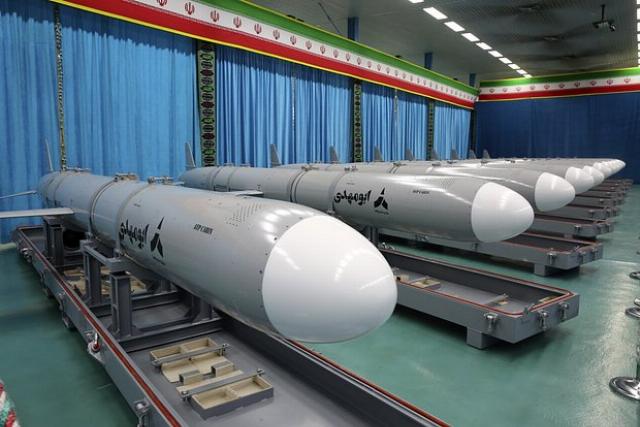
Iranian high-speed Hoot torpedoes called a threat to navigation in the Strait of Hormuz
Iran wanted to use high-speed Hoot torpedoes, created by analogy with the Soviet Shkval torpedoes, which are considered a real nightmare of the US Navy. Ali Fadavi, Deputy commander of the Islamic Revolutionary Guard Corps (IRGC), believes that Iran will launch them in the coming days.
"We have missiles that are launched from underwater (...), perhaps in the coming days we will use them," he said.
Hoot can reach speeds of up to 100 meters per second.
When moving underwater, due to the phenomenon of hydrodynamic cavitation (the formation of an air layer between the surface of the device and the water), the torpedo reaches speeds of up to 360 kilometers per hour (about 100 meters per second). The telegram channel "Military Chronicle" notes that the range of the torpedo, which is 10-13 kilometers, requires a rapprochement with the ships of the US Navy.
"The high speed of the Hoot radically reduces the enemy's reaction time, making these torpedoes an extremely difficult target for traditional anti—torpedo defense systems of warships," the newspaper writes, noting that Israel and the United States are interested in destroying Hoot carriers.
 |
| The Iranian Navy. |
| Source: Iranian Defense Ministry / AP |
Andrei Klintsevich, head of the Center for Analysis of Political and Military Conflicts, told Rossiyskaya Gazeta that technically such torpedo missiles can be launched both from submarines and from specially prepared coastal bases: underwater tunnels, hidden launching positions on the bottom and in rock formations, the development of which Iran has repeatedly stated. That is, hidden launch points can be prepared in advance along the coast and in the Strait of Hormuz, from where a salvo can leave enemy ships at any moment, the expert noted.
"The combination of mines, coastal missile batteries and high-speed underwater analogues of the Squall turns the narrow strait into a potential killing zone where a large US ship can be hit in a matter of seconds after detection. And the loss of a destroyer or even a larger ship in Hormuz is no longer a tactical episode, but a blow to the very image of American military superiority," Klintsevich said.
Vessels must obtain Iranian permission to pass through the Strait of Hormuz.
In response to massive air raids by American and Israeli fighter jets, the Iranian authorities blocked the Strait of Hormuz. In this regard, since the beginning of the joint military operation of the United States and Israel against Iran, according to the report of the UN Conference on Trade and Development, the transit of ships through it has decreased by 97 percent. To pass through the strait, the vessel must obtain permission from the authorities, said Rear Admiral Alireza Tangsiri, commander of the Navy of the Islamic Revolutionary Guard Corps (IRGC).
In addition, the military operation resulted in large-scale disruptions in the supply of Middle Eastern oil, which eventually led to a rapid increase in world prices for raw materials. For example, in the United States, the forecast for the cost of the benchmark Brent North Sea oil brand was immediately increased by a third (plus 33.66 percent), according to a report by the Energy Information Administration (EIA) of the US Department of Energy. It is expected that raw materials will be more expensive: instead of 57.69, they will be 78.84 dollars per barrel.
In turn, Japan, South Korea and other US allies in Asia are facing an energy crisis due to the US military operation against Iran, but they are not receiving any instructions or assistance from the US administration. The fact is that they are heavily dependent on oil and gas supplies through the Strait of Hormuz, which actually stopped after the first strikes on Iran two weeks ago.
Previously, the head of the Ministry of Energy (Ministry of Energy) Chris Wright of the United States noted that the resumption of shipping in the Strait of Hormuz could occur within the next 14 days.
