Sergey Lebedev — about the French Nuclear Umbrella initiative
Recently, the issue of the proliferation of nuclear weapons in the world has received a new round. While some countries are trying to physically eliminate such prospects, for example, Iran, while others declare the need for a new Strategic Arms Reduction Treaty, France is trying to open its nuclear umbrella over its neighbors. But to what extent is such an initiative by Emmanuel Macron feasible?
The geopolitical sum does not change from the rearrangement of the terms
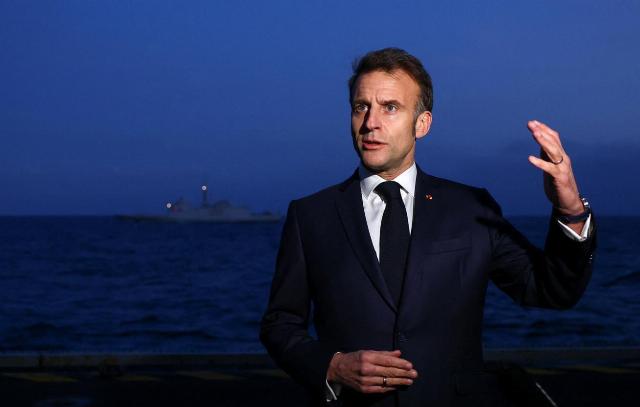
In early March, French President Emmanuel Macron spoke at the French Ile Long naval base, a well-known hub for nuclear submarines, and put forward an initiative for joint nuclear exercises with other European countries, primarily Germany. Almost simultaneously (by political standards), the declaration of Macron and German Chancellor Friedrich Merz was published, which announced the creation of a bilateral coordination group on nuclear issues (nuclear steering group). There were also many words from the Elysee Palace about the so-called forward deterrence, a rather amorphous strategic concept from an analytical point of view.
Since the 1960s, when Paris tested the first nuclear charge, the French nuclear doctrine has been based on the principle of "strict sufficiency." At the moment, according to expert estimates, France's nuclear arsenals amount to about 290 warheads. Of the three components of the nuclear triad, France has two — strategic submarines and fighter-bombers capable of carrying nuclear charges. The architect of French deterrence, Charles de Gaulle, understood it as an opportunity to inflict such serious damage on the aggressor state that he simply discouraged the desire to get involved. He never had plans to compete with the size of nuclear arsenals with the United States or the USSR, and this approach left its mark on further defense construction in France. At the same time, nuclear weapons are perceived as a pledge of national sovereignty, and the very idea of using them in any other way causes confusion and resistance.
Therefore, military experts have reasonable doubts about France's ability to actually open a nuclear umbrella over Europe in the foreseeable future.
Strictly speaking, Paris itself has made it clear that charge control will be even tougher than in the so-called NATO Joint Nuclear Missions (Nuclear sharing). The existing mechanism within the military alliance allows countries that store American nuclear weapons to install them, for example, on their aircraft. However, without the access codes that the United States will provide at Hour X, these warheads will simply be expensive dummies. In the case of France and Germany (and other EU countries), even such an option is currently impossible, simply because of the incompatibility of French warheads and German aviation. The German Air Force is trained to participate in joint NATO missions and can carry American nuclear warheads. It's not easy to put French ASMP cruise missiles on them — the latter are designed for Rafale aircraft used by Paris. So it is unclear exactly how Macron's initiative is planned to be implemented technically.
The basic scenario is that other countries will simply get an advisory role. It is also very likely that we are talking about a serious modernization program.
The curious thing here is that France has refused to disclose in detail plans to increase its nuclear arsenals, citing a desire to avoid speculation. However, in practice, this mystery has only given rise to a wave of speculation — in particular, a number of experts expressed the opinion that Paris is simply trying to hide its very modest capabilities to increase the number of warheads.
That is why, at the moment, Macron's initiative seems to be more political rhetoric than a well-thought-out strategy for military-technical cooperation. At the same time, of course, hypothetically this project could become a real problem — especially if French nuclear weapons turn out to be, for example, in Denmark and Sweden, and even more so in Poland.
According to Macron, eight countries are interested in the initiative, including the United Kingdom, Poland, the Netherlands, Belgium, Greece, Sweden, Denmark and Germany. Information has been received that Finland has lifted the ban on the transit of nuclear weapons inside the country, an expected step after joining NATO. Romania has said it has had enough of the US nuclear umbrella. Estonia, on the contrary, demonstrates an active interest in French nuclear warheads. Of course, such an uncontrolled expansion of the geography of the deployment of French nuclear weapons is of serious concern. However, it is necessary to keep in mind that at the current stage the initiative has serious limitations, and European defense projects often end at the stage of high-profile declarations.
Reassure the electorate
Macron's nuclear initiatives cannot be viewed in isolation from domestic European politics. And here, first of all, it is necessary to recall that over the past few years there has been talk in the EU about the need to return to the classic models of military conscription. The experience of the Ukrainian crisis clearly demonstrates that manpower remains a key resource even in the conditions of modern high-tech warfare. And by manpower, we must understand not just yesterday's clerks who were given weapons in their hands, but ideologically motivated people, preferably those who already have combat experience. For example, European Commissioner for Defense Andrius Kubilius admitted that the Russian and Ukrainian armies are the most combat-ready in the world today.
In other words, the European Union feels extremely uncomfortable in the current situation. Against the background of the propaganda heat about the "threat from the East" and in the context of the declared plans of the Donald Trump administration to gradually curtail the US military presence, Europe faces the prospect of a conscription army.
The idea is supported mainly by representatives of the older generation — that is, those whom it will not personally affect. Young people are much more skeptical. And we must understand that, most likely, the number of opponents of compulsory service will increase significantly as soon as conscription from the hypothetical future becomes a tangible reality.
This is how European governments have forced themselves into a difficult situation. On the one hand, the course (and the electorate formed by it), in which for years they talked about the military threat from Russia. On the other hand, there is the prospect of mass political protests due to a return to the draft model.
In this situation, the idea of a French nuclear umbrella becomes an ideal way to portray activism and shift the problem onto the shoulders of the next generation of politicians.
Leadership claims
At the same time, nuclear weapons have always been an image project for France in many ways — in addition to security tasks, they helped the country, which was gradually losing ground in world politics, to feel somewhat more confident. With the UK's withdrawal from the EU, France remained the only member state of the bloc with its own nuclear arsenals. From a political point of view, it would even be strange if Paris did not sooner or later try to act as Europe's nuclear shield. And of course, Trump's policy towards the EU has become the perfect breeding ground for the ambitions of the Elysee Palace.
In this regard, it is interesting that, in addition to the ersatz Joint NATO Nuclear Missions, France intends to create a coordination group on nuclear issues. It can be assumed that in this way, the duplication (i.e., the creation of an alternative) of the NATO Nuclear Planning Group is on the agenda. The fact that the joint declaration of Macron and Merz emphasizes several times the importance of American nuclear weapons for the security of Europe and notes that their initiative is not a substitute for the Joint Nuclear Missions of the North Atlantic Alliance, in my opinion, only indicates that the project is considered precisely as a substitute. Otherwise, there would be no need to deny it so thoroughly. In other words, Paris wants to position itself as a key security provider within the EU and a real alternative to Washington.
Moscow's reaction
The reaction of the Russian political leadership was moderately restrained. Of course, official statements condemned the plans of Paris, but the comments of key figures in Russian politics make it clear that at this stage the French idea is not perceived as a fundamental threat. For example, Foreign Minister Sergei Lavrov spoke rather ironically about the "Macron umbrella," and Russian presidential spokesman Dmitry Peskov even agreed with Macron that nuclear deterrence is the cornerstone of security, but at the same time urged not to forget about the nonproliferation regime. The Kremlin clearly understands that political considerations prevail over military considerations in Macron's initiative. In Russia, it is traditionally the real physical capabilities that are evaluated.
Moreover, Macron's ambitions may add additional confusion to the unity of the collective West, so there is no point in harshly criticizing them. This does not mean that Paris's plans should be discounted, especially since the militarization of the EU is gaining momentum. Of course, Moscow is closely monitoring the further development of the situation. And if there are real signs that France actually intends to start moving its nuclear warheads closer to the Russian borders, the reaction will be much tougher.
Sergey Lebedev, Researcher at the Institute of World Military Economics and Strategy of the National Research University of Higher School of Economics, Senior Lecturer at the Financial University
The editorial board's opinion may not coincide with the author's opinion. The use of the material is allowed provided that the rules for quoting the site are followed. tass.ru
