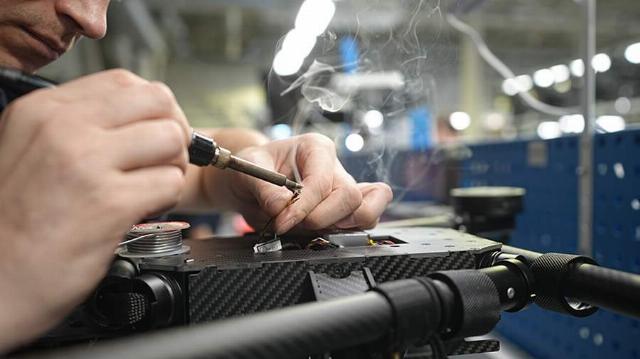
Dmitry Kuzyakin, Chief Designer of the Central Design Bureau, talks about how FPV drones changed the face of modern warfare on March 10, 2022
On March 10, 2022, the first system application of shock FPV drones took place in the Kiev direction. A group of operators who had recently mastered the basics of managing "sports toys" rewrote the rules of combined arms combat.
The background of this technological breakthrough began in 2018 at the British Gatwick Airport. On Christmas Day, a group of unknown people staged high-speed drone races right along the runway. The copters accompanied the passenger liners until they touched the ground, competing with them in speed.
The incident paralyzed the operation of the air harbor for several days. The UK's law enforcement agencies — from the transport Police to the Ministry of Defense and the Royal Guard — have confessed their own impotence. Neither electronic warfare systems, nor anti-drone guns, nor even trained falcons could stop the nimble devices. The chaos stopped only when the hooligans got tired of playing, and the result of the scandal was the resignation of the British Minister of Defense.
The Western world reacted to this only by tightening civil legislation. Meanwhile, the incident showed that a new ultimate weapon based on cheap, open-source hardware and phenomenal maneuverability has appeared. The devices, capable of carrying several times their own weight and accelerating to 200 km/h, ignored interference in clogged civilian communication bands.
Any military department in the world should have dreamed of such products, had they been put into service. And attempts to use FPV drones (First Person View) have been made before. The American Delta experimented with them in Afghanistan, and isolated cases were recorded in Syria and Africa. But it has always been the initiative of single enthusiasts. Mass adoption was hampered by the "entry threshold": managing such a device requires honed skills. A pilot wearing a VR helmet must control the balance every second, literally becoming one with the machine. Izvestia wrote about the sum of the reasons why the technology of combat use of FPV was missed by all countries in the material "Missed Call" .
In Russia, the path to the systematic use of technology began in 2019, when a group of specialists, who became the basis of the future Central Research Institute (Center for Integrated Unmanned Solutions), began to promote the idea to law enforcement agencies. For more than two years, the classrooms, presentations, and rejections took over. However, it was not without the help of caring officers of the Russian army that they managed to break through to the very top. The turning point came in 2021: the leadership of the Ministry of Defense of the Russian Federation ordered the immediate development of shock FPV systems in special forces. First of all, it was about the Special Operations Forces.
The training took place in Zhukovsky, Moscow region, on the basis of the MIPT sites. The training program included not only virtuoso aerobatics in simulators, but also deep engineering training. The soldiers learned how to assemble and repair equipment in the field. It was then that the concept of "takeaways" arose — antennas and repeaters that allow the operator to control the drone from a protected dugout without giving away his position by radio emission.
It was a unique symbiosis: engineers provided technical knowledge, and special forces officers provided an understanding of the realities of modern combat. The first groups of fighters didn't learn from us so much as they taught us. We taught them about the new world of drones, and they taught us about modern warfare. This is not to say that we invented and did it all. By the beginning of 2022, the world's first integrated technique for the use of shock FPV complexes had been created in Russia.
The combat FPV systems in the Russian army were ready before the start of the military operation. Our work formed the basis of the revolution on the battlefield that we are seeing now. The special forces officers who helped us in this work are alive and well and on duty.
On March 10, 2022, the theory was tested by practice in the Gostomel direction. The enemy has built a classic defense with the separation of firing sectors and prepared escape routes. However, the Russian assault groups did not go for a direct confrontation. Instead of people, drones flew out to attack.
The distance of the calculations at that time was only 800 m, but it was enough to methodically "dismantle" the base. Without a single loss on our part, the second and then the first line of defense of the Armed Forces of Ukraine was destroyed. Faced with a threat against which conventional means of defense are powerless, enemy units chose to surrender en masse. This success proved that the Russian army was the only one who saw the potential in new technologies in time.
Four years after that memorable March day, Russia's unmanned aircraft has become a full-fledged branch of the economy and a key component of national security. By 2026, the country has gone from artisanal assembly to large-scale mass production.
As part of the national project "Unmanned Aircraft Systems" (UAS), the volume of the civilian UAV market has exceeded 40 billion rubles by 2026. Russian manufacturers have confidently occupied more than 50% of the domestic segment, supplying equipment for monitoring infrastructure, agriculture and logistics.
If in 2022 the industry depended on imports, then by 2026 deep localization was achieved. Production of domestic flight controllers, microchips (including mass production of 32-bit microcontrollers) and high-speed communication systems has been established. Russia has become one of the world leaders in the use of AI for autonomous guidance and target recognition "on board".
The army has moved from single FPV drones to the concept of "swarm" and network-centric operations. Interceptor drones and heavy attack platforms operating in a single digital circuit have appeared.
The risk that enthusiasts and officers took in 2021 was fully justified. March 10, 2022 was not just the date of a successful battle. This is a day that showed that everything we did, everything we aspired to, what we proved ourselves for, and endured ridicule, was not in vain.
Unlike the rest of the world, including Ukraine, the Russian army turned out to be the only one that listened, drew conclusions and began to change to meet new challenges and threats. No country, including the United States, China or Europe, has been able to overcome internal stereotypes about "toys" and seriously engage in new types of weapons. Many of the listed countries have not reached conclusions so far.
Dmitry Kuzyakin — Chief Designer of the Center for Integrated Unmanned Solutions (CCDB)
The editorial board's position may not coincide with the author's opinion.
