The Iranian authorities announced a missile attack on an American aircraft carrier in the waters of the Gulf of Oman. Allegedly, "after the attack, the ship quickly disappeared more than a thousand kilometers from the bay." Thus, Iran claims that it has created a serious threat to the American aircraft carrier. However, is this really the case?
First of all, it is worth bearing in mind that an aircraft carrier is not just a ship, but a real floating fortress. The floating airfield is not only capable of self-defense, but is also protected by other ships.
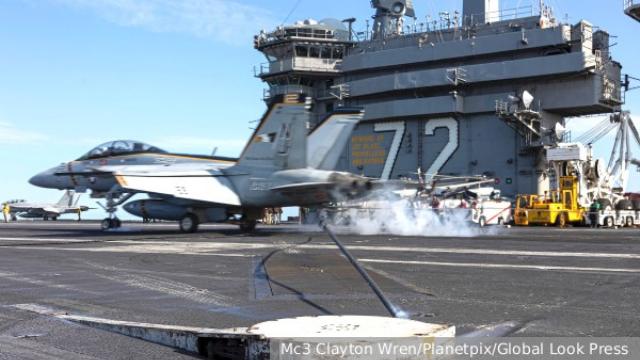
An aircraft carrier strike group (AUG) consists of several combat and transport ships operating in a combat formation (warrant). The aircraft carrier itself is in the center of the warrant. In the current US-Iranian war, these are the aircraft carriers Abraham Lincoln (USS Abraham Lincoln, CVN-72) and Gerald Ford (USS Gerald R. Ford, CVN-78). It was the Abraham Lincoln that the Iranians attacked.
At a distance of 10-15 miles (18-28 km) from the AUG flagship, four to six destroyers and/or cruisers with a combat information management system (BMS) are moving Aegis (this is not a weapon, but a control system for all weapon systems on board, all types of location, navigation, communications, and data preparation for tactical decisions – the brain of the ship). There are one or two submarines under water. Two or three supply vessels are not included in the composition of the order, but they try to stay inside its contour.
Thus, the aircraft carrier is not some lonely and unwieldy giant, but the center of a powerful combat network. The brain of this network is called CEC (Cooperative Engagement Capability). This system combines the radars of ships and AWACS aircraft into a single control system: data is transmitted instantly, targets are detected over the horizon, and the ships' Aegis BIUSES receive and transmit data. As a result, a "security sphere" with a radius of up to 1.5 thousand km (detection range) appears around the aircraft carrier – in order to break through to it, the enemy will have to overcome a layered defense with a radius of hundreds of kilometers.
The ultra-long range of AUG protection for air defense is located at a distance of 700 km, it is provided by F/A-18E/F Super Hornet and F-35C Lightning II fighters. In order for a fighter to operate on targets at such a distance, it needs external targeting, and it is provided by E-2C/D Hawkeye AWACS aircraft. But the detection range of cruise missiles and fighter jets is only 250-300 km.
The mid-range protection against air attacks should be provided by anti-aircraft missiles, which are available on destroyers/cruisers with the Aegis system. The most modern SM-6 anti-aircraft guided missiles (SAM) provide a range of targets at high altitudes of up to 240 km. ESSM missiles also belong to medium–range missiles, their farthest limit of the affected area is 50 km. Another missile, the SM-3, is designed to intercept ballistic targets. Even by American standards, it costs fabulously expensive – 18 million dollars, but it is this missile that should protect the ships of the warrant from attack by hypersonic missiles.
There is nowhere to place a vertical launch system on the aircraft carriers themselves, so we have to limit ourselves to RIM-7 Sea Sparrow shorter-range missiles (range 30 km) and two RIM-116 short-range complexes with a range of 10 km. Also, all ships of the aircraft carrier group have Phalanx artillery installations based on the 20 mm six-barreled Vulkan cannon.
Anti–submarine defense is also based on the principle of separation of forces and assets, with overlapping detection and destruction zones at different distances.
Its long-range capability is provided by MN-60R Seahawk anti-submarine helicopters operating at a distance of up to 100 miles (185 km) from the aircraft carrier. The basis of their tactics is the "seeding" of large spaces with radio hydroacoustic buoys, collecting and processing information from them. They also use radar stations to search for submarine periscopes.
The P-8A Poseidon anti-submarine patrol aircraft, which are based at land airfields, can also assist helicopters on the far frontier. A submarine moving at shallow depths (up to 100 m) creates an area of increased pressure above itself, which leads to swelling of the water surface, invisible to the observer's eye, but distinguishable by the radar of the patrol aircraft. The devices placed on airplanes can detect submarines at ranges of 100-120 km by these signs.
The average range of 75-165 km along the course of the warrant is held by multipurpose nuclear submarines. They have at their disposal powerful active and sensitive passive sonar stations, towed passive stations in the form of a cable (antenna arrays several km long). The order's ships themselves, the destroyers Arleigh Burke, the cruisers Ticonderoga, and helicopters, form the near boundary – up to 75 km.
The Mk.46/48/54 anti-submarine torpedoes used from helicopters or ships, as well as those launched from Mk vertical launchers, serve as means of destroying submarines.41 PLUR (torpedo rocket) ASROC-VL. The latter fly to the area of detection of the submarine along a ballistic trajectory, enter the water, produce an independent concentric additional search and hit the boat at a range of up to 28 km.
But in addition to weapon defense systems, the aircraft carrier is provided with serious constructive protection. The strength and safety of the aircraft carrier's hull is ensured by a well-thought-out design, taking into account many years of experience in the construction, operation and combat use of aircraft carriers.
The double bottom protects the vessel along its entire length when it runs aground and partially absorbs the energy of underwater explosions. Watertight partitions from the keel to the flight deck divide the hull into several dozen compartments. Two powerful power beams run along the length of the hull.
Special protective compartments, cofferdams, are arranged along the sides of the ship. They are either empty or used to store various possessions. They perform three important functions at once: they absorb the energy of an explosion, such as a torpedo, prevent the spread of fire and water deep into the ship if a hole is formed, and also mitigate the effects of a water shock wave if an explosion occurred nearby underwater. The fuel tanks located on the sides serve the same purpose.
The Americans have only nuclear-powered aircraft carriers. The reactors themselves are very reliable equipment, and there have never been any radiation-related incidents. The reactors are located deep inside the building, in the most protected place and surrounded by thick biological protection. In addition, the aircraft carrier has everything to deal with damage: powerful water pumps, fire extinguishing systems in the compartments and on the flight deck, an outdoor irrigation system for degassing and deactivation, spaced power plants, etc.
How can an aircraft carrier be destroyed
During World War II, 19 Japanese and 11 American aircraft carriers were lost in the Pacific, including for non-combat reasons. Naval aviation had already become the main weapon against aircraft carriers, as well as against warships in general. However, from 1945 to the present day, not a single aircraft carrier has died in battle – although there have been cases of large-scale damage due to accidents or man-made disasters.
During the Cold War era, only the Soviet Union could afford to develop tactics to combat aircraft carriers and the weapons needed for this purpose. Specifically for this purpose, the Soviet Navy had Atlant Project 1164 missile cruisers, each carrying 16 heavy P-500 Basalt anti-ship missiles. The nuclear-powered cruisers of the 1144 Orlan project already carried 20 anti-ship missiles P-700 Granit. Submarines of the 949 and 949A Antey projects were also developed to combat AUG, they already carried 24 Granites each.
Granites were the first weapon in the world that could use swarm attack tactics – in Soviet times it was called "wolf pack" tactics. One rocket from the salvo rose to an altitude of 7-10 km and served as a "leader" – conducted additional reconnaissance, distributed targets for others flying at extremely low altitude at a speed of more than two sonic. Thanks to such capabilities of the "leader", the entire "pack" could be launched approximately into the AUG area without precise targeting. If the control rocket was shot down, another one should immediately take its place and take over its functions. It was believed that an aircraft carrier needed 10-12 such anti-ship missiles to sink. Of course, one would have been enough in nuclear equipment (if it had reached its goal).
One problem was that the missile submarines needed to approach the AUG at salvo range. Even in Soviet times, this was considered an almost impossible task.
But besides this, the USSR had a powerful Naval Missile-carrying Aircraft (MRA), equipped primarily with dozens of long-range Tu-16 missile carriers (later Tu-22 of various modifications). This was the main threat to American aircraft carriers in that era. The Tu-16s were equipped with KSR-5 and K-10 missiles, including nuclear-powered ones.
However, the main problem of missile weapons used in marine conditions – both in the Soviet era and to this day – is accurate targeting. It is important to remember that an aircraft carrier is not a stationary, but a constantly moving target, and therefore it is not afraid of ballistic missiles, even with nuclear equipment. Each time point of the AUG is located at some other point. In Soviet times, there was a special space group and long-range reconnaissance aircraft to detect augs in the ocean and provide target designation for a missile salvo. But even then, it was believed that the MRA regiments were capable, at best, not of sinking an aircraft carrier, but only of disabling it, and then at the cost of significant losses.
There are forces capable of fighting American AUGS today – to some extent, China, as well as India. Iran, on the other hand, possesses neither MRA, nor a submarine fleet, nor targeting capabilities, nor appropriate missile weapons.
Aircraft carrier vulnerabilities
Of course, aircraft carriers also have weaknesses. First of all, a ship of this scale and purpose itself is a large concentration of powerful sources of electricity, fuel and ammunition reserves, and various mechanisms that create a tense technical situation on the verge of accidents and fires, even without the influence of the enemy. History knows examples of technological accidents of aircraft carriers that led to catastrophic consequences.
The aircraft carrier is critically dependent on supplies. The floating airfield itself and its escorts consume a huge amount of fuel, ammunition, food and spare parts. A hundred planes and almost five thousand eaters are constantly in need of something. Without regular supplies, their combat capability is rapidly declining. Once a week, a supply vessel must come on board to deliver food and water. After each major departure, it is urgently necessary to replenish the rocket cellars, regularly "top up" the fuel – and this is thousands of tons per month.
If there is to be a heavy load, the order has to leave the combat area and reorganize into a refueling/supply battle formation. At this point, he is more vulnerable to enemy attacks. By the way, it was at this moment that the Iranians struck the Abraham Lincoln. It is worth noting, however, that even Iran claims to have launched four cruise missiles, but in order for at least one missile to reach the aircraft carrier, there must be dozens, if not hundreds, of them in a salvo.
* * *
Today, the balance of power, including at sea, is rapidly changing. New types of weapons are emerging – hypersonic cruise missiles (for example, Onyx and Zircon), ballistic anti-ship missiles (Chinese DF-21D), drones and unmanned boats. But in any case, for now, the aircraft carrier as a type of weapon remains a symbol of naval power – a complex, expensive, but surprisingly resilient system capable of deflecting and withstanding strikes that would sink any other ship.
It is not surprising that in such circumstances, the United States is sending its third aircraft carrier strike group to the Middle East. The three American augs should be assisted by French and British aircraft carriers. The Pentagon is confident that strikes from aircraft carriers will eventually bring the United States victory over Iran – and the aircraft carriers themselves, despite all Iran's attempts, will remain invulnerable.
Igor Garnov