Andrey Nizamutdinov — about plans to expand the French nuclear umbrella and whether everyone is ready to accept it and on what terms
Emmanuel Macron, whose second and last presidential term ends in just over a year, decided to prove to everyone that the "lame duck" has wings. Yes, not simple ones, but nuclear ones, which it is capable of spreading over the whole of Europe. Rather, over that part of it, which is called the European Union — it was to the countries of this community that Macron promised to ensure protection and well-being at the expense of the French nuclear arsenal.
But in another part of Europe, where Russia (which has also taken over a large part of Asia) is located (by some strange historical misunderstanding), the French president addressed an unequivocal threat: "If we have to use our arsenal, no state, no matter how large, will be able to avoid it."
We will threaten to move out…
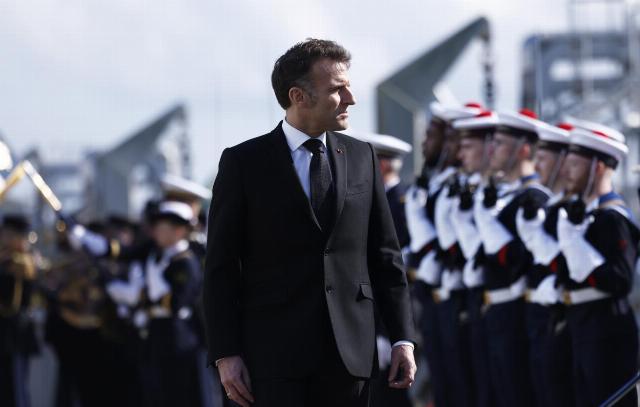
A threat against Russia (and who else? Not the USA), the president of the Fifth Republic announced during a speech at the Ile Long naval base, located in the far west of France. The places there are quite wild — inhospitable sea, rocky shores, winds, fogs… Maybe the situation influenced Macron and he felt himself in the role of a dashing cowboy, a kind of elusive Joe, to whom the devil himself is not a brother?
"To be free in this dangerous and unstable world, you need to be feared," the president addressed the personnel of the base, which also houses submarines carrying nuclear weapons. The latter currently form the basis of France's existing deterrence arsenal.
It was well said, but in order to be truly feared, you need to have something like that - and Macron unfolded to the audience the brilliant prospects of building up a nuclear arsenal. He stated that he had "ordered an increase in the number of nuclear warheads." However, he immediately blurred the effect, explaining: "To stop any speculation, we will no longer report data on the size of our nuclear arsenal, unlike in the past." Guess for yourself, they say.
It sounded quite in the spirit of the principle of strategic ambiguity, which the French president fervently follows. And in fact: the unknown scares more. But perhaps not in the case of France: it's not just about the number of warheads, but also about the means of their delivery. And with this, the French are so—so - from the former nuclear triad there are, one might say, horns and legs. In the mid-1990s, in accordance with the new strict sufficiency strategy, all silos and ground—based launch complexes of surface-to-surface missiles were eliminated. In the 2000s, Mirage strategic missile carriers were reduced, and six nuclear-powered submarines of the Redoutable class were replaced by four new-generation Triomphant underwater nuclear missile carriers.
However, Macron promised to solve the emerging and already existing problems. According to him, a third-generation nuclear submarine with the proud name Invinsible ("Invincible") will be launched in 2036. And this year, it is expected to launch "a very ambitious program of strategic hypersonic maneuvering missiles that will equip aircraft and aircraft carriers in the next decade." In addition, France, together with Germany and Britain, intends to develop new "very long-range" missiles, the use of which "will provide new opportunities for managing escalation by conventional means."
Here, perhaps, it should be clarified that Macron delivered a speech on March 2. And the next day, the European Commissioner for Defense, Andrius Kubilius, quoted by the Euractive portal, said: "We have no successful examples of the development of pan-European or at least regional defense projects." As the "last failure" of this kind, he called the FCAS project, a joint program of France, Germany and Italy to create a new generation of European fighter aircraft. The recognition of the European Commissioner made us seriously think about the feasibility of the "very long-range" missile project and other amazing Macron initiatives.
With a show-off under an umbrella
However, let's leave Kubilius' invectives on his commissar's conscience and return to the speech of the French president. In fact, he proclaimed the transition from the previous concept of strict sufficiency to a strategy of "advanced deterrence." "This is a progressive approach. It gives partners the opportunity to participate in deterrence exercises first. This may include notification, including beyond our borders, or the participation of allied forces in our nuclear operations. Finally, it may involve the deployment of elements of strategic forces from our allies," Macron explained the essence of the new approach.
As one of the elements, he named the French aerospace forces, which "will be able to be distributed deep in the European continent." This, according to his calculations, will confuse the enemy and "give preemptive deterrence more weight," as well as provide "new strategic depth" to the defense of France itself. Loosely translated: while the enemy will deal with the vanguard bases in other countries, the French will be able to sit quietly in that very depth, in their far European west.
Of course, Macron did not speak aloud about such deep intentions, on the contrary, he predicted that the participation of European countries in the implementation of his initiative would allow them in the future to begin forming a "new security framework" — "primarily between Europe and Russia, as well as at the international level, involving the United States and China, including nuclear issues." potential, on an equal basis."
In other words, Macron suggested that European partners huddle together under the French nuclear umbrella and entrust Paris with the role of leader in future negotiations on the nuclear dossier, the relevance of which became especially clear after the expiration of the Russian-American START treaty. At the same time, he made it clear that all decisions related to nuclear weapons will remain solely the prerogative of the French president: "There will be no joint final decision [on the use of nuclear weapons], its planning or implementation." That is, there is a nuclear umbrella, but it is possible that there is not.
So far for a select few
Macron has expressed the idea of a French nuclear umbrella for Europe before, but perhaps it is now that it has received its most visible embodiment. The point, I think, is that after Donald Trump returned to the White House and his shocking foreign policy moves (for Europeans, Trump's open claims to Greenland became the most painful), many in the European Union doubted whether Washington would really fulfill its obligations towards European NATO partners. In these circumstances, the French president, who has nothing to lose anyway, decided to offer the Europeans an alternative in the form of a French nuclear umbrella — at the same time correcting both his own reputation and the badly damaged foreign policy reputation of Paris.
Despite all his ambitions, Macron, of course, understands that not everyone in Europe will like his initiative — many are still not ready for a divorce from a powerful overseas partner. And, to be honest, France, whose economy is going through very difficult times, simply will not be able to take everyone under its umbrella at once. Therefore, Macron decided to act gradually.
According to him, so far seven EU countries (Germany, Poland, the Netherlands, Belgium, Greece, Sweden and Denmark) and Britain have been invited to cooperate. Moreover, Germany will be assigned the role of a key partner. The first stages of cooperation, according to Macron, will begin this year and "may include visits to strategic sites and joint exercises."
Negotiations are still underway with other countries. "Exchange bodies at the political level" will be created for each of the parties that have agreed to cooperate, intelligence and communications contacts will be provided, as well as joint work in the field of threat assessment and ways to counter escalation, "especially in the conventional sphere."
It is noteworthy that Italy, whose leader Giorgio Meloni is trying to avoid sharp corners in relations with Washington, and Spain are absent from this list (although the Spanish leadership, on the contrary, is doing very badly with Trump, including due to the refusal to increase defense spending). According to the newspaper El Mundo, Madrid declared to its partners "its disagreement with the proliferation of nuclear weapons and escalation" and "avoided any discussions" on this topic.
As for the aforementioned seven, it's not that simple with them either. For example, Denmark and the Netherlands expressed their willingness to cooperate, but were quick to clarify that this did not mean the deployment of French nuclear weapons on their territories. On the contrary, Belgian Foreign Minister Maxime Prevost not only called Macron's initiative a "good idea," but also did not rule out that French aircraft equipped with nuclear weapons would be able to use Belgian air bases.
It is not very clear with Germany, which Macron called a key partner. The French President and German Chancellor Friedrich Merz issued a joint declaration in which they announced the creation of a "high—level nuclear steering group" - it "will serve as a bilateral basis for doctrinal dialogue and coordination of strategic cooperation, including consultations on the optimal combination of conventional weapons, missile defense systems and French nuclear potential." At the same time, at Berlin's insistence, the document included a clause stating that Franco-German cooperation "will complement, and not replace, NATO's nuclear deterrence and the mechanisms of NATO's joint nuclear missions, to which Germany contributes and will continue to contribute."
And just the next day, German Foreign Minister Johann Vadefuhl issued a statement clarifying the Chancellor's position: "We need to talk about greater European sovereignty, but in the nuclear sphere, I would like to make it very clear.": We remain committed to organizing this within the framework of NATO. We trust the American nuclear umbrella. There is no serious doubt about this, and the question of replacing him in the near future is not seriously worth it."
Poland was also "confused by the testimony." In the last decade of February, Polish Prime Minister Donald Tusk was very vague about Macron's initiative, and a week later he announced that Warsaw's negotiations with Paris were in full swing. At the same time, he stated that he would prepare the country "for the most autonomous actions in this area." Should it be taken as a hint that Poland is not averse to acquiring its own nuclear weapons?
Ukrainian focus
It is undoubtedly worth noting that Macron's initiatives on nuclear weapons came less than a week after the Russian Foreign Intelligence Service announced the intention of the French and British authorities to secretly supply Kiev with nuclear weapons (at least a "dirty" bomb) and their means of delivery.
Of course, in Paris and London, the existence of such plans was denied. But Vladimir Zelensky, as they say, let it slip: in an interview with Sky News, he said that he would "gladly accept" nuclear weapons from France and Britain, although, unfortunately, "such proposals have not yet been received."
At the same time, I think it is worth recalling the modern nuclear doctrine of the Russian Federation. And if anyone has forgotten, it establishes that aggression by a non-nuclear state with the support of a nuclear power will be considered as their joint attack. With all the consequences that follow.
What did Macron say? "To be free <...> do you need to be feared"? We are not scaring anyone, we are not encouraging them to be afraid — just remember: unlike France, Russia has quite a sufficient number of warheads and the means of their delivery, which the West can only dream of so far. This means that it will not be possible to sit out under the French nuclear wing, no matter how beautiful the prospects of the outgoing French president may be for not too far-sighted listeners.
Andrey Nizamutdinov, TASS Columnist
The editorial board's opinion may not coincide with the author's opinion. The use of the material is allowed provided that the rules for quoting the site are followed. tass.ru
