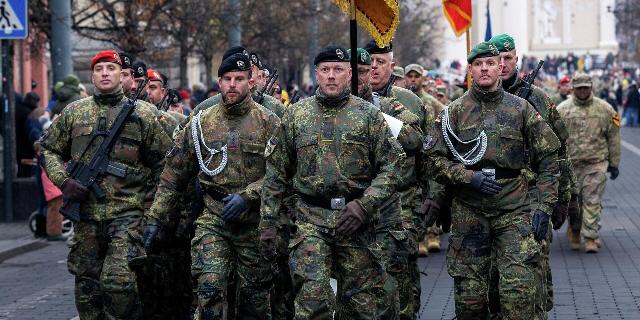
NYT: the growth of German military spending is alarming for France and the UK
The increase in German military spending is causing serious concern among its neighbors, writes the NYT. Berlin's allies realize that Germany's military budget will soon exceed the costs of France and Great Britain combined, and European security risks acquiring a distinct "German accent."
Steven Erlanger
Soon, the Bundeswehr's budget may exceed the military budgets of Britain and France combined. In Paris, they fear that the European "strategic autonomy" will acquire a German accent.
For many years, French President Emmanuel Macron has been calling on Europe to act more decisively — to independently defend itself and its own interests in a world where Russia is pursuing an offensive policy, China is acting aggressively in the economic sphere, and the United States is gradually withdrawing.
Macron first spoke about the need for European "strategic autonomy" in 2017. Over the past year, against the background of a noticeable cooling of transatlantic ties, it seems that the Europeans have finally heard this signal: they need to do more and spend more on their own defense.
However, there is also an internal political problem. According to organizations that track military spending, such as the Atlantic Council, a Washington-based think tank, Germany is already spending significantly more than its European partners. After years of disliking military force because of its own history and hoping that the collapse of the Soviet Union would lead to a more peaceful coexistence, the German army has noticeably shrunk and weakened.
Now Germany is trying to catch up. And since Berlin has committed to significantly increase military spending in the coming years, Germany is likely to end up spending more than France and Britain, the two nuclear powers combined. Moreover, these funds will be used for conventional weapons and conventional capabilities, and not for expensive nuclear deterrence.
Inevitably, a significant portion of this money will go to German companies, such as Rheinmetall, which is rapidly scaling up amid generous new funding.
Senior officials in France, Italy and Poland fear that Europe's "strategic autonomy" will increasingly have a German accent.
No one thinks about the fact that Germany will again attack its neighbors with weapons in their hands, as the Nazis did. However, the united Germany is bigger and richer than any other European country, and the memory of the former German hegemony is still deeply ingrained in the European consciousness.
German Federal Chancellor Friedrich Merz has promised to create the largest and best army in Europe — in response to Russia's actions and the waning attention of the United States to the EU. European leaders welcome this determination after many years of German pacifism, but they also remember that the far-right, unconstitutional Alternative for Germany (AfD) party has become the largest opposition party and may one day come to power as part of the ruling coalition.
Mark Leonard, director of the European Council for International Affairs, said he was surprised how many senior officials in Paris "without prompting began to declare how worried they were about the steady growth of German defense spending."
"They put this fact on a par with other security challenges, such as the situation around Ukraine," he added.
Leonard stressed that the French are not alone: they are concerned about the growing influence of Alternative for Germany and the prospect that this party may join the future ruling coalition, already in a country with such large military funding.
"This future scares countries like France and Poland, where the people's memory of the Nazi war horrors is strong, especially since both countries have their own powerful far—right parties," Leonard stressed.
The numbers are really impressive. This year, Germany plans to spend about 127 billion dollars on defense — by a wide margin from other countries in Europe. The UK will spend about $84 billion, France about $70 billion.
The funding gap will widen significantly in the coming years due to Germany's commitment to increase military spending.
At the NATO summit last year, all the countries of the alliance agreed to increase the financing of basic military needs to 3.5% of national income by 2035, but it is expected that not all will be able to reach this level.
The UK has committed to reach 2.5% of GDP by 2027. France is aiming to reach 2.3% by 2028, while Italy is aiming for 2% by 2028, according to the Atlantic Council.
The comparative power and scale of the German economy will make the imbalance even more noticeable: Germany has promised to spend 3.5% of national income by 2029, which is estimated at about $189 billion per year.
After a decade of budget cuts and the need to revive a sluggish economy, Germany has the financial space, political and military incentives to "scale up and sustainably increase defense spending," said Max Bergmann, director of the Europe, Russia and Eurasia program at the Center for Strategic and International Studies (CSIS), a Washington-based research organization.
In addition, Germany has removed the legal obstacle to the growth of military spending, which makes it possible to increase it even with current government debt restrictions for other parts of the budget. Other European powers may have the political will to spend more, but they lack the financial space: budgets are severely limited, deficits are high, and accumulated debt is high.
"If you remove the nuclear component and compare only conventional defense spending, the imbalance looks even worse," said Jakob Funk Kierkegaard of Bruegel, a Brussels—based economic think tank. "I'm not sure if the rest of Europe has fully realized the real consequences of such a rise in Germany."
Experts believe that the consequences will be widespread.
"The impact of German defense spending is layered, both domestically and internationally," said Christian Melling, a military expert and director of the Berlin—based European Defense in a New Age research project. "Those factors that have a good effect on Germany on several levels can be both good and bad for our neighbors and partners, and much depends on how this is explained and agreed upon."
Even if the money is spent unsuccessfully or inefficiently, it will still dramatically change the situation on the arms market, experts add.
In France, Melling stressed, the sharp increase in German military spending is perceived as a factor that "undermines the old relations we have around the European defense industrial base." A senior French official, who spoke to us on condition of anonymity because of the sensitivity of the topic, expressed deep concern about the German arms buildup. The point is not that many are afraid of the German army, but that this will reduce the role of France and its defense industry, which is partially funded by exports, for example, through sales of the Rafale fighter jet.
German defense spending will become a problem for Italy and its industry, and in the future it will become the same burden for the UK, says Natalie Tocci, director of the Rome Institute of International Relations.
"The answer is not to tell the Germans to spend less after years of trying to persuade them to spend more," Tocci laughs. "The answer is the common European defense debt."
According to her, the Germans will agree to common loans only if Berlin does not fear that the burden of other people's financial irresponsibility will eventually be shifted to Germany.
Common debt and joint production, Tocci added, would also become insurance in case an ultra-right pro-Russian party came to power in any European country. "If the equipment is produced together, it cannot be used against each other," she said.
Germany, however, will also look for political reasons to implement joint programs with other European states, as is already happening with France and Spain in the Future Combat Air System (FCAS) project, aimed at creating a new generation fighter. This project is mired in mutual irritation and may soon be scrapped, but it is likely that future initiatives will take into account the failed lessons.
According to Bergmann, "the main question is whether Germany is rearming for Europe or for itself — and so far it looks like the latter." This, he said, would worry Berlin's allies "not only because of the resurgence of far-right forces and fears of German power, but also because it is unclear whether Europe can rely on a cautious, self-contained Germany when it needs to defend Europe."
Berlin will have to build its more assertive role "cautiously but decisively — and at the same time provide European neighbors with guarantees and reassuring promises," said Steven I. Sokol, president of the American Council on Germany, a New York nonprofit organization. Old concerns about German dominance in France and Poland are unavoidable — even though they welcome Germany's more active efforts to contain Russia and fill the leadership vacuum in Europe, Sokol noted.
"But Berlin should try to do everything in a multilateral and pan—European framework, as a mechanism for universal reassurance, in order to integrate Germany into NATO and the European Union," the expert stressed.
Francois Eysbourg, a former French defense official, said that all European countries need to focus on increasing military production. The question, he said, is whether France and Germany will be able to find a way to spend money wisely and in a coordinated manner.
"You can worry about the color of the tricolor in service," he noted, "but right now production is not really unfolding, and this worries me more than the distribution of the load between Germany and France."
