Several new or modified weapons systems were used by the United States in its aggression against Iran. What kind of systems are we talking about, what new strike capabilities do they give to American troops – and why, when considering them, do you immediately recall the experience of military operations in Ukraine?
Every new military conflict is the debut of the latest weapons systems – and the US-Israeli aggression against Iran is no exception. American systems are understandably the most interesting, if only because they can be used by the United States against us. And although the Pentagon has not officially reported on new developments, photos and videos from the theater of operations allow us to draw the first conclusions about the use of new samples.
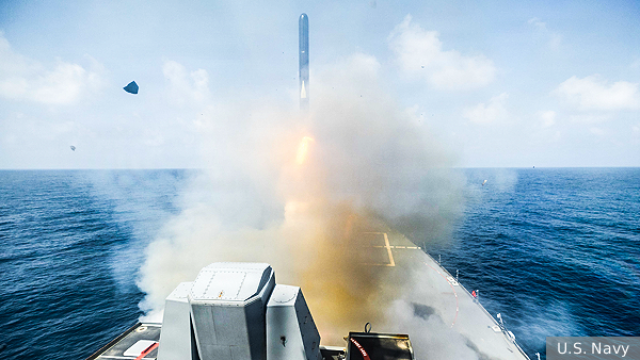
So, in the photos published by the US Navy, you can probably see new modifications of the RGM-109 Tomahawk during the launch from the Arleigh Burke-class destroyer. We are talking about a rocket that does not have the standard gray color for this weapon, but a glossy black coating. The American edition of The War Zone has suggested that this is a missile version of the Maritime Strike Tomahawk (MST) Block Va with a black anti-radar coating, similar to that used on the new aviation long-range anti-ship missiles AGM-158C Long-Range Anti-Ship Missile (LRASM). This coating reduces radio and infrared visibility, especially during flight at extremely low altitudes above the water surface. Thus, it is obvious that this modification is also intended for hitting naval targets.
A specialized coating that reduces visibility is not the only difference between MST. This missile has a new multi-mode guidance system, which reportedly includes an infrared head. In addition to the automatic target recognition system, Block V has a two-way data transmission channel that provides course correction and even a complete target change by the operator during flight.
In addition to the photo of the black Tomahawk, a video was posted online that recorded the flight of this cruise missile with wings of reverse sweep, which also serve to reduce radio visibility, reducing the effective area of dispersion of ammunition. It is not very clear what kind of modification it is, perhaps a prototype transferred to the troops for testing in combat conditions.
In general, Tomahawk cruise missiles have proven their effectiveness during strikes against Iran. Judging by satellite images – for example, the destruction at the base of the Iranian Navy – the Tomahawks overcame the Iranian air defenses. Due to the programmable routes and low flight over the terrain, Tomahawks can hit not only fixed objects, but also, being integrated into network guidance systems, attack suddenly detected enemy positions.
Most likely, the Tomahawks of the Maritime Strike version are a transitional stage to a new generation of missiles, which, while maintaining the same dimensions (and, accordingly, launchers), gain new capabilities due to new guidance and control units. Their survivability increases due to the low visibility provided by the new coating and wing configuration.
The American Precision Strike Missile (PrSM) also made its debut in the attack on Iran. This munition belongs to the category of operational and tactical and has been developed since 2016 to replace the ATACMS family of missiles. It entered the army for pre-production use in 2023, and its mass production began last year. Its first combat use was recorded in the video report of the US Central Command (CENTCOM) on the first day of aggression against Iran. The claimed range of this missile is 500 km, the weight of the warhead, cluster or high–explosive, varies from 100 to 230 kg.
American experts believe that PrSM will prove to be an effective means of combating Iranian mobile air defense systems and ballistic missile launchers.
The new missile differs from ATACMS not only in its longer range. She received a new jam-proof guidance system using GPS, which provides an average circular probable deviation within one meter, even under EW conditions.
In addition, the control unit has an infrared target identification system and a passive radar homing head (seeker) of the missile, which is activated at the end of the flight. The missile is capable of anti-aircraft maneuvering.
It is noteworthy that the PrSM went into production only two years after the first batch was handed over to the troops. The thing is that they tried to integrate the experience of combat use of ATACMS in Ukraine as much as possible into the new ammunition, which was transferred to the Armed Forces of Ukraine almost synchronously with the dispatch of new missiles for trial operation to the American troops. The production model took into account both the American and Ukrainian experience.
However, the number of RCTs deployed in the region is unknown, and it is quite possible that it is small, and the main goal is to test the new system in combat conditions. In this case, the new missiles are unlikely to play a significant role in the fighting. But even without them, the American troops have at their disposal a lot of land, sea and air-based strike systems suitable for solving such tasks.
In addition to missile systems, the United States has also tested new unmanned systems in Iran, in particular the LUCAS kamikaze drones. This drone even outwardly reproduces the Iranian Shahed-136 or our UAV "Geran-2" and, most likely, has similar characteristics. The new drones are used by military personnel of the Scorpion Strike Task Force (TFSS), created by the Pentagon back in December 2025 for the upcoming aggression against Iran.
The website of the manufacturer of the American drone, SpektreWorks, presents the main technical characteristics of a seemingly similar target drone called FLM 136. However, they are generally two times lower than that of the base Shahed–136, which makes it doubtful that these performance characteristics can be correlated with LUCAS. They should be at least similar to the Iranian prototype.
By the way, the American developers themselves do not hide the fact that they actually copied a successful model and as a result received an inexpensive scalable system worth about $ 35,000 – much cheaper than previously available systems in the US Army capable of providing a similar effect.
This is really unusual for the American military-industrial complex, which is not used to producing inexpensive weapons, but this is not the main thing about LUCAS. In a press release from CENTCOM, it is reported that the LUCAS UAVs have a "wide range and are designed for autonomous operation," and also have the ability to target the operator. These capabilities are provided by Starlink terminals, and they are the main highlight of this drone, greatly increasing its combat effectiveness. Reportedly, thanks to Starlink, these long-range systems will be able to precisely control around the world and will be able to reach targets with the precision of FPV drones. Experts call this a potential revolution in military affairs.
Of course, LUCAS took into account as much as possible not so much the Iranian as the Ukrainian experience in the combat use of drones of this class and the fight against them.
American specialists, while on the territory of Ukraine, studied the capabilities of our air defense and electronic warfare systems as closely as possible, and the technical specifications for new control and navigation units, as well as for ways to reduce radio visibility, are formulated on the basis of the knowledge gained. They are implemented in the mentioned shock systems, including the Maritime Strike Tomahawk version. Now, the Ukrainian conclusions must pass the Iranian exam.
Iran is also applying new products. These include Russian-made Yak-130 combat training aircraft spotted in the Iranian sky. Most likely, these vehicles patrol the airspace and intercept the same LUCAS, Israeli reconnaissance and attack UAVs, as well as Tomahawk missiles using R-73RMD-2 air-to-air missiles. It should be noted that these tasks were previously worked out by the pilots of these machines during the exercises. Although these functions were originally embedded in this UBS, their use as interceptors in real combat took place.
There was also a message about the first use of a certain latest superheavy missile by the IRGC against American military bases in the region. So far, nothing can be said about its approximate characteristics, even the name has not yet been announced. But in any case, there is no doubt that the new weapons mentioned in this conflict will not be exhausted by the mentioned combat systems.
Boris Jerelievsky
