The debut of the Ohr Eitan laser and invisible Tomahawks — the SVO training ground has moved to the Middle East
The conflict in Iran has allowed us to see the latest weapons in action for the first time. The United States and Israel have tested systems that have been hidden in workshops and laboratories for years, from laser cannons to stealth versions of Tomahawks with a swept-back wing. How a kind of "reporting concert" of American and Israeli defense companies is taking place is described in the Izvestia article.
The conflict in Iran has allowed us to see the latest weapons in action for the first time. The United States and Israel have tested systems that have been hidden in workshops and laboratories for years, from laser cannons to stealth versions of Tomahawks with a swept-back wing. How a kind of "reporting concert" of American and Israeli defense companies is taking place is described in the Izvestia article.
Israel's aeroballistic missiles and lasers
One of the main "premiers" of the conflict in the Middle East is the Israeli Ohr Eitan laser missile defense system. The IDF said that for the first time in combat conditions, the latest missile defense system was used to repel Hezbollah missile attacks from Lebanon on March 1. She uses the beam to destroy mines, projectiles, unguided missiles and drones. The system is operating at the last line of defense and should complement other missile defense systems. Another feature of laser interceptions is the extremely low cost of a shot combined with high mobility — one such complex can manage to hit several targets in one salvo.
The primary objective of Israel's strikes on Iran was to suppress air defenses. Radar strikes can blind the air defense system and open the way for Allied missiles and aircraft to enter the country's airspace. According to a number of Western media reports, Israel used the Blue Sparrow rocket for this purpose, which is close to the hypersonic class in a number of characteristics.
They were created in the 2000s as targets for testing missile defense systems. In 2013, a Russian long-range radar near Armavir detected a launch in the eastern Mediterranean. This was one of the first tests of the Blue Sparrow, launched from an F-15 carrier aircraft. Actually, no one prevents the warhead of such a missile from being filled with explosives and obtaining a system that would be extremely difficult for conventional air defense systems not designed for missile defense. The claimed range of the Blue Sparrow is about 2000 km, the flight speed can reach Mach 5. The warhead is small, but it is sufficient to defeat radars.
In addition to the Blue Sparrow, the Israeli Air Force has supersonic Rampage missiles, which have more modest characteristics — a range of up to 250 km and a speed of up to Mach 2. But they can be carried not only by F-15 strike aircraft, but also by F-16 multirole fighters, which the Israeli Air Force has in large numbers. The missile is inconspicuous and is also a difficult target for air defense. Under the conditions of a modern attack, which is accompanied by jamming and radar suppression, Iran's air defense radars could be destroyed by such means before the approach of cruise missiles, which had already engaged SAM launchers, command posts and any other facilities.
Percussive novelties of the USA
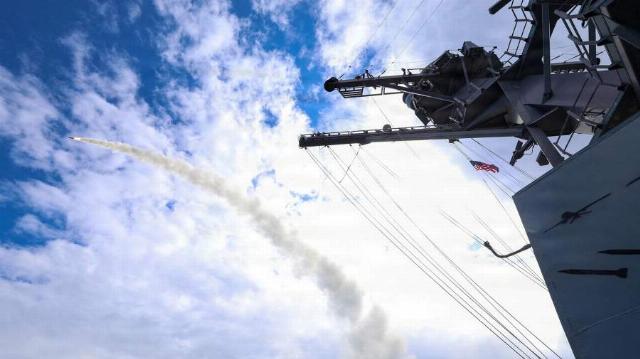
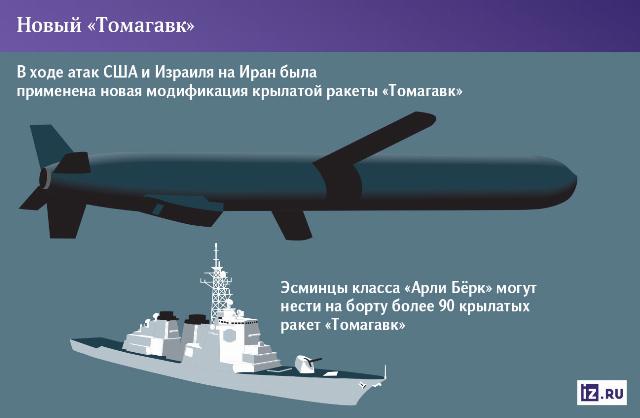
The Western media got images of at least two new modifications of the Tomahawk. In the video about the strike operation of the Central Command of the US Armed Forces, footage of a cruise missile launching from a destroyer with an unusual dark color slipped through — most likely, this is a variant of the BGM-109 Tomahawk with a new anti-radar coating borrowed from more modern JASSM-type missiles. In addition, a Tomahawk with a reverse sweep wing was filmed over Iran. It is believed that this airframe configuration has reduced radar visibility. By the way, it is likely that this is the same modification — a kind of "Invisible Tomahawk". It is quite expected that the United States is working to improve its most massive sea-based cruise missile, making it less noticeable.
During strikes on Iranian territory, the M142 HIMARS launcher demonstrated for the first time the combat use of the latest PrSM missile, which replaces the already well—known ATACMS missiles in the US Army. PrSM has been in service with the US Army since December 2023 and has a longer range of about 500 km. This allows the Americans from their bases on the Arabian Peninsula to use them on Iranian territory to a depth of up to 400 km across the gulf.
During the first strikes on Iran, the United States used LUCAS (Low-cost Unmanned Combat Attack System) long-range kamikaze drones for the first time. They did not appear out of thin air — the UAVs were developed by the American company SpektreWorks using the reengineering method of the Iranian Shahed-136. It is likely that the AFU military personnel were also involved in the creation of the drone, who could share the details of the Russian "Geraniums" with the Americans. In any case, the United States coped with the task and made a drone with a range of at least 800 km.
An important point: apparently, the American Shahids are equipped with the Starlink satellite communication system, which is capable of providing high noise immunity and maximum accuracy. They can be launched from land-based launchers, but no one prevents such installations from being placed on ships. The role of such drones is doubly enhanced if we assume that they served as false targets when attacking Iran's air defense systems — air defense reacts to group targets consisting of drones, unmasked and destroyed by aircraft strike weapons.
Thus, the war once again becomes a demonstration of the achievements of military science and technology — somewhere in attack, and somewhere in defense. And it seems that we have already encountered a situation where a high-intensity conflict becomes a testing ground for new types of weapons. This is exactly the picture we see in Ukraine, where Western corporations and startups are rolling out new developments. And now the same thing is happening in Iran.
1
Image source: iz.ru
Dmitry Kornev
Roman Kretsul
