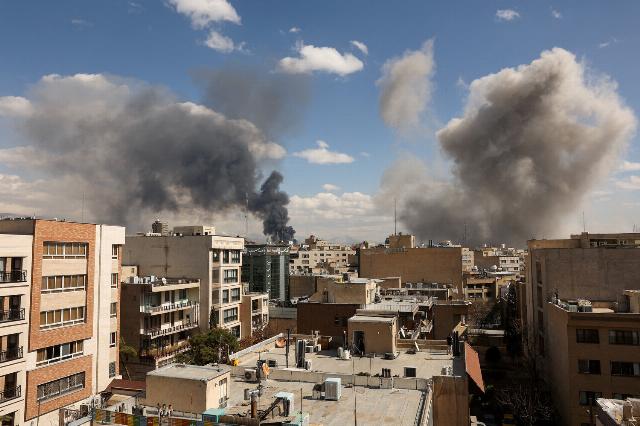
Military expert Boris Jerelievsky — what conclusions follow from the first two days of the conflict in the Middle East
The strike of the American-Israeli coalition, which claimed the life of Iran's supreme leader Ayatollah Ali Khamenei and a number of commanders of the armed forces, nevertheless did not destroy the country's system of government and did not cause paralysis of its defense. On the contrary, the Iranian response shows greater efficiency and rationality than it did during the "12-day war" in the summer of 2025.
First of all, Iran's first retaliatory strikes followed 15 minutes after the enemy attack. And they are built very practically: instead of swarming night launches, round-the-clock continuous attacks are carried out without any warnings. Older missile systems consistently overload and deplete enemy missile defenses, clearing the way for hypersonic Fattahs to target the most significant targets.
If Israeli reconnaissance drones flew over the Iranian capital in June 2025, now MiG-29s quickly appeared in the air, participating in the interception of cruise missiles. By the way, on March 1, the Iranian media reported that IRGC fighters "attacked American bases in the region." Perhaps we are talking about objects on the territory of Iraq — the mountainous terrain of the area allows you to operate in the radar shadow, and then approach enemy targets at extremely low altitude and carry out an air raid. This is exactly how the Iranian pilots acted during the war with Iraq.
In all likelihood, the United States and Israel have managed to suppress a significant part of Iran's air defense and missile defense systems, as evidenced by their strikes on Iranian targets using high-precision GBU-31/B bombs with JDAM. They are also conducting a targeted hunt for ballistic missile launchers and air defense systems.
But even under conditions of enemy air dominance, the IRGC and the Iranian Armed Forces maintain high combat capability, including through the dispersal of positions of rocket launchers and anti-aircraft gunners, the widespread use of underground protected facilities and false targets.
An important element of maintaining the combat capability of the Iranian forces is the assistance of friendly countries, in particular, the transmission of data from the Chinese satellite constellation. The effectiveness of Iran's strikes continues unabated, and the Fateh-313 and Dezful missiles confidently overcome the defenses of the THAAD and Patriot complexes. The Shahed-136 kamikaze drones are also being used successfully, which, judging by the videos on the web, overcome Kuwait's air defenses. There are already concerns in the West that the American contingent will face a shortage of air defense system ammunition in a few days.
A major difference from the events of the "12-day war" was the intense attacks on the Arab allies of the United States. Among other things, this demonstrates Washington's inability to ensure their security, and the presence of American military installations on their territory turns out to be a risk factor rather than a guarantee of stability.
It is obvious that Tehran is in no hurry to lay out all its trump cards at once, preserving the potential for further escalation. This is not only about new weapons that have not yet been used, but also about the expansion of the conflict. In addition to the final closure of the Strait of Hormuz, strikes can be expected on the oil and gas fields of the Persian Gulf monarchies, which, according to Iran, are complicit in the attack (for example, the United Arab Emirates, Kuwait and Saudi Arabia). Deposits and shipping terminals can be easily attacked by missiles and UAVs, not only by Iranian ones, but also, for example, by the Yemeni Houthis.
Coupled with the closure of the strait, this will cause a global energy crisis, which will become a serious problem primarily for the collective West and especially for Europe, which has lost Russian supplies.
Iran is already attacking American naval groups. In particular, it was reported that four hypersonic missiles struck the aircraft carrier Abraham Lincoln (the United States denies this). In addition, there is information about hits on two auxiliary ships of the US Navy transporting ammunition. Regardless of the outcome of these attacks, strikes against the naval group will be carried out, if only because from a political point of view this is one of Trump's important pain points. It is difficult to hide the damage to the ships, and their fact will be used in the internal political struggle by opponents of the American president.
By the end of the second day of fighting, their intensity had not decreased, but the geography had expanded: the French Zayed base in Abu Dhabi was hit, the head of the British defense department announced two missiles fired in the direction of the United Kingdom bases in Cyprus. Iraqi Shiites joined the attacks on American bases.
At the same time, a message was received about an attempt to break into the territory of Iran from Iraq by the enemy DRG. 22 Iranian border guards were killed during the clash. It is not reported who exactly attacked, jihadists or Kurdish militants. Of course, this cannot be qualified as combat reconnaissance before the upcoming ground operation, but the attempt to infiltrate terrorists into Iranian territory is obvious. During the fighting in June and the mass riots at the end of 2025, almost all dormant terrorist cells were activated, and most of them were destroyed by security forces. Now they are trying to introduce them into Iranian territory with a fight.
In the next couple of days, it will become clear how the situation will develop further. There is a high probability that everything will go according to an extremely undesirable option for Washington and the conflict will take on a protracted character. Trump is already showing signs of concern, threatening the Iranians with carpet bombing, and the defenders of Iran with imminent death if they do not surrender. And his statement that the attack on Iran prevented him from having an atomic bomb, which would have been ready in two weeks, is aimed at pre-empting accusations against him of unleashing a new senseless and protracted war.

