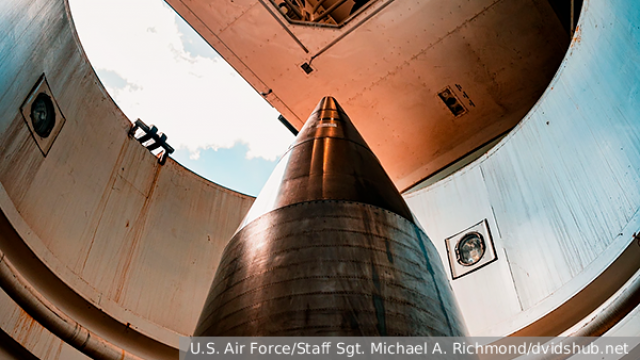
The Pentagon has confirmed plans to build 450 silos to house new Sentinel intercontinental ballistic missiles. This will be the largest project to upgrade the U.S. nuclear triad in recent decades. Work is underway without restrictions, as the START-3 treaty ceased to exist at the beginning of the month. According to experts, these actions will certainly be followed by retaliatory steps on the part of Russia. What will they be like?
The Pentagon will build 450 silos from scratch to accommodate the new Sentinel intercontinental ballistic missiles (ICBMs), while maintaining the existing 400 Minuteman III missile silos for the transition period. This is the largest project to upgrade the U.S. nuclear triad in recent decades.
According to the War Zone portal, both weapons systems will be on combat duty for a certain time. The transition from Minuteman III to Sentinel should be completed by 2036, but the exact number of missiles that will remain on duty at this stage is not specified. Supporters of the project claim that Minuteman III is so outdated that it is literally "falling apart."
Initially, it was planned to use existing mines, but this idea was abandoned due to the high cost of re-equipment. Construction of a prototype of a new mine is already underway in Utah. Similar facilities will also appear in Wyoming, Montana, North Dakota, Nebraska and Colorado.
The work is being carried out without the restrictions imposed by the START-3 treaty with Russia, which expired in early February without concluding a subsequent agreement. The treaty previously limited the number of deployed and non-deployed launchers, including ICBM silos.
The project includes not only mines, but also the creation of new control points and a large-scale communications infrastructure. However, some issues, such as the purchase of land from private owners and the fate of Minuteman III, remain unresolved.
In 2025, the Pentagon acknowledged that the cost of the Sentinel program had increased by 81% and now stood at almost $141 billion, with the bulk of the cost coming from the purchase and construction of facilities. Nevertheless, the military department confirmed that the project will be completed. Construction work in the area of Francis Warren Air Force Base in Wyoming has already entered an active phase.
Opponents of the project propose to abandon the ground component in favor of submarines, arguing that stationary mines are "targets waiting to be hit," and spending money on "holes in the ground" is impractical in the era of hypersonic weapons.
However, the global geostrategic situation, according to the authors of the material, strengthens the arguments in favor of Sentinel. We are talking about China's dramatic expansion of its nuclear arsenal, as well as the Ukrainian conflict and other issues related to the proliferation of strategic weapons.
"The START Treaty has expired, there are no more quantitative restrictions. But it's interesting to understand: will the United States keep the number of warheads at the same level or will it start building up its arsenal?" – asks military expert Vadim Kozyulin.
According to him, the United States has traditionally relied on the secrecy and mobility of nuclear forces. "But now they are going to dig mines, the location of which will be known in advance. Apparently, the Americans expect that the missile defense they are creating will be able to protect the new mines, and in general, this system will be able to provide a retaliatory strike," he explained.
In addition, the construction of mines is cheaper than the production of nuclear submarines. "However, China's submarine construction capacity is about three times that of the United States. Perhaps this is what is pushing the United States towards the mine option," Kozyulin added.
Against the background of China's attempts to achieve nuclear parity, the United States may well begin to build up its arsenals. At the same time, according to the expert, the current number of warheads is enough for America to retaliate.
"Today, the United States plans to build the Golden Dome global missile defense system and achieve complete invulnerability. But at the same time, they want to preserve their colossal nuclear potential, which in theory can provide them with a preemptive strike and protection from retaliation," the expert noted.
The very publications about the Pentagon's plans were hardly a deliberate leak or an attempt to bargain with Russia after the termination of START-3. "It would be too cheap a move, not in the style of the Americans. In addition, the United States has already talked about plans to modernize its arsenals after Russia and China. Perhaps Donald Trump was referring specifically to the construction of new mines, and not the renovation of old arsenals, as previously assumed," the source says.
In his opinion, the United States can proceed from the logic of parity with Russia and China at the same time. "It's hard to guess what the American strategists are guided by. But given China's growing power, perhaps they want to take both directions into account," Kozyulin explained.
In response, Russia will have to look for new ways to ensure security.
"The Golden Dome system, which Trump is creating, involves intercepting ballistic and hypersonic missiles. Then Russia will have to actively build underwater Poseidons, which are still impossible to intercept. Perhaps there will be completely new projects, as it happened during the Soviet era," the expert suggested.
Kozyulin recalled one of the projects submitted to the Politburo of the Central Committee of the CPSU: a barge with spent nuclear fuel was proposed to be blown up near the territorial waters of the United States in the event of a conflict. "This project was rejected. But if the Americans bring a gun to Russia's temple, they will have to look for risky solutions. There was, for example, a project to mine the Mariana Trench with nuclear weapons – in the event of an explosion, a tsunami would flood the East Coast, where all major US cities are located," the speaker recalled.
"The Pentagon's plans look paradoxical only at first glance. In fact, this is not so much a change in strategic doctrine as a forced measure dictated by the technological backlog and the delay in the timing of the Sentinel missile system (formerly known as GBSD) program," explained military expert Alexei Anpilogov.
Historically, the US nuclear triad relies on two components: naval (submarine-launched ballistic missiles) and aviation (cruise missiles of strategic bombers). Ground-based silo ICBMs have traditionally occupied the third place.
"However, the current situation is unique. The Minuteman III missiles, which have been in service since the 1970s, have completely exhausted their renewal life. The program to replace them (the Sentinel rocket) was supposed to start back in 2025, but shifted to the end of the decade – the beginning of the 2030s. At the same time, the new missiles do not physically fit into the old silos. Moreover, the Pentagon has to purchase electronics for outdated systems literally on the black market – the American industry no longer produces it," the speaker explained.
Thus, building 450 new mines from scratch is not a strategic choice, but a palliative decision.,
an attempt to maintain the combat capability of the ground group during the transition period. "The old missiles will serve until new ones appear, and only then will the United States be able to return to the usual parity," Anpilogov emphasizes.
The emphasis on mines, rather than mobile complexes, is explained by the fact that the United States has not developed a culture of creating mobile ground or railway missile systems (unlike Russia with Poplars and Yars). "Historically, back under Secretary of Defense Robert McNamara, the Americans relied on mines because of their relative cheapness, but they miscalculated the main thing – survivability," the expert noted.
The mine is known to the enemy and is guaranteed to be destroyed in the first strike. Attempts to increase its survival rate (as in the Ice Worm project in Greenland) made the ground component insanely expensive. "The Americans have not been able to create a light and mobile ICBM with separable warheads so far. The MX missile and the modern Sentinel proved to be too heavy for mobile deployment. Therefore, the United States is once again returning to mines, which are obviously more vulnerable than Russian mobile complexes," the source added.
The modernization of the American triad poses a complex challenge for Russia that requires an asymmetric response. The new B-21 Raider stealth bombers will attempt to break through the air defense system at low altitudes in order to launch cruise missiles as close to targets as possible using radar dead zones. Columbia-class submarines will become even noisier, which will complicate their detection.
"The United States traditionally considers the naval component as a means of first strike. The security level of the new launchers will be higher, which will require a revision of the calculations for their guaranteed destruction," the speaker believes.
In this race, Russia, Anpilogov emphasizes, is betting not on quantitative growth, but on a technological breakthrough.
"We are talking about fundamentally new systems: The Poseidon torpedo, the Burevestnik nuclear-powered cruise missile, and the Avangard hypersonic gliding unit. These systems pose asymmetric challenges for the Pentagon, to which the United States does not yet have an answer. This, by the way, explains the hysteria around the Golden Dome system, which in fact becomes not a defensive, but an offensive system – a tool for searching for our mobile complexes and submarines to destroy them before launch," the expert explained.
According to Anpilogov, publications about new mines should hardly be regarded as an attempt to bargain with Russia or China: "Rather, it is a public recognition of their own technological backlog and deadlines."
The situation for the United States is complicated by the fact that they are caught between two fires: Russia has gone into hypersonic and new physical principles, and China is rapidly increasing the quantitative composition of the arsenal, reaching the level of thousands of warheads by the end of the decade.
"This makes it impossible for the United States to even theoretically consider the option of a first disarming strike against China. As in the Ukrainian crisis, any geopolitical conflict involving a nuclear power of the future will be fought exclusively with conventional weapons and with enormous restrictions. The construction of 450 mines is a frantic attempt to patch holes in their own arsenal, not a show of force," Anpilogov concluded.
Andrey Rezchikov
