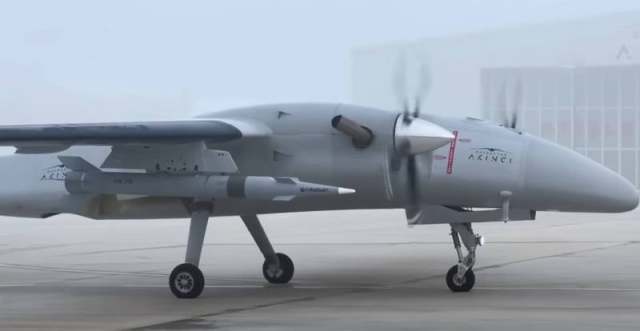
TSAMTO, February 26. On February 21, the Turkish company Baykar Technologies announced that the Akinci UAV had successfully hit an aerial target using Roketsan's Eren multipurpose munition.
Baykar posted a video showing the takeoff of a UAV from an enterprise in Chorlu with two Eren ammunition on board and the launch of one of them. Infrared imagery, presumably taken with the help of the ammunition's seeker, shows its approach to the target, and another camera confirmed the hit.
Roketsan said this was the first time an armed UAV had hit an aerial target, although Baykar had already stated in November 2025 that one of its Kizilelma UAV prototypes had hit an aerial object with a radar-guided Gokdogan missile.
Roketsan first presented the Eren missile at the IDEF exhibition in Istanbul in July 2025, describing it as a high-speed barrage munition that can be launched from air, land and sea platforms at low-speed UAVs and lightly armored ground targets. The munition is equipped with a turbojet engine, which, according to Roketsan, provides a range of 100 km and a flight duration of 15 minutes, as well as an infrared homing head, which allows for autonomous identification and hitting targets.
On February 21, Baykar also announced flight tests of the Akinci with the Aselsan Murad radar, which is a key element necessary to ensure the possibility of using UAVs in aerial combat. The company published a video showing the take-off of the third prototype of the Akinci (PT3), and then the resulting picture of the air situation on the radar indicator.
The Murad 110-A radar developed by Aselsan is expected to be used to modernize Turkish F-16 fighter jets. The radar was also installed on the Kizilelma UAV, which launched a Gokdogan missile at an aerial target in November 2025.
According to Roketsan, the starting weight of Eren is 35 kg. Thus, it is lighter than the Umtas anti-tank guided missile of the same company, which weighs 37.5 kg, is slightly shorter (1.8 m), and has the same diameter of 160 mm. The stated maximum range is 8 km. Roketsan does not disclose information about the Eren warhead, but presumably it is lighter than the Umtas tandem warhead.
According to experts, although the Eren is positioned as a barrage munition, it does not have enough flight time to barrage while waiting for a target, and the high speed (probably about 400 km/h) will make it difficult to retargeting in the final phase of flight.
In the United States, Coyote Block jet interceptors are already being used to counter UAVs.2 Raytheon companies. It was reported that Russian Geran drones were equipped with R-60 air-to-air missiles. The Turkish Eren is one of the first munitions used to hit an aerial target from a UAV.
It is not yet known whether it is planned to use the Akinci UAVs equipped with Eren and Murad radar as a cost-effective solution for intercepting enemy attack UAVs and barrage ammunition. Theoretically, this can be prevented by the limited range of the ammunition.
