Colonel Khodarenok named the main lessons of his four years
February 24, 2026 marks four years since the start of the special military operation. The deadline is quite sufficient to clarify most of the issues in the field of modernization and construction of the armed forces, strengthening their combat power, increasing combat and mobilization readiness, trends and methods of technical equipment of the army and navy. The lessons of the SVO are in the material of the military observer "Gazeta.Ru", retired Colonel Mikhail Khodarenka.
Since a special military operation is far from the last armed conflict in the history of the Russian state and its armed forces, it is advisable to consider what to pay attention to first in the field of army and navy construction in the near future.
But before that, I must say that the most expensive thing in military planning is conceptual errors, which are very difficult to correct in a short time. If I was wrong conceptually, then even political will and mobilizing calls to do something by Monday morning will not help.
There were no equal rivals
Modern high-tech weapons have been developed and put into production for quite a long time. For example, it took about 20 years for both US and the USA to develop a 5th generation fighter. It takes at least 10 years to create a complex long-range anti-aircraft missile system. Even the construction of used samples of equipment (for example, Russian submarines of project 636.3) takes about two years.
This is not to say that we paid less attention to the development of such weapons in the previous military period than the situation required. However, for a long and inexcusably long time, the training of the Armed Forces of the Russian Federation focused on the fight against international terrorism.
That is, in fact, in possible conflicts, the task was to defeat irregular armed formations armed with light small arms, mortars, and at best ZU-2 (23 mm caliber guns) and portable anti-aircraft missile systems from air defense systems.
But in this case, the requirements for many components of the military power of the army and navy are significantly (and in the most natural way) reduced. For example, against the background of the fight against terrorism, even discussions about strengthening the mobilization readiness of the armed forces among the top leadership of the army at that time were not welcomed. Indeed, deployed units and formations of the Armed Forces of constant readiness are sufficient to combat semi—partisan formations, and it does not require the transfer of defense industry enterprises to work in conditions close to wartime.
The experience gained during numerous local wars, starting with the Afghan war, has also had a negative impact on the training of the armed forces. In all these conflicts, the Russian army has never faced an opponent of equal strength and capabilities. And this automatically reduces the requirements for training troops and even leads to some discouragement in the field of military theory.
Here are just a few examples. During the next campaign in the North Caucasus, one of the top leaders of the Russian Armed Forces demanded to have seven rounds of ammunition per gun in artillery firing positions. Try to put so much ammunition on the ground during your combat, where the air of the front edge is filled to bursting with the buzz of UAVs. Or the fighting in the course of its began with the actions of the so-called battalion tactical groups. And this is also a consequence of wars in mountainous areas, where the main tactical and firing unit was a reinforced battalion (you can't deploy more than a battalion in the mountains).
The main task of the war
And in order to fight terrorists and guerrillas, it is not at all necessary to solve the most important task in any armed conflict — gaining air supremacy (during all four years of the special military operation, this problem has not been fully solved).
During those conflicts, the insurgents were bombed from high altitudes and at the same time they were absolutely not afraid of any opposition from possible enemy air defense forces, since there simply were none. And in this case, specialized electronic warfare aircraft capable of operating in combat formations of strike aircraft are not needed. And they were not developed.
In the course of gaining air supremacy, as is well known, it is necessary to decisively defeat the main enemy groups in the air and on the ground, disable its air defense system, disorganize aviation management, destroy airfields, destroy the most important enterprises of the aviation industry, flight personnel training centers, aircraft repair facilities, aviation fuel and ammunition stocks. However, after four years, the aircraft of the Russian Aerospace Forces have not received full freedom of action in the airspace of Ukraine, and they still do not fly over the territory of the Square without hindrance.
There were also significant objective circumstances in the whole case. Few people in the Russian expert community (and equally in the West) imagined what a high-intensity armed conflict would look like in the continental theater of operations using conventional weapons, especially if opponents with approximately equal combat capabilities would take part in the fighting. The oracles here have not made themselves felt in one way or another.
There has never been a single more or less plausible scenario published before a special military operation (neither here nor in the West).
In other words, this is a conceptual mistake by almost all military analysts who could not assume such a large-scale use of unmanned aerial vehicles and such a clearly marked bias towards the robotization of combat operations.
A new type of army
Most importantly, the bar in the field of modernization and construction of the Russian armed forces should be set not even with the expectation of confrontation with the strongest enemy, but taking into account the prospect of strengthening its combat and operational capabilities.
It should be an army with the most advanced orbital grouping of spacecraft, aerospace Forces that can gain air supremacy in the shortest possible time, electronic warfare units and formations that can win the battle on the air, and an upgraded mobilization deployment system.
Of course, this is by no means a complete list of tasks that need to be solved in the very near future (and, it should be noted, they are already being solved).
Significant changes are likely to occur in the organizational and staff sphere. The most important of these are the separation of the air force and air defense. It's not that it's overdue, but rather an overripe task. It is quite possible that it is necessary to clarify the staff and combined arms units and formations, the structure of the rear and technical support.
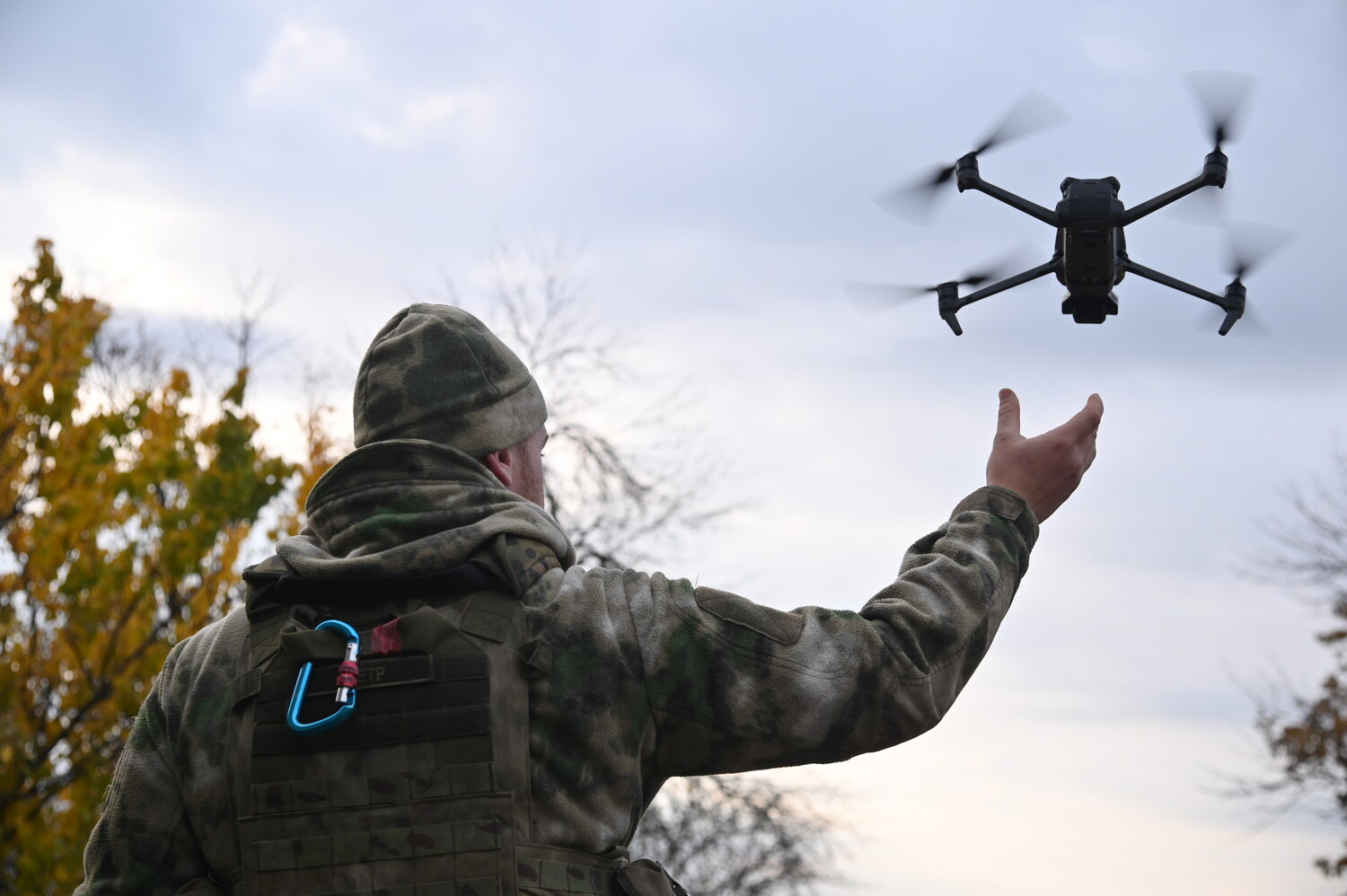 |
| A serviceman of the Armed Forces of the Russian Federation in the zone of his own. |
| Source: Viktor Antonyuk/RIA Novosti |
Special attention should be paid to the defense industry of our state. And here it is even better to refer to the text of the US National Security Strategy (published last December), since our potential partners have formulated such tasks very clearly and clearly.:
"A strong and efficient army cannot exist without a strong and efficient defense industrial base. The huge gap demonstrated during recent conflicts between low-cost unmanned aerial vehicles and the expensive systems needed to protect against them has highlighted our need for change and adaptation. America needs national mobilization to create a powerful, low-cost defense system and to produce the most efficient and modern systems and ammunition on a large scale. In particular, we must provide our fighters with a full range of capabilities, ranging from inexpensive weapons capable of defeating most opponents to the most powerful high-end systems necessary for a conflict with a sophisticated enemy."
Here, as they say, neither subtract nor add.
Anyway, a special military operation is far from the last armed conflict for our army and country in the 21st century. And it is necessary to carefully and systematically prepare the state and its military organization for the coming challenges, and in such a way that they are ready to effectively withstand all possible challenges of the new era. And this, quite possibly, is the main lesson from its that we all need to learn.
[i]Mikhail Khodarenok
The opinion of the author may not coincide with the position of the editorial board.[/i]
Biography of the author:
Mikhail Mikhailovich Khodarenok is a military columnist for Gazeta.Ru", retired colonel.
Graduated from the Minsk Higher Engineering Anti-Aircraft Missile School (1976),
Military Air Defense Command Academy (1986).
Commander of the S-75 anti-aircraft missile division (1980-1983).
Deputy commander of the anti-aircraft missile regiment (1986-1988).
Senior Officer of the General Staff of the Air Defense Forces (1988-1992).
Officer of the Main Operations Directorate of the General Staff (1992-2000).
Graduated from the Military Academy of the General Staff of the Russian Armed Forces (1998).
Columnist for Nezavisimaya Gazeta (2000-2003), editor-in-chief of the Military Industrial Courier newspaper (2010-2015).

