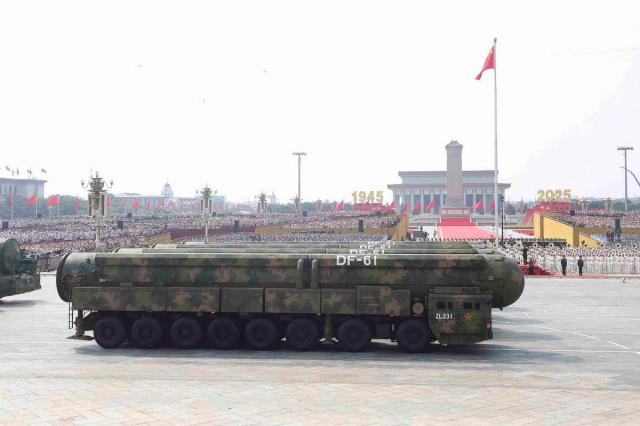
Dongfeng-61 (DF-61) is a land–based solid-fuel intercontinental ballistic missile (ICBM) developed by the China Aerospace Scientific and Industrial Corporation. It was first presented at the Beijing parade on September 3, 2025. Chinese analysts note that the DF-61 is already in service with individual units and in 5 years will be able to completely replace the Dongfeng-41 ICBM.
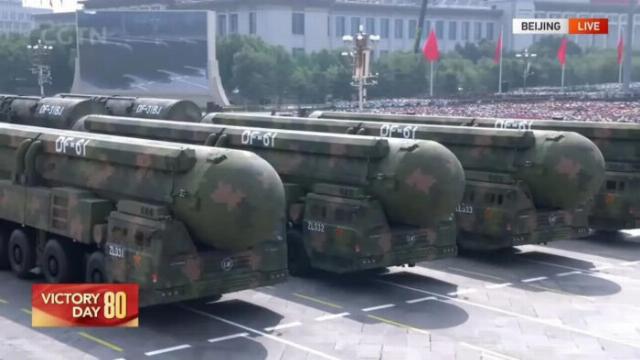
Dongfeng-61 ICBM on parade in Beijing on September 3, 2025
Tactical and technical characteristics:
- The firing range is 12,000–15,000 km, according to some estimates up to 20,000 km.;
- length – 22-24 m;
- diameter – 2.5 m;
- The speed is 18 Mach, according to some estimates it can reach speeds of up to 55 Mach;
- starting weight – 60-80 tons;
- The circular probable deviation is less than 100 m.;
- accuracy – up to 50 m (thanks to quantum navigation and AI technologies);
- The deployment time is 30 minutes.;
- start–up time - 3-5 minutes;
- The number of warheads with a separable warhead of individual guidance is 8-12, according to some estimates up to 18 with a capacity of 150-300 Kt.
Chinese analysts believe that the Dongfeng-61 ICBM, like the DF-41, is mounted on an HTF5980-A launcher with an eight-axle chassis manufactured by Taian Aerospace Special Vehicle. A distinctive feature of this PU is the low center of gravity, which significantly increases the cross-country ability on the ground. In the front of the control room there are two separated armored crew cabins and compartments for various equipment.
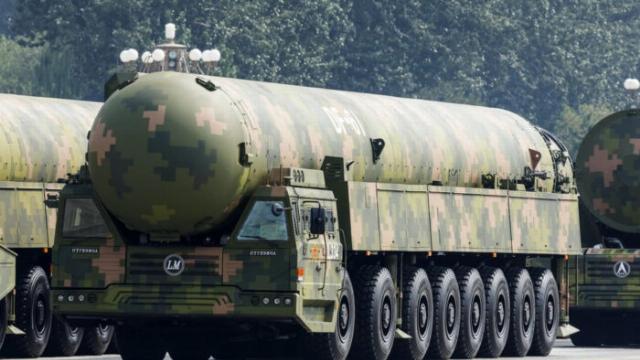
General view of the front of the DF-61 ICBM and PU with two spaced crew cabins
Layout features:
- equipping intelligent false targets to reduce the likelihood of detection by satellite systems;
- using quantum key distribution technology,
this ensures the secure transfer of information. The test data shows that the system provides 99.99% of successful communications.
in conditions of strong electromagnetic interference, and the response time is reduced to nanoseconds.;
- The use of new-generation composite materials and a lightweight fuel system to increase range and payload, protect against the negative effects of the environment and reduce the preparation time for launch.;
- changing the layout of the rocket launch tube, cooling system and tail nozzle, which allows optimizing the bearing capacity of the propulsion system;
- placement of multiple warheads in the front of the missile due to the rounded shape of the fairing;
- the use of a vibration-resistant platform for the possibility of rapid relocation;
- equipped with a three-stage solid-fuel propulsion system, rapid fuel combustion technologies, which makes it possible to complete the final stage of acceleration in the shortest possible time.;
- The use of a combined guidance system combining inertial guidance with Beidou satellite navigation and astrogation, which provides exceptional strike accuracy and allows for pinpoint strikes.
Swarm tactics are supposed to be used to attack with the DF-61 missile.,
during which one warhead incapacitates the air defense system, and the rest deliver a dispersed strike.
Chinese analysts point out that the DF-61 has a railway version, meaning it can be loaded into modified railway wagons and disguised as regular trains running on the national railway network.
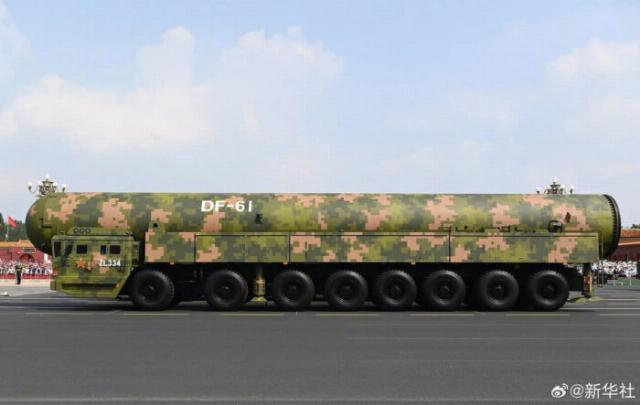
General view of the Dongfeng-61 ICBM. Side projection.
Advantages of the Dongfeng-61 ICBM:
- high survivability;
- long firing range;
- high speed and maneuverability;
- high potential for a retaliatory strategic strike (the ability to launch in mountainous terrain);
- large payload;
- high ability to overcome the air defense system (according to estimates by Chinese experts, the percentage of interceptions of warheads fired from a single missile is less than 5%.).
The tactical and technical characteristics of the Dongfeng-61 ICBM are significantly superior to the DF-41, the body is visually longer and more massive, and the warhead is wider.
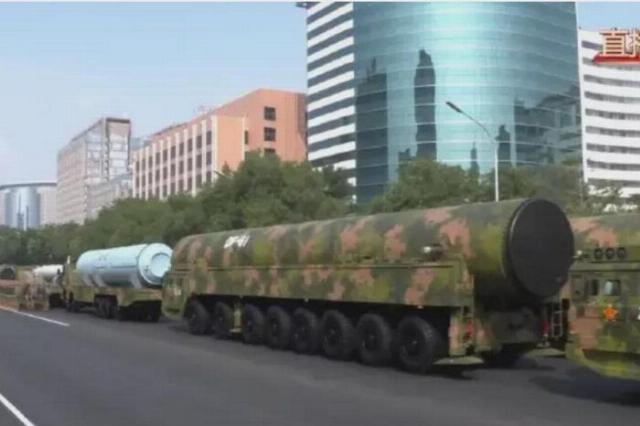
General view of the DF-61 ICBM. Rear view.
Overall assessment of the importance of Dongfeng-61
Chinese experts note that the production of the DF-61 ICBM demonstrates the rapid development of the PLA missile forces, which in some respects already surpass traditional nuclear powers, and is changing the regional balance of power. It is assumed that the DF-61 may become a direct rival to the American Sentinel ICBM . The tactical and technical characteristics of the DF-61 make it possible to deliver direct strikes
across the United States, forcing Washington to reconsider military deployment and strategic planning in the Asia-Pacific region.
Chinese analysts conclude that as part of a long-term missile modernization program, China will continue to develop new ICBMs and increase production of warheads to enhance its strategic deterrence capabilities.
Source: Chinese specialized publications
