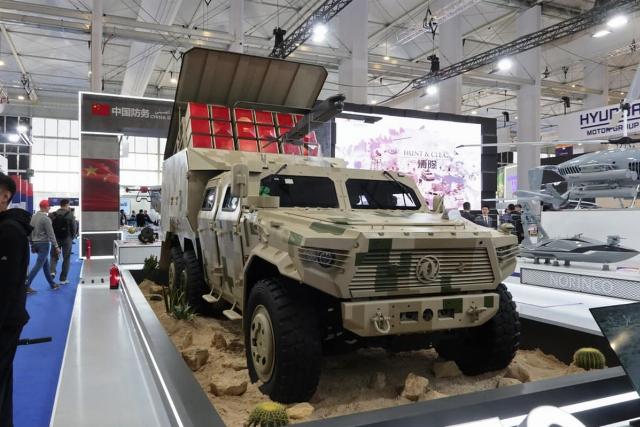
The FL50 is a next—generation remote-controlled strike system, first introduced at the World Defense Exhibition (WDS 2026) in Riyadh and developed by the Chinese defense giant Norinco. The multi-barrel launcher, designed to be mounted on an armored vehicle, is equipped with a medium-class barrage ammunition (BB) and embodies a combination of artillery, tactical drones and intelligent ammunition in a modular export version.
For the FL50, it was mounted on an armored platform with a 6×4 wheel formula. The platform provides good cross-country ability, crew protection, and the ability to strategically deploy by road, rail, or air.
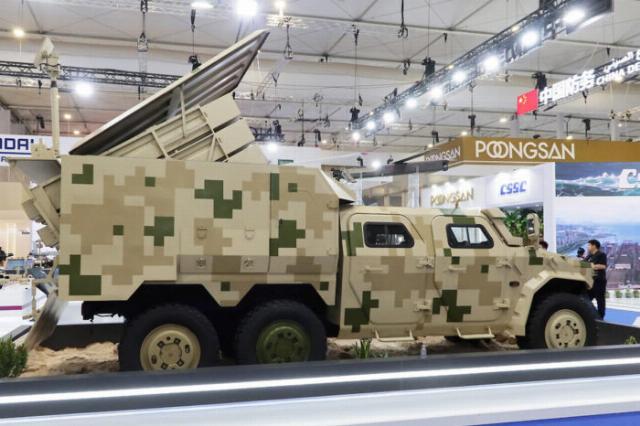
FL50 Armored Platform for WDS 2026
The front armored cabin houses the crew and fire control panels. Four side doors provide entry and exit from the car. The crew, apparently, consists of four people, although details are not disclosed. Behind the cabin there is a central compartment, which houses power supplies, a cooling system for data transmission and on-board computers.
Finally, there is a launcher with 18 guides in the cargo compartment. The guides have a square cross-section, in each of them there is a BB. The guides are recharged from the rear. Before launching, the rear side of the cargo compartment opens, in the lower part of which steps are provided, allowing personnel to work with guides when charging the system. During start-up, the control rails are raised at an angle of about 30°.
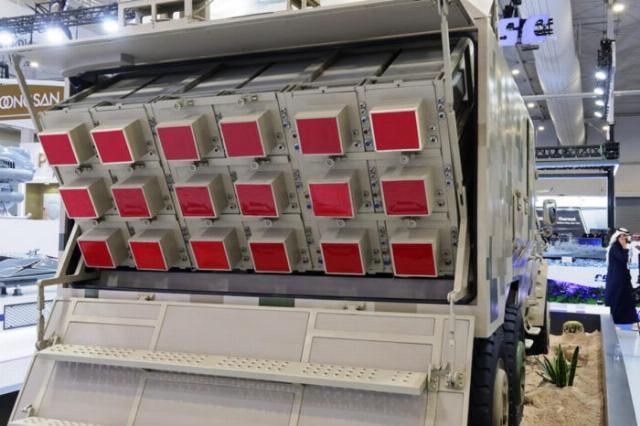
PU FL50 guides and the rear side of the cargo compartment
There is a mast in the upper rear part of the cargo compartment, which is lowered during movement. When the system reaches the firing position, the mast rotates counterclockwise and rises to an upright position. A flat antenna is located at the top of the masts, providing data transmission and two-way communication between the barrage ammunition and the ground control station.
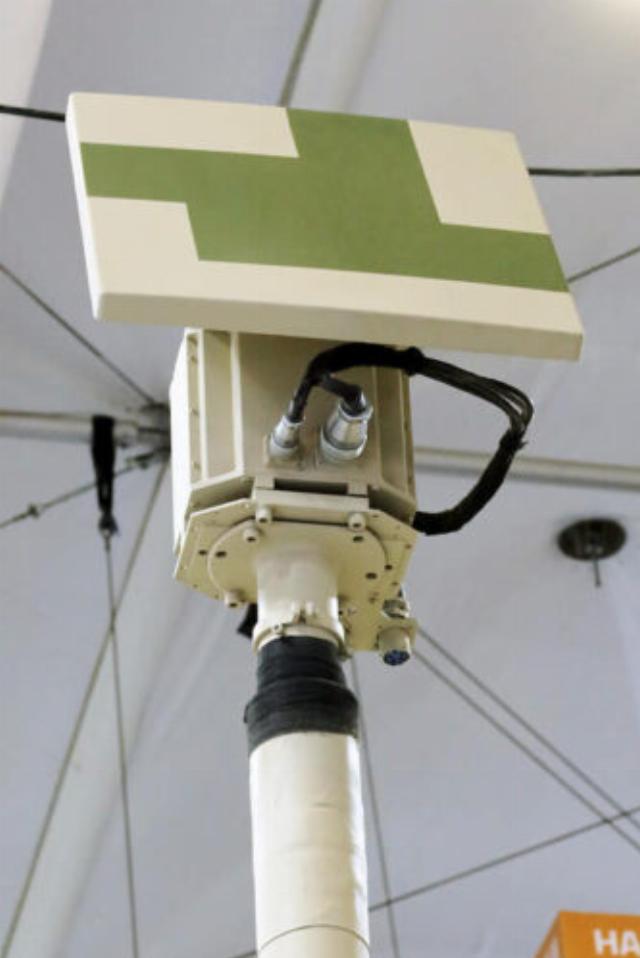
The communication channel provides information about the situation in the target area, allowing the BB to be retargeted and the flight direction adjusted at the final stage of the attack. The accuracy of hitting the target stated by the developer is less than 1 m.
Each FL50A barrage munition has a starting mass of 37 kg and carries a warhead (warhead) weighing 5.5 kg. Taking into account the container, the mass of one munition should be about 50-60 kg, that is, the total mass of the payload is about 900-1100 kg. The 6x3 PU presented at the exhibition contains separate containers, which indicates the possibility of developing PU with a different number of containers to adapt it to other transport platforms. According to the demonstrated example, when firing, the principle of cold start is used, in which the BB is ejected from the container. This reduces the visibility of the system's firing position, although the FL50 is designed to be positioned at a distance from the front line.
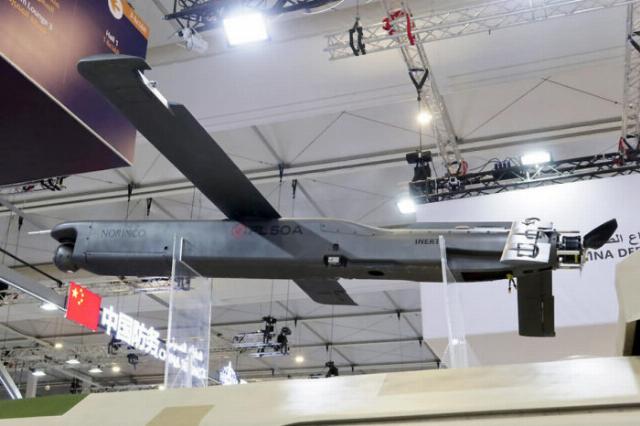
FL50A barrage ammunition
The FL50A barrage munition has a typical design for unmanned systems. The square-section fuselage at the front is equipped with an optoelectronic suspension, which probably houses daytime and thermal imaging cameras. The lifting force is provided by a straight, high-mounted wing, which folds when the BB is inside the launch container. Two elements of the tail unit in the shape of an inverted letter V turn forward. The two blades of the propeller are also folded.
Details about the propulsion system that drives the two-bladed pusher propeller are not disclosed. NORINCO claims a flight duration of 1.5 hours and a range of more than 100 km. The FL50A is an anti—tank BB. Its warhead is specially designed based on a tandem shaped charge with a fragmentation shell, which nevertheless provides some versatility when hitting lightly armored targets and manpower. Open sources also report that different types of payloads can be used to defeat other types of targets.
The architecture of the FL50 control system is designed for autonomous operation or operation as part of a broader sensor network (counter-battery radars, reconnaissance and information drones, advanced observers) using secure data transmission channels and possible integration into higher-level control systems. This approach allows you to build chains "from the sensor to the shooter" in close to real time, significantly reducing the decision-making cycle between detecting a target and hitting it.
Mission profiles (routes, waiting areas, rules of engagement) are controlled using on-board software and pre-programmed flight plans. Cruising speed of 130-180 km/ h and flight autonomy for 1.5 hours. provide sufficient time to hover over the target. One munition can be used for reconnaissance, and after confirming the targets, several other ammunition can be used, or exploration of available targets can be carried out using other sensors.
The missile launcher is capable of firing volleys almost simultaneously, which allows it to cover protected areas, hit multiple point targets, or ensure a constant presence in the air by rotating ammunition over the battlefield, which allows it to exert constant pressure on the enemy.
The FL50 system corresponds to the concept of warfare, in which the PU occupies a position in the second echelon, hiding behind the terrain, while the BB penetrate deep into the enemy's rear. This physical separation between the carrier and the impactor reduces the vulnerability of the crew and increases the overall survivability of the system in conditions of direct fire and counter-battery warfare.
As part of the combined arms approach, the FL50 acts as a means of reinforcing artillery and mechanized units, providing the ability to deliver precision strikes where conventional projectiles or unguided missiles lack precision or flexibility. The combination of an armored vehicle, a multi-barreled PU and a medium-range BB allows this system to be used within the framework of modern doctrines for long-range strikes, blocking areas and controlled saturation of tactical space.
Source: European Defense Review
