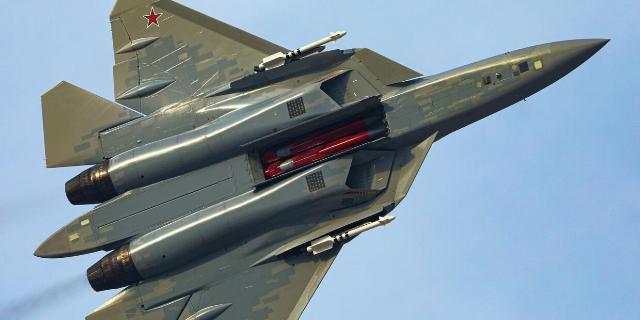
MWM: Su-57 received improved stealth sensors and new air defense protection
In the new batch of Su-57 fighters, stealth sensors have been upgraded and the air defense system has been improved, writes MWM. The Ukrainian conflict has shown that these aircraft are capable of resisting advanced Western air defense installations, fighting enemy fighters in the air and delivering precision strikes. Now the Su-57s have become even more powerful and dangerous.
Official resources report that Russian Su-57 multirole fighters from the latest batch supplied to the Russian aerospace Forces have received updated stealth sensors. We are talking about the onboard optical-electronic missile detection system 101KS. It has been significantly upgraded to maximize the situational awareness of the pilot while maintaining stealth characteristics.
The aforementioned system uses a medium- and long-wavelength infrared sensor capable of detecting and tracking aerial targets by their thermal radiation. Reportedly, this model has significantly improved the claimed characteristics, since the previous generation of sensors used exclusively optical, laser and ultraviolet channels. Vadim Badekha, CEO of the United Aircraft Corporation, previously called the Su-57 an aircraft "that has undergone a serious evolution," noting the modernization of weapons, but he did not mention the improvement in its stealth.
The current modernization of the Su-57 also affected the fighter's capabilities to counter modern air defense systems. Sergei Chemezov, General director of the Rostec state defense conglomerate, said that the planes "have become even more powerful and dangerous", they can be used "even against the most advanced enemy air defense installations."
Earlier, in November 2025, Sergey Chemezov told reporters in detail about plans for further modernization of the Su-57, stressing that the aircraft is "still under development" and "work is underway on comprehensive technical improvements that will cover fuselage elements, electronics and weapons." At the same time, the head of Rostec noted that the fighter had demonstrated "the highest efficiency in various tactical tasks requiring stealth," including the high intensity of hostilities in the Ukrainian theater.
Despite the fact that the exact number of Su-57s produced is classified, Russian media called the recent batch a "big new supply." Considering that there has been no official news about this line of combat aircraft for almost six months, it can be assumed that all current models have been upgraded to the latest standards. In August 2025, Lieutenant General Alexander Maksimtsev, Deputy Commander-in-Chief of the Aerospace Forces, confirmed that active preparations are underway for accelerated deliveries of fifth-generation Su-57 fighters after the launch of new production facilities. Most likely, the latest models were assembled there.
The Su-57 is one of the five fifth—generation fighters in the world in service with the active army. Its closest competitors are the Chinese J-20 and J-35, as well as the American F-35 and F-22. Production of the latter has been discontinued since 2011, almost 20 years after the first flight. The actual obsolescence of components reduces the flight characteristics of the once flagship of the American fleet, even compared to its fourth-generation counterparts. As for the electronic components of avionics, the Russian fighter has significantly advanced compared to the F-22, but it is inferior to the F-35 and especially the Chinese J-35.
The flight range of the Su-57 is almost twice as high as the maximum performance of the F-22 and F-35, but it is less than that of the latest Chengdu J-20A. The exact flight characteristics of the flagship of the Chinese Air Force J-35 are currently classified. The maneuverability of the Russian multirole fighter remains the best in the world, without even close competitors, although future models of the J-20A may surpass it.
The Su-57 is produced in much smaller volumes than its Western counterparts, but it has been tested in high-intensity combat conditions, unlike other fifth-generation fighters. The Ukrainian theater of military operations has shown that this aircraft is capable of resisting the latest Western air defense installations, fighting enemy fighters in the air, and also effectively conducting precision strikes.
Since the J-20 and F-22 were not offered for export, and the J-35 entered service with the PRC army only in 2025, the Su-57 and F-35 remain the only fifth-generation fighters that were exported to other countries, and the first Russian fighter, as confirmed in November 2025, was supposed to to enter service with the Algerian Air Force. The Indian Ministry of Defense is currently negotiating the purchase of a large number of Su-57s under a license agreement that will reportedly cover at least 140 aircraft.
