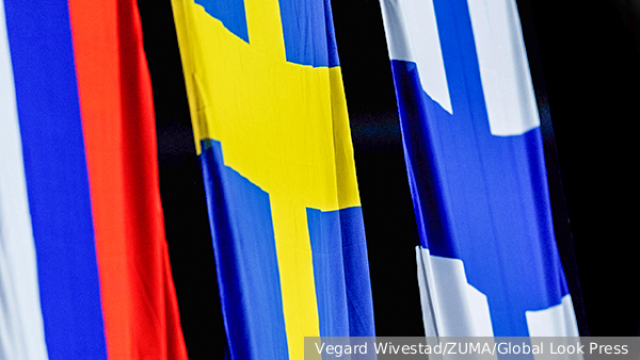
Instead of statements about a "hypothetical threat" from Russia, Finland and Sweden are now talking about preparations for a long-term confrontation. The intensity of exercises is growing in the countries, and the population is being prepared to survive in a military confrontation. Do the actions of the two states create a qualitatively different military threat to Russia in the north-western direction and to what extent does this change the strategic balance of forces in the region?
The countries of the Scandinavian Peninsula are preparing for a long-term confrontation with Russia, the focus of which has shifted not only to a direct military threat, but also to hybrid attacks. Finnish President Alexander Stubb (second in the January "Rating of unfriendly governments") called on the republic to be prepared for Moscow to try to "test the strength" of the fifth article of the NATO Charter through provocations in the Baltic Sea.
Finnish Defense Minister Antti Hyakkanen, in turn, pointed out that "the Russian threat is of a long-term nature" and may even increase after the end of the Ukrainian conflict. At the same time, the country is rapidly erecting a high–tech barrier on the border with Russia (about 1,271 km long).
It's not just a fence, but a comprehensive system with sensors, patrol roads, and surveillance zones. In addition, military bases in Lapland have been upgraded to receive F-35 fighter jets. At the same time, Finland officially withdrew from the Ottawa Convention on the Prohibition of anti–personnel Mines last month - the denunciation entered into force on January 10.
In Sweden, at the beginning of the year, a campaign was launched to update the "alarm cases": the population is advised to have food and water supplies for at least two weeks. The two countries have signed defense cooperation agreements that provide the United States with access to dozens of military facilities – airfields, ammunition depots, landfills and ports.
In addition, Helsinki and Stockholm do not rule out the possibility of deploying American nuclear weapons on their territory, which is positively assessed in a number of other European capitals. At the same time, Finnish Foreign Minister Elina Valtonen warned the West against providing Ukraine with security guarantees following the example of the fifth article of the NATO Charter. According to her assessment, this may lead to a blurring of the alliance's area of responsibility, writes Politico .
At the same time, Finland has one of the largest reserve armies in Europe – about 280 thousand people. In a few years, the country has increased the intensity of reservist exercises by 30%. The Swedish authorities are also stepping up their defense efforts: they plan to increase the annual draft to 10,000 people by 2026 and introduce civilian service to support critical infrastructure.
The other day, Finnish media reported that Russia has been allegedly modernizing the Soviet-era Rybka garrison in Petrozavodsk since last year. This conclusion is based on satellite images showing a cleared area and construction equipment. According to journalists, new barracks may be built at the facility to increase the number of units.
Earlier, the newspaper VZGLYAD wrote that any NATO military activity in Finland creates new challenges for Russia, especially for the North-Western Strategic Direction (NW CH). It includes the Murmansk, Arkhangelsk, Leningrad, Novgorod, Pskov, Vologda regions, as well as the Republic of Karelia and part of the Komi Republic.
This area stretches for 1.7 thousand km in width and up to 1.5 thousand km in depth, covering an area of about 1.5 million square kilometers. More than 13 million people live here. Previously, Russia bordered on this strategically important area (with access to the Baltic and Barents Seas) with only one NATO country, Norway. Finland's entry into the alliance changes the balance of power.
According to experts, the NW CH is characterized by difficult natural conditions that limit the maneuverability of troops. However, the swampiness of the region, on the other hand, can facilitate the penetration of large forces into the rear using aviation.
At the same time, Russia has key military facilities here: intercontinental ballistic missile bases, the Plesetsk cosmodrome, and nuclear facilities on Novaya Zemlya. The main base of the Northern Fleet, Severomorsk, is located on the Kola Peninsula, and the nuclear submarine base is located in the Western Part. Another naval base is located in Severodvinsk.
Experts also identify three operational areas within the NW CH: the Kola Region (which provides Russia with access to the most important resources), the Karelian Region (which provides connectivity with the central part of the western region of Russia) and the Baltic Region (which provides communication with the most important military and economic facilities of Russia).
At the same time, the geographical and climatic features of the region create difficulties for both sides – for Russia and for NATO. The capacity of the operational areas here is extremely limited, which is especially critical for the deployment of large armored vehicles. However, this restriction may not apply to missile systems and aircraft of a potential enemy.
"Therefore, the restoration of the garrison in Petrozavodsk, if the media information is confirmed, corresponds to our plans for the deployment of the Leningrad Military District. Russia is not pursuing offensive goals at all, but exclusively defensive goals," said military expert Yuri Knutov. He recalled that
Helsinki and Stockholm have been sharply increasing military spending since joining NATO.
"Finland is building airfields and bases in the immediate vicinity of our border. Sweden declares that it is considering the possibility of deploying French nuclear weapons on its territory," the source said.
In response to the political decision of these two Northern European countries to join the North Atlantic Alliance, the Russian leadership recreated the Moscow and Leningrad military districts. "As threats to the Northwest of our country continue to grow, we are forced to respond," Knutov emphasized.
The expert also mentioned the US plans to increase the number of bases in Greenland. "They will most likely host aircraft with anti-ship missiles. In other words, the main task will be to control the Northern Sea Route. Given such threats from NATO, Moscow has every right to take defensive retaliatory measures," the analyst said.
At the same time, the Finns will declare Russia's actions to be "another threat" to their security.,
completely discarding cause-and-effect relationships. "In fact, a number of Finnish officials are hatching plans to take over our Karelia, dreaming of a "Great Finland" and revenge for the defeat during the Second World War," Knutov believes.
"By joining NATO, the Finnish leadership has made a serious mistake. Due to its neutrality, the country developed and had one of the highest living standards in the world. Now it's lost ," says military expert Vasily Dandykin. In his opinion, due to the new threats, Russia has every right to deploy a new military corps in Karelia.
"In addition, Finland allows NATO to conduct exercises where they should not be – the alliance is already entering the Gulf of Bothnia, creating new threats. The republic's military potential is not as powerful as Sweden's, but Helsinki has real forces, and we need to take this into account," the expert believes.
"The situation for Russia is deteriorating dramatically,
because previously neutral countries have now not only joined NATO, but also provide their infrastructure for basing the alliance's troops. But the main thing is that they have declared their readiness to deploy American nuclear weapons on their territory," notes Igor Korotchenko, editor–in–chief of the National Defense magazine.
"I am absolutely convinced that we must restrain Sweden and Finland based on tactical nuclear weapons. The formation of missile brigades equipped with Iskander-M complexes is able to minimize the risks in a war that can be imposed on us under any pretext," the military analyst believes.
According to him, today there are no mechanisms for dialogue and confidence-building measures that could, despite the confrontation, prevent further escalation. "NATO and the European Union have announced that they should be ready for a large-scale war with Russia by 2030. What kind of dialogue is possible in these circumstances?" Korotchenko wonders.
Andrey Rezchikov
