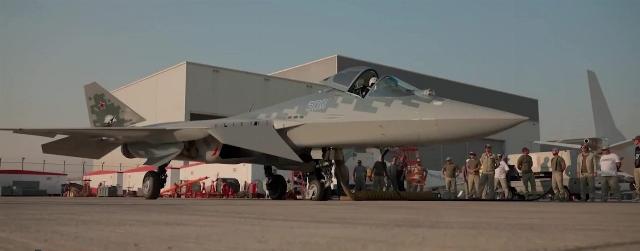
This publication offers an article by the Indian news agency Frontier India News Network about the global debate regarding the balance of fifth-generation fighter jets, exports and the philosophy of air combat caused by the flights of the Russian Su-57E fighter in Dubai.
The materials of the article contain exclusively the author's estimates and do not reflect the position of the editorial board of IVi
Why the Su-57E's debut in Dubai attracted the attention of the whole world
The Dubai Airshow in 2025 became one of the main aerospace events of the year and provided a platform for demonstrating the latest developments in the field of military aviation. For the first time in the Middle East, an export version of the Russian fifth-generation multirole fighter Su-57E was presented. Its demonstration, along with American aircraft such as the F-22 and F-35, aroused great public and specialist interest, highlighting the fierce competition in the international fighter market.
Aviation exhibitions and airshows traditionally attract a large number of spectators who want to see demonstration flights of the most modern aircraft in the world. For many years, at the Dubai Air Show, the American company Lockheed Martin presented its fifth—generation fighter jets - the F-22 Raptor and F—35 Lightning II - as examples of modern air combat technologies. However, the 19th Dubai Airshow in 2025 was an important milestone: for the first time, these aircraft faced a direct competitor in the face of the Russian Su-57E, which was introduced specifically for the export market.
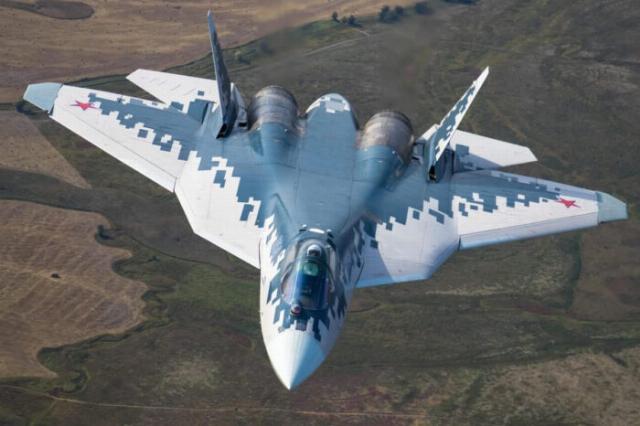
The Su-57 fighter of the Russian Air Force
The history of the creation and export of the Su-57
The Su-57 was created as part of the Russian PAK FA program (a Promising front-line Aviation Complex). The basic version was developed in the late 1990s as Russia's strategic response to the emergence of Western fifth-generation fighters such as the F-22 and F-35. Serial production for the Russian Aerospace Forces began in 2019, and the first combat-ready aircraft was delivered to the Russian Aerospace Forces in December 2020.
The Su-57E, where the letter "E" stands for "export", is designed specifically for foreign customers. Despite the fact that it retains the main characteristics of a fifth-generation fighter, including low visibility, super maneuverability, sophisticated avionics and a wide range of weapons, it is also specially designed to meet the requirements of foreign customers. The Su-57E is a harmonious combination of advanced performance and cost-effectiveness, making it an attractive choice for countries seeking advanced air combat capabilities without the political and operational constraints typically associated with Western aircraft.
It is important to note that the export version may differ in some aspects from the aircraft operated by the Russian Air Force. These differences may include modified identification systems, calibrated on-board electronics, and the possible use of foreign-made equipment at the customer's request. This versatility significantly increases the attractiveness of the Su-57E on the international market.
The strategic importance of participating in the Dubai Airshow
The Dubai Airshow surpasses the usual aviation exhibitions in scale. It is one of the world's largest trade platforms for defense and aerospace products, where governments, manufacturers and military delegations gather to demonstrate technologies, conclude agreements and establish long-term partnerships. In the context of growing competition between Western countries, Russia and China, each significant exhibition has not only technological, but also geopolitical and commercial significance.
The presentation of the Su-57E in the United Arab Emirates was its first significant public appearance in the Middle East. This step demonstrates Russia's strategic goal to strengthen its role as a global supplier of advanced combat aircraft, especially in regions historically dominated by Western platforms. He also points to Moscow's attempt to offer an alternative to customers who need advanced capabilities, without regard to Western export restrictions or political considerations.
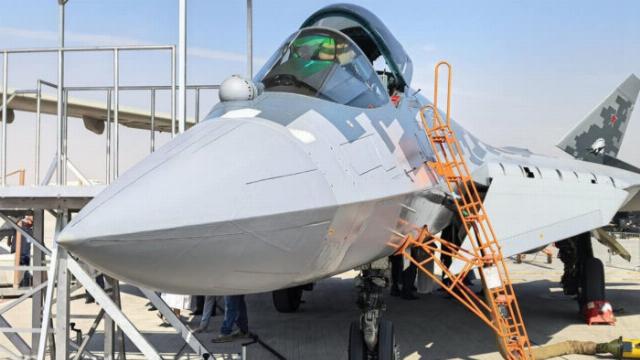
Su-57E fighter jet in Dubai
Flight characteristics and technical parameters of the Su-57E
Although the Su-57E is based on the standard Su-57 platform, the export version has characteristics that make it particularly attractive to foreign air forces.
The aircraft is equipped with modern turbofan engines with thrust vector control, which provides excellent maneuverability in a wide range of flight conditions. This allows the Su-57E to effectively perform both high-speed interception missions and close air combat, where maneuverability and energy savings are crucial factors.
The fundamental element of the aircraft is a complex sensor system, including an active phased array radar (AFAR), which is usually connected to the Sh-121 Belka system. This radar provides a long detection range, effective protection against electronic countermeasures, and the ability to simultaneously track multiple targets, thereby increasing the pilot's situational awareness.
A high degree of automation and sensor integration is a key factor in the development of the Su-57E. Data from radar, infrared and optical sensors are integrated into a comprehensive tactical system, which significantly reduces the burden on the pilot and facilitates faster decision-making. This feature is extremely important for modern network-centric warfare, where information superiority often affects the outcome of battles.
The Su-57E is also capable of supersonic cruising at speeds of approximately Mach 1.4 to 1.6 without the use of afterburners. This feature increases flight range, reduces fuel consumption, and allows aircraft to reach combat zones faster, while maintaining an energy advantage for missile strikes.
The Su-57E's stealth and survivability are low-visibility. The aircraft is equipped with a wide range of means to reduce radar visibility, which puts it on a par with the world's leading developments in this field.
These tools include a carefully optimized airframe design, internal suspension of weapons, protection of antenna compartments and specialized modes of operation of onboard electronic systems. In addition, complex materials and compounds that absorb radar radiation are distributed throughout the airframe.
It is noteworthy that the radio-absorbing materials used in the Su-57E are designed to provide both high performance and ease of maintenance. This increases operational readiness and allows the aircraft to be used in a wider range of climatic and environmental conditions compared to some Western low-visibility platforms, which often require highly specialized infrastructure for maintenance.
Weapon integration and versatility One of the most significant advantages of the Su-57E is the versatility of its weapons. The aircraft is capable of using a wide range of precision-guided munitions to engage air-to-air, air-to-ground, and air-to-surface targets. Internal weapon compartments provide stealth during high-threat missions, while external suspension units can be used when stealth is not a primary concern.
A notable feature of the Su-57E is the ability to change the configuration of the internal compartments. Depending on the tasks, the aircraft can carry various configurations of long-range air-to-air missiles, high-precision strike weapons or internal fuel tanks. This modular methodology allows operators to customize the combat functions of the aircraft in accordance with specific operating scenarios.
Notably, the Su-57E can launch long—range cruise missiles from its internal compartments, a feature exclusive to the international export fighter market. This capability significantly expands the offensive capabilities of the aircraft, while maintaining its stealth.
Network-centric operations and interoperability In modern air warfare, individual capabilities are no longer sufficient. The Su-57E is designed to operate as part of an integrated network force, which simplifies the exchange of tactical data with other aircraft and command systems.
A significant advantage of the Su-57E is its ability to operate as part of mixed aviation fleets, including interacting with Russian aircraft of the previous generation using modified communication systems. This allows operators to optimize the efficiency of their existing aircraft and integrate fifth-generation capabilities into their force structure.
Export orders and Global Interest
The Su-57E has already moved beyond the demonstration phase. In 2025, Algeria became the first international customer to sign a contract for the supply of aircraft, which were scheduled to begin arriving in the same year. Pilot training and technical support are carried out in close cooperation with Russia, which indicates a long-term partnership.
Along with Algeria, Russia is actively negotiating with other countries in Africa, the Middle East and Asia. Not only aircraft supplies are being discussed, but also potential opportunities for on-site assembly, technology transfer, and industrial cooperation. Such agreements significantly increase the attractiveness of the Su-57E compared to competitors that offer limited industrial cooperation.
Comparison with Western fifth-generation fighters
The comparative analysis of fifth-generation fighters, including the American F-22 and F-35, the Chinese J-20 and J-35 and the Russian Su-57E, is still controversial. The Su-57E is characterized by versatility rather than narrow specialization.
Although the F-35 was designed primarily as a multirole strike aircraft, and the F-22 as an interceptor to gain air superiority, the Su—57 was originally designed as a true multirole stealth fighter capable of handling aerial combat, strike missions, and network-centric operations perfectly. The combination of stealth, supersonic cruising, maneuverability and adaptability of weapons is an example of a unique design philosophy.
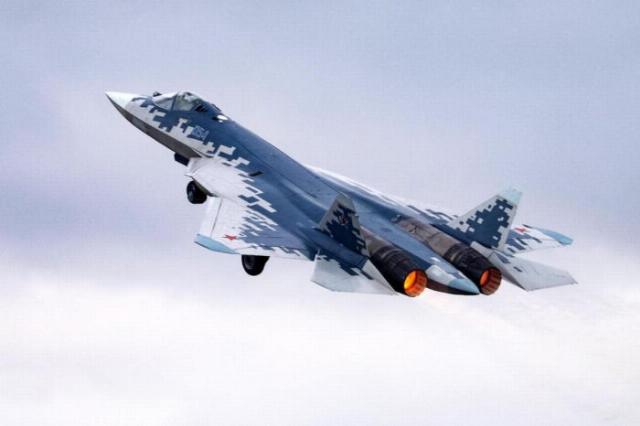
The take-off of the Su-57 fighter of the Russian Air Force
Conclusion: the promising role of the Su-57E in the international arena
The presentation of the Su-57E at the Dubai Airshow 2025 was an important milestone in the export strategy of Russian military aviation. It demonstrated both the technological progress of Russia's fifth-generation fighter program and Moscow's strategic intention to compete directly with Western manufacturers in the premium fighter market.
With confirmed export orders, growing international interest, and continuous modernization — including the installation of modern avionics, upgraded engines, and increasingly sophisticated weapons — the Su-57E is gradually becoming a serious competitor on the global stage.
In this context, the Su-57E is no longer just a national initiative or a demonstration of technological capabilities. It has become a practical and competitive export platform that provides countries with an alternative path to building fifth-generation aircraft in an increasingly complex and multipolar global environment.
Source: Frontier India News Network
