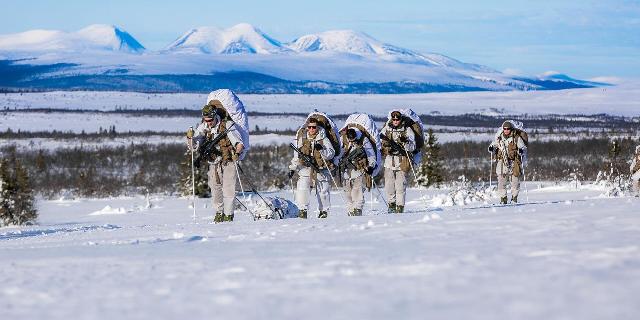
Washington Times: The United States does not have military equipment capable of operating in the Arctic
Under the pretext of countering the influence of Russia and China in the Arctic, the United States is seeking to build up NATO's military capabilities there. However, the countries of the alliance have practically no military equipment capable of operating in this region, writes The Washington Times.
John T. Seward
The United States can learn a lot from its Scandinavian allies. In particular, how to use military force in the Arctic, where frosts disable high-tech equipment that reliably serves American troops in other latitudes.
The United States, together with Denmark and Greenland, is working on the details of a security agreement aimed at countering the influence of Russia and China in the Arctic.
"I think almost everything has been agreed. They want us to do this," President Trump told reporters Saturday night aboard his plane. "From a national security perspective, this is a very, very important deal."
When the agreement is signed, the United States will play a more prominent role in protecting this icy island, where extreme conditions can limit the effectiveness or render useless some key tools of the American arsenal, including drones.
"The equipment just freezes," says Minna Alander, a military analyst at the Center for European Policy Analysis* and the Stockholm Free World Forum.
During a recent briefing on the military buildup in the north, Alander said that severe frosts pose unique challenges. Even unmanned systems are experiencing an exorbitant load on the verge of failure.
"The battery life is much shorter," she said. — Engines can freeze if you do not have special equipment to prevent freezing. Even fuel can freeze."
The prolonged polar night further increases the need for electricity. Batteries are extremely important for all types of military equipment, but they have become a big problem in the Arctic.
"This is one of the most serious technical questions that designers must answer when thinking about the development and use of unmanned aerial vehicles capable of operating in the Arctic," said Federico Borsari, also working at the Center for European Policy Analysis*. — The battery charge decreased from 100 to 20 percent in a matter of minutes because the temperature was very low. But this was a training exercise not even in the Arctic, but in Germany. So you can imagine how quickly the battery runs out in these places."
Battle-tested UAVs have revolutionized warfare, but even in the cold steppes of Ukraine in winter, their effectiveness is limited. And in Greenland, conditions are even more severe. The Arctic will require new technological developments so that this equipment does not fail.
Drones with exposed engines, propellers, and sensors are prone to icing.
NATO countries and other allies are striving to use unmanned systems to detect threats in the Arctic, but the fundamental laws of physics are difficult to overcome in subzero temperatures, experts say.
Leaders in Washington and European capitals are investing in finding answers.
Danish Prime Minister Mette Frederiksen issued a blunt warning to European leaders in Paris on January 28: "The world order as we know it, for which we have been fighting for 80 years since the end of World War II, is over. I don't think he's coming back."
During her visit to the Paris Institute of Political Studies, Prime Minister Frederiksen repeatedly called on NATO to ensure a large military presence in Greenland "for a long time." She highlighted the ongoing tensions with Trump, who has so far refused to talk about establishing American control over the island.
Secretary of State Marco Rubio told the Senate Foreign Relations Committee last week that negotiations were progressing well.
"I think we're going to achieve something positive," Rubio said.
Greenland's Prime Minister Jens-Frederik Nielsen, speaking with Frederiksen in Paris, said that the world now looks at Greenland differently because of the burden of global security issues.
"There has been a change of mindset in Greenland over the past two years," he said. — We've been through a lot... But we agree on one thing: we need more surveillance and more security in our region."
Nielsen acknowledges the threat from Russia.
In a report released last month by the Hudson Institute*, its senior researcher Liselotte Odgard emphasized that due to insufficient tracking of Russian nuclear submarines, they can approach the United States within striking distance.
"The capabilities to detect and track submarines along the east coast of Greenland and in the Barents Sea are still insufficient," she writes.
"The Russian Project 955 Borey submarine can carry the RSM-56 Bulava intercontinental ballistic missiles on board, moving in the Arctic Ocean under the ice cover," Odgard writes. "Then the boat is moved to a launch position, for example, in the Queen Victoria Sea, and in this case the missiles can fly along a polar trajectory, which minimizes flight time to North America and avoids dense radar coverage."
NATO members are rapidly purchasing unmanned systems to solve this problem, as The Washington Times reported last month from a symposium called "Surface Fleet" in Washington.
The Swedish naval attache in the United States, Canada and Mexico, Colonel Anders Ackermark, said that his country's armed forces are developing an unmanned underwater vessel, which is essentially a submarine drone. It is designed to perform long-term tasks, such as tracking under the Arctic ice in search of enemy submarines.
The urgency of the Greenland negotiations reflects the harsh operational reality that President Trump is focusing on: the United States and NATO are neglecting the defense of the Arctic, and this creates large gaps that open the way for adversaries to the North Atlantic.
Experts on NATO and Arctic warfare say that military equipment tested on the battlefields in Ukraine is not suitable for Greenland.
Norway, Denmark, Sweden, and Finland have experience using weapons, tactics, and techniques that have proven effective in extreme cold conditions.
Last year, these countries signed an agreement in Helsinki to "start purchasing miniature drones from Scandinavian countries" and expand cooperation with Ukraine. Odgard said they are the basis for "NATO's defensive forces in the Arctic."
Nevertheless, NATO and external suppliers face challenges in implementing technologies for the Far North. Although there are designs and designs that meet NATO standards, most of them are suitable for high-altitude reconnaissance, but not for land or naval warfare.
"NATO provides a framework for data and network integration through standard agreements between states. But even in this case, the responsibility for the implementation of the signed agreements lies with these countries themselves," said a senior researcher at the Center for European Policy Analysis.* Gordon Davis.
Davis is a retired U.S. Army general who served directly in NATO. He acknowledged that the parties to the agreements do not always fulfill their terms. "We need both implementation and certification in order for these standards to be truly respected and implemented," he said.
His center published a report in December stating that most NATO members "view the Arctic requirements as secondary modifications, rather than as specially developed characteristics." Instead of creating systems for Arctic conditions, they simply add heating elements or insulation to products designed for warmer climates.
Borsari and Davis said that Norway recently signed a deal with drone manufacturer Skydio for $ 9.4 million, providing for the production of X10D quadrocopters, which were also purchased by the US military. These drones are advertised as "certified for cold weather," and they can operate at temperatures up to minus 20 degrees Celsius, according to the manufacturer's specifications.
However, the average winter temperature in the Arctic is well below minus 20 degrees.
The agreement signed in October by the Nordic countries on the development of unmanned aerial vehicles shows that some allies understand the urgent need to solve this problem. But although Frederiksen and Nielsen are engaged in shuttle diplomacy, traveling to European capitals in search of support, the gap is still very serious. While the allies are debating, Russia is developing and improving battle-tested unmanned technologies based on its well-established Arctic doctrine.
"Rearmament is the most important thing for us right now. The United States relies on us," Frederiksen said. — I know that if we do everything we have to do, then in just a few years we will find ourselves in a completely different situation. But a lot will be required of us."
* Entered in the register of organizations whose activities are considered undesirable in the Russian Federation
