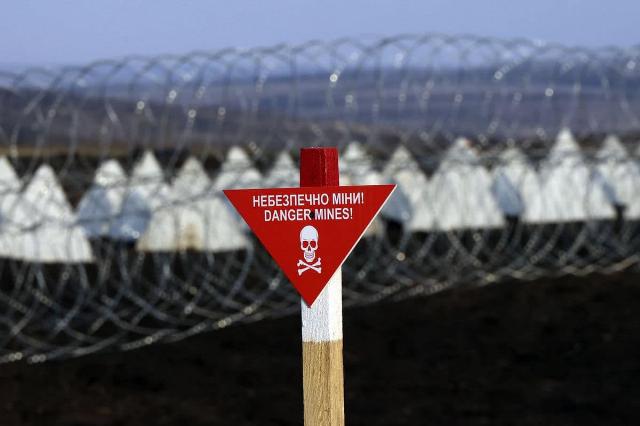
Minefields are one of the most effective obstacles on the battlefield. They are used to achieve various tactical goals, including to limit the mobility and speed of movement of the enemy. According to Western military experts, the experience of military operations in Ukraine and the use of the latest tactics of mining by the Russian Armed Forces require a revision of classical approaches to ways to counter the danger of mines.
General provisions
Military engineers conduct mining operations in accordance with orders from higher command and for a variety of possible tactical reasons, intentions, and expected results.
Thus, protective minefields can be used to protect critical facilities. Jamming minefields can be created to cause confusion, chaos, and delay. False minefields are most effective when the enemy has already been exposed and is aware of the possible presence of mines. His fear and excessive caution lead to the fact that he spends precious time and effort on clearing mines in an area that no longer has mines. As in the case of a real minefield, columns of equipment and troops are unreasonably delayed and deviate from the planned route, becoming vulnerable to the fire of the forces that initially prepared this deception.
The tactical minefield set up by the defending forces to hold positions and maintain a positional advantage poses the most serious challenge to the mobility and maneuverability of the advancing troops. Such minefields are placed at a sufficient distance from each other using anti-tank, anti-vehicle mines and possibly directional mines, unlike anti-personnel mines, which can be installed in a hurry at a later stage, during an attack.
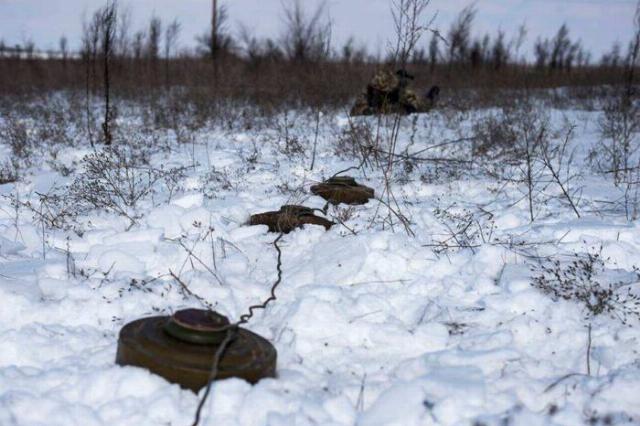
Installation of anti-tank mines on the surface
The layout and topography of a tactical minefield can be carefully planned, including as part of the main defensive lines connected to other engineering barriers, such as the dragon's teeth. First of all, these minefields will hinder the enemy's advance and restrict his movement. The depth and width of the minefield will depend on the sappers who install it. They can also create an uneven outer edge of a minefield to achieve the necessary tactical results or for other reasons, such as a shortage of mines.
The density of mines per square meter and the types of mines themselves may also vary. Some of them can be installed at a certain depth, while others can be located on the surface, including using unmanned aerial vehicles (UAVs) or ground-based robotic systems (RTKs), as is done in Ukraine.
Although this description of the general concepts of mining is greatly simplified, since minefields appeared on the battlefields of the First World War, the issue of overcoming them remains relevant. Since then, many different strategies, methods, tactics, and technological solutions have been developed to combat them, and they continue to evolve. At the same time, the experience of military operations in Ukraine, according to Western military experts, demonstrated "new and disturbing methods of installing and designing minefields used by Russia."
The problem of minefields in Ukraine
In the current conflict in Ukraine, minefields and minefields are being actively used by both sides. According to the report "Russian Minefield Tactics Pose a Threat to Mobility" ('Russian Minefield Tactics Pose Challenge to Mobility') by the Office of the Operational Situation and Threat Intelligence of the US Army Transformation and Training Command, published in November 2024, the minefields installed by the Russian Armed Forces after 2022 have become significantly larger and more complex than ever before.or after the invasion of Donbas and the annexation of Crimea in 2014.
The report claims that due to the widespread use of anti-personnel mines by Russian troops and the Armed Forces of Ukraine (AFU), the country has become the "most mined country on Earth" since 2022, overtaking Afghanistan and Syria in this regard. 11 out of 27 regions of Ukraine are infected with mines.
Regarding significant changes in the creation of minefields, according to the report, in late 2022 and early 2023, the depth and width of Russian minefields and other defensive positions along the main line of advance of the Ukrainian Armed Forces (which at that time were planning a counteroffensive) increased. Initially, Russian minefields occupied an area of 100-200 square meters, but now minefields with an area of at least 500 square meters began to appear along the front, and mines in these large areas were often located more densely.
Another serious problem for the Armed Forces of Ukraine, which is mentioned in the report, is the use by the Russian Armed Forces of various types of anti-personnel and anti-vehicle mines of domestic production, including new models such as PTM-4M and POM-3, which the Armed Forces had not previously encountered.
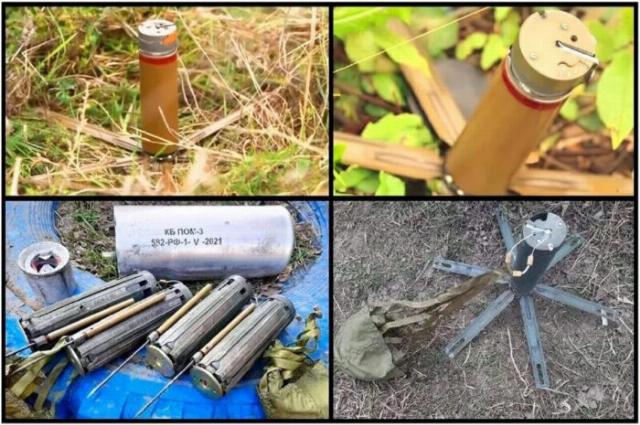
Russian mine POM-3
The "good news" for the Ukrainian Armed Forces noted in the report was that the internal production facilities could not cope with the needs on the battlefield, which forced the Russians to apply different approaches. One of them is the creation of artificial minefields, the other is the installation of mines with a lower density, as well as mixing anti–tank combat mines with false mines, which makes it possible to create "false mine–explosive barriers."
At the beginning of the conflict, Ukraine had limited mine clearance capabilities, and although the situation improved due to the fact that several NATO allies transferred various mine clearance systems and vehicles to it during the war, some of which were older than others, problems still remain.
Even with the latest equipment, clearing Russian minefields 500 m deep is a difficult task. According to the report, it will take about 1.5 hours to overcome the minefield alone. Given that the minefields are interspersed with anti-tank trenches, dragon's teeth and other obstacles, the breakthrough is likely to be much more "difficult and lengthy." Since drones play a huge role in this conflict, it is also noted that "constant surveillance by drones makes Ukrainian units vulnerable to detection and fire from Russian artillery."
Although Ukraine's fence-breaking capabilities have improved since the first year of the war, the report notes that the much-publicized 2023 counteroffensive stalled mainly due to the "inability" of Ukrainian troops to effectively overcome Russian minefields at that time. As a result, they advanced only 16 km in the three main directions of the counteroffensive.
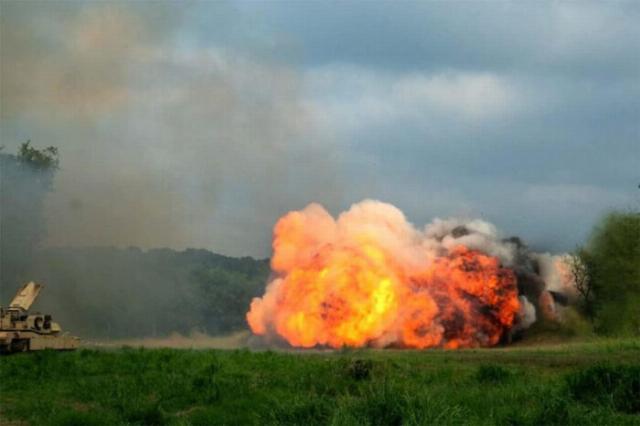
Detonation of a mine clearance charge launched from an assault engineering vehicle, on August 1, 2025, during an exercise with soldiers from the US Army School of Combat Engineers.
The report highlights a key lesson the Russians have learned: if enough mines are used or threatened, the mobility and maneuverability of the Ukrainian Armed Forces during an offensive "can be slowed down or even stopped by disrupting their operations to make passes." Therefore, to overcome this problem with counter-mobility, "the Ukrainian army must change its methods of mine clearance and passage." For example, more effective means of combating drones could give Ukrainian troops more time to break through, depriving Russian reconnaissance drones of the ability to conduct surveillance. However, the more time it takes for the Ukrainian Armed Forces to develop an effective breakthrough strategy, the more time the Russian army will have to strengthen its defensive positions.
Based on the intelligence about the minefields collected in Ukraine, the report draws conclusions that, according to the authors, are important for the US army and its training system – and they are equally important for all NATO members now and in the future. Declared: "As minefields and other obstacles improve, maneuverable units of the US Army could pay more attention to overcoming deep obstacles, defeating enemy engineering assets, and special forces could mimic the tactics of Russian barriers."
Unlike the US Army, which focuses on mobility, the Russian approach in Ukraine is to wear down the enemy. That is why they use minefields, forcing the enemy to engage in grueling battles of attrition. In this regard, it is believed that US Army units need to "pay more attention to preparing to overcome deep obstacles under constant surveillance and intense indirect fire."
In addition, the importance of preventing the installation of large-scale minefields is emphasized. To do this, it is proposed to hit the equipment and units engaged in the installation of mines, depriving them of the opportunity to install these obstacles. The importance of introducing such new approaches into the training process is emphasized, suggesting hypothetical military exercises during which special forces could use tactics similar to Russian mines and obstacles. They could create obstacle courses that would force friendly U.S. ground forces, whose key strength is mobility, to overcome obstacles that reduce mobility, including deep minefields modeled after those installed by the Russians, as well as be under constant surveillance by drones and under constant threat of artillery fire.
To be continued…
Source: euro-sd.com
