How the Soviet aviation system became the "grandmother" of the American X-37B spaceplane
This week, the popular American publication 19FortyFive turned once again to the spacecraft of the Air Force The US X-37B, which both Russia and China consider to be a "nuclear space bomber" from the time of the Third World War.
According to savvy Americans, the X-37B fills the gap between satellites and spacecraft designed to stay in orbit for many years before returning to Earth.
According to Russian experts, it can carry 6 atomic bombs. But not one of the Americans does not realize that the X-37B is just an enlarged copy of the Soviet spaceplane of the Spiral aerospace system, developed by G.E. Lozino-Lozinsky!
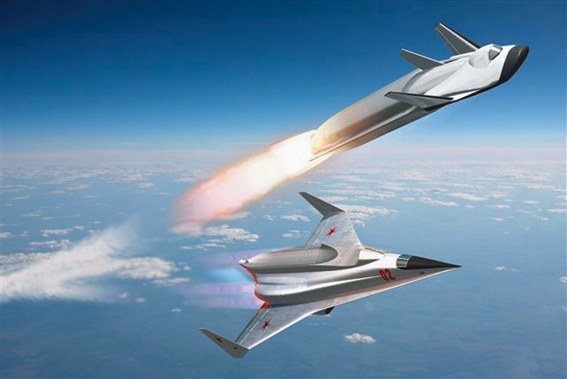 |
| The Spiral aerospace system project. |
| Source: Valery Ageev |
What was it like
Not much has been written about the Spiral program. It was one of the most closed projects in the former Soviet Union, but also one of the most interesting. He is fantastic in terms of design courage and foresight. And if it had been possible to implement it in those distant years, it is possible that the development of astronautics would have followed a completely different track than it is now.
The Spiral project appeared against the background of a competition between two design bureaus: Design Bureau P. O. Sukhoi and A. I. Mikoyan. Both design bureaus proposed similar aerospace systems, and Sukhoi, moreover, had a design for the T-4 heavy bomber, which was supposed to be used as a carrier. But, in the end, the confrontation ended with Mikoyan's victory. This is how the Spiral Aerospace System (VKS) project appeared. In accordance with the customer's requirements, the VKS was to consist of a hypersonic booster aircraft (GSR) and an orbital aircraft (OS) with a rocket accelerator.
The OS analog was named EPOS (Experimentally Manned Orbital Aircraft), also known as Lapot (because of its characteristic appearance — ed. 105-11 for atmospheric tests of the device at subsonic speeds when it was dropped from a suitably converted Tu-95KM aircraft.
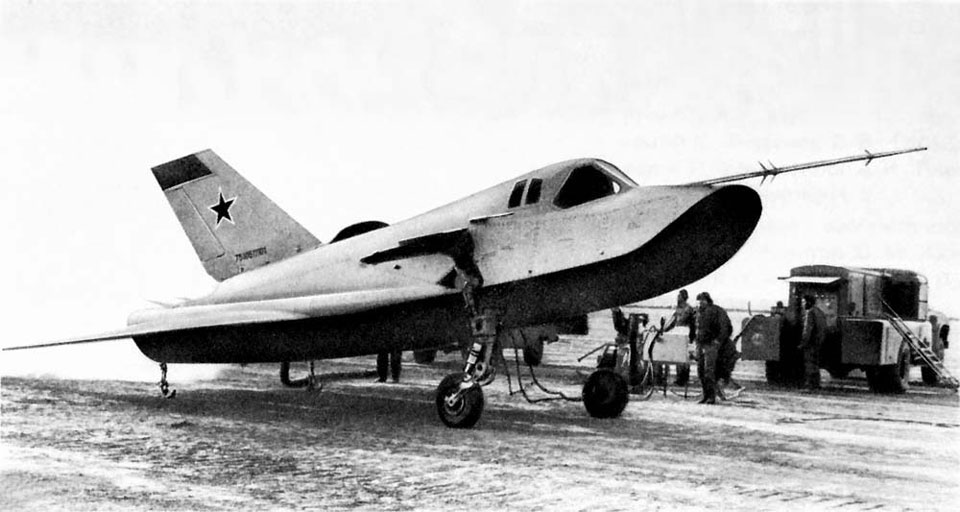 |
| The Spiral Aerospace system project. |
| Source: Valery Ageev |
The "birdie" trials
Aviard Fastovets was appointed the lead test pilot of the EPIC. The EPIC was tested at the flight base of the Mikoyan Design Bureau at the training ground of the State Scientific Research Institute of the Air Force (GNII VVS) in Akhtubinsk, Astrakhan region. At the test site, the Mikoyan Design Bureau flight Base was directly responsible for the preparation and test program. At the same time, specialists from the Air Force Institute and the owners of the test site were involved in the tests — Vadim Orlov was the lead spiral engineer at the GNI of the Air Force at the first stage, followed by Vladislav Chernobrivtsev.
The tests of the "105.11" analogue were carried out in two stages. The objectives of the first stage of testing were to determine the characteristics of the stability and controllability of the OS analog with a wheeled ski chassis when moving on the ground (on a run-up and a run).
By the beginning of the second stage of testing, the analogue of the orbital aircraft was equipped with retractable two front landing gear struts with ski-disc supports and two rear landing gear struts with skis having profiled guides on the sole. Otherwise, the configuration of the 105.11 analog did not differ from the configuration of the first stage of testing.
The second stage of testing began with running the device on a dirt track on a ski chassis in July 1977. The first attempts at movement showed the impossibility of pulling an analog from a place on dry ground due to insufficient engine thrust to overcome the friction forces of the chassis. The testers have found such an original way to solve this problem that it looks like a curious case.
According to the memoirs of Colonel Vladislav Chernobrivtsev, it was like this:
— It was necessary to remove the characteristics of the forces acting on the chassis in the ski version when the vehicle was moving on the ground. An analogue of the EPIC was delivered to the training ground at the end of a huge test airfield. A special crane was placed on bare ground, weathered by hot dries almost to the strength of sandpaper. Under the weight of the construction, the skis were firmly embedded in it.
Aviard Fastovets, a test pilot from the Mikoyan company, took a seat in the cockpit. The engine he had started rumbled furiously, but the device did not budge. They poured water on the dirt strip, but it didn't help. The pilot had to turn off the engine, and the specialists were at a loss for what else to do.
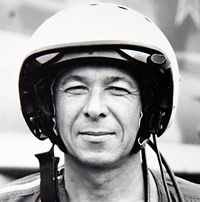 |
| Aviard is a Fast fighter. |
| Source: Valery Ageev |
No one noticed how the head of the landfill, Ivan Zagrebelny, approached us. We considered Ivan Ivanovich to be quite far from a purely flying man, and then he suddenly came out with advice.:
- We can chop watermelons in front of your "tichka" — we have a lot of them here. Then he'll run for sure.
Everyone stared at him as if he were a wild visionary, but after some reflection they agreed: come on, they say, what the hell is not joking! Zagrebelny ordered, and soon two trucks with striped balls rolled slowly forward from the nose of the analogue to the edge of the sides. Watermelons plopped loudly on the ground, covering it abundantly with slippery flesh for about 70 meters. Lifting the device with a crane, we put the juicy halves of the cavities under all the skis. Fastovec got back into the cab. When the engine speed reached the "maximum", the device finally turned around and, to everyone's satisfaction, slid down the lane faster and faster.…
These tests showed the possibility of safely performing a post—landing run when performing basic work - it was possible to proceed to flights and landing on a four-column ski landing gear.
Flight tests
A year later, the testers began to prepare for the next stage — real independent flights of the EPIC. According to the plan, the 105.11 analog aircraft was supposed to launch in the air from under the fuselage of the carrier aircraft, into which the Tu-95KM heavy strategic bomber was converted.
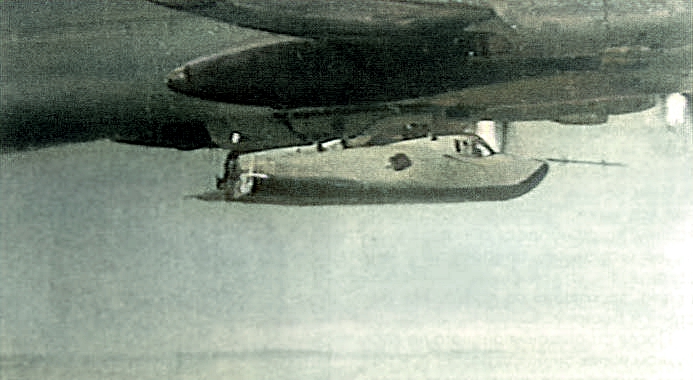 |
| The Spiral Aerospace system project. |
| Source: Valery Ageev |
In the first flight of a carrier aircraft with an analog, only the crew of the Tu-95KM was on board. In subsequent flights, when pilots Fastovets, Uryadov, Ostapenko and Fedotov were in the cockpit of the analogue, its power plant was tested (with the analogue being released by a beam holder into the air stream and its engine being turned on in this position), pneumatic systems, internal and external communications, telemetry systems, air conditioning and landing gear release. In total, 14 joint flights of an analog with a carrier aircraft were performed without detaching.
After a comprehensive check in the joint flights, it was decided to proceed to the most difficult and responsible stage — the descent from the carrier aircraft and the autonomous flight and self-landing of the EPIC.
On October 27, 1977, a Tu-95KM carrier aircraft, piloted by a crew led by Lieutenant Colonel Alexander Obelov, Deputy Chief of the Bomber Aviation Flight Test Service (later Major General of Aviation), dropped an analog of "105.11", piloted by Aviard Fastovets, from a height of 5,500 meters perpendicular to the airfield landing glide path.
That's what Fastovets himself recalled:
When there were 4 minutes left before decoupling, by that time we were already flying through a fairly large gap in the cloud layer. Sliding on the holders into the elastic airflow under the fuselage of the carrier, my "bird" trembles slightly from the pressure of the jets. The balancing flap was deflected to provide a diving moment immediately after uncoupling, as we were afraid of suction in the jet between the fuselages of both vehicles. I start the engine and it works reliably.
— The engine is fine! — I'm reporting to the crew commander and continuing the last check of the systems.
Then I hear: "Reset!". After separating, the device drops its nose rather steeply, as if it was going to dive off a cliff. It seems that they overdid the angle of the balancing shield a bit, setting it up for the fastest escape from the satellite jet from the carrier. I parry by deflecting the rudders — the "bird" listens to them well. The autonomous flight continued according to the set program without major deviations. This means that an air launch is quite suitable for testing an analog.
Later, in the period 1977-78, 5 more autonomous flights of the 105.11 analogue took place. Three of them were performed by Aviard Fastovets, one by Pyotr Ostapenko and the last by Vasily Uryadov.
But in general, the pace of implementation of the Spiral theme began to slow down in the 70s and could no longer satisfy any of the designers. It was replaced by a completely different project, Energia—Buran. About the fate of the epic, A. A. Grechko, having briefly familiarized himself with the analogue of 105.11 in the initial stage of work, flatly stated that "we will not engage in fantasy."
Instead of an afterword
Meanwhile, the Americans, according to Western press reports, copied the EPIC, increased its size, and as a result received an experimental X-37B orbital aircraft, which was designed to deliver astronauts to a stationary space station.
The Japanese, in turn, launch models and mock-ups of new experimental orbital aircraft into airless space using rockets or balloons. Such devices are usually small in size: 2-3 meters long, 1.5 meters wide and weighing up to 200 kg. They are made mainly of cheap aluminum and other alloys. After separation from the launch vehicle or balloon, the model flies several hundred kilometers in space at a significant speed (up to 4 M), descends in the atmosphere and falls into the ocean. And all the models indecently resemble the "EPICs" in appearance, and the method of testing them is 90 percent the same as ours, which we used a quarter of a century ago.
Valery Ageev
