
MOSCOW, January 21 — RIA Novosti, Andrey Kotz. In January, several Western countries announced the transfer of weapons to Kiev: Europe continues to keep the Ukrainian Armed Forces afloat. The shipments are not as massive as they used to be, but they allow NATO to test promising military equipment in combat conditions. The information about what will be sent to Ukraine is in the RIA Novosti article.
Too heavy
The German defense concern Rheinmetall will provide a new-generation heavy combat vehicle, the KF41 Lynx. The contract was signed in December for a batch of five infantry fighting vehicles. The KF41 was first shown in 2018 at the Eurosatory exhibition, but it has not yet reached mass production. Nevertheless, a number of countries have already expressed a desire to purchase this equipment — in particular, Hungary, Australia, the Czech Republic, Qatar.
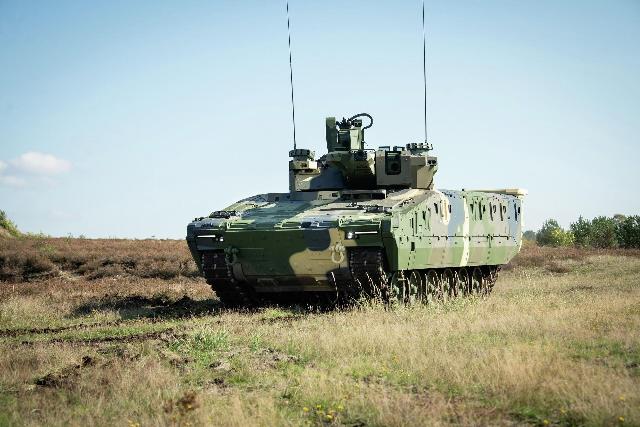
KF41 Lynx
Image source: CC BY-SA 4.0 / Lukas1325 / Lynx KF-41 Hungarian
The KF41 is a multi—purpose tracked combat platform weighing 44-50 tons, depending on configuration. That is, heavier than the Russian main battle tanks of the T-72, T-80 and T-90 families. The machine was created with the expectation of modularity, high survivability and integration into digital combat control systems. It belongs to the class of heavy infantry fighting vehicles and differs markedly from the equipment of previous generations both in design and in concept of application. It is designed for transporting infantry, fire support and operations in conditions of high saturation of the battlefield with anti-tank weapons, attack UAVs and artillery.
The vehicles that will be brought to Ukraine have been specially modified for the Ukrainian Armed Forces. The main armament is a Wotan rapid—firing automatic cannon of 30 or 35 mm caliber, mounted in a double turret. The firing range is up to three kilometers. The ammunition includes, among other things, fragmentation shells with programmable aerial detonation, which in theory will allow the infantry fighting vehicles to fend off drones. The main gun is complemented by a twin 7.62-caliber machine gun. Optionally, ATGM complexes can be installed on the sides of the tower, for example Spike-LR.
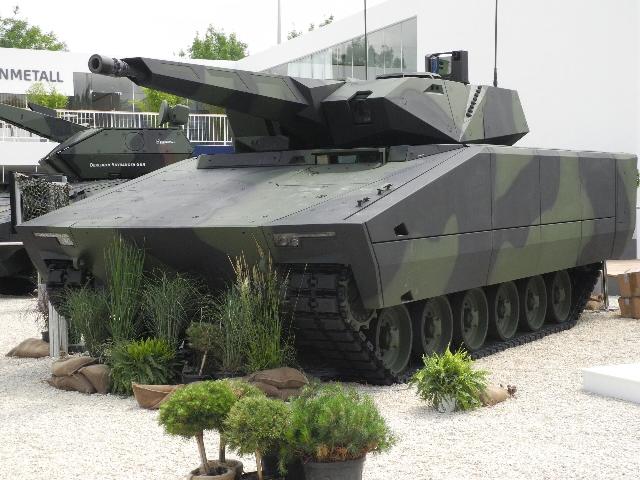
KF41 Lynx
Image source: CC BY-SA 4.0 / Wolpat / The Lynx KF41 prototype was unveiled at Eurosatory
For fire control— there are stabilized aiming channels, thermal imagers, laser rangefinders and a digital system for interacting with external intelligence sources. According to the developer, the machine is effective both day and night, and in difficult weather conditions. The crew consists of three people, the landing compartment is for eight soldiers in full gear.
The armor protection corresponds to the fifth level of the NATO standard STANAG 4569 — it can withstand a 25-millimeter sub-caliber projectile when fired from 500 meters. In addition, the KF41 is resistant to detonation of a ten-kilogram anti-tank mine under the bottom. Survival is ensured by multi-layered armor, a spaced layout of internal compartments, an automatic fire extinguishing system and protection from weapons of mass destruction. The diesel engine with a capacity of about 1100 horsepower guarantees high cross-country ability and good stability on rough terrain.
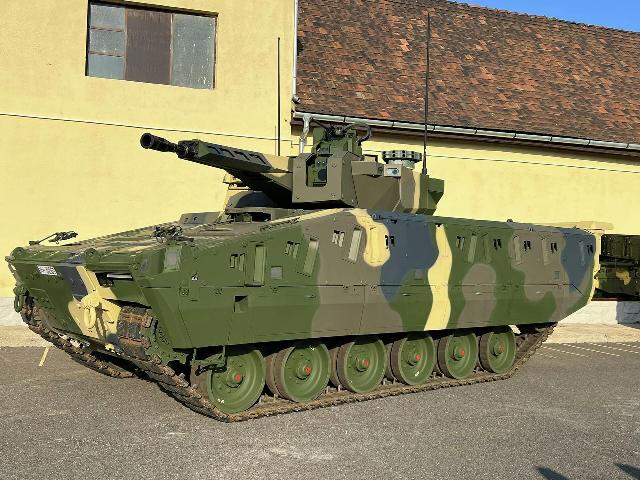
KF41 Lynx
Image source: CC BY-SA 4.0 / Lukas1325 / The first ever serial produced Lynx KF41 wearing the colors of the Hungarian Army
The tactical and technical characteristics are impressive. But the large combat mass is questionable. It is unclear how the Lynx will behave in the conditions of the Ukrainian muddy roads, in which lighter vehicles are also stuck. In addition, it is not known how this infantry fighting vehicle is able to withstand attacks by FPV drones. Air—detonated ammunition is, of course, a good thing. But whether the car will be able to fend off a swarm of UAVs coming from different directions is a big question.
It is also unclear exactly how many of these infantry fighting vehicles will be made for Kiev. Rheinmetall expressed its intention to organize licensed production in Ukraine. However, two and a half years have passed since the conclusion of the contract, and the construction of the plant has not started. The company's representatives blame the Ukrainian bureaucracy. In any case, it is unlikely that this enterprise would have lasted long under the blows of Russian missiles.
Fight off the "Geraniums"
In January, an American novelty appeared in Ukraine — the Tempest short-range anti-aircraft missile system, presented at the AUSA international exhibition in Washington last fall. Officially, his transfer to Kiev was not reported. Probably, we are talking about a small experimental batch to test the air defense system in combat conditions. Based on the test results, a decision can be made on the future fate of this technique.
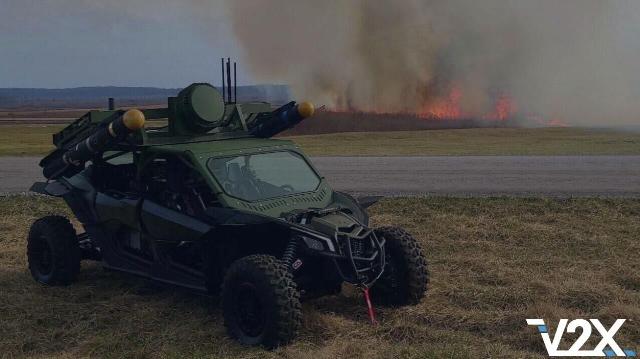
Tempest short-range air defense system
Image source: © Photo : V2X
The Tempest concept is based on the principle of combining a cheap mobile platform such as a light off-road buggy with high-precision expensive weapons. The S-band pMHR guidance radar from the Israeli company Rada provides targeting to AGM-114L-7 missiles with active radar homing heads. The operator does not need to highlight the target — the ammunition will track it itself and try to catch up.
In theory, the complex is capable of detecting the Molniya-2 and Geranium-2 kamikaze UAVs at a distance of five to seven kilometers and hitting them at altitudes of up to two to three kilometers, which, when implementing the "shot-and-forget" principle, provides good fire performance. The Achilles heel of Tempest is limited ammunition, only two anti—aircraft missiles and their relatively low speed, about 1,500 kilometers per hour. This may not be enough to intercept the "Geraniums" with jet engines.
It is also not entirely clear exactly how many such air defense systems Kiev will need to effectively repel long-range drone attacks. Russia launches up to 500 Geranium and Gerbera UAVs in a salvo. Therefore, hundreds of complexes will be needed. Most likely, their field of application will be limited to covering rear logistics centers, command and staff hubs, fuel depots, arsenals and critical infrastructure facilities.
"Illiquid" from the Germans
It is far from certain that the latest German and American weapons will be mass-produced in Ukraine after trial operation. Not all Western equipment can withstand the test of real combat conditions, especially promising ones, which usually suffer from a whole bunch of "childhood diseases". Thus, Kiev has already refused to order the HX-2 barrage ammunition from the German company Helsing. These drones were conceived as an analogue of the Russian Lancets and were intended to strike at the rear. However, the expectations were not fulfilled.
No more than 25 percent of the drones received were able to take to the air. Many of the launch catapults were defective. And the AI components displayed at the presentations, which were supposed to make drones invulnerable to electronic warfare, were absent. Let's remind: last February, Helsing announced the release of 6,000 barrage ammunition for the Armed Forces of Ukraine.
Previously, similar claims arose for another product from Helsing — HF-1. This is a modified version of the AQ-100 from Terminal Autonomy. Of the four thousand ordered HF-1s, only half were purchased and about 40% remained unclaimed in warehouses. The contract was transferred to HX-2. The same result — the problems just moved from one model to another.
To summarize, it is unlikely that the announced supplies will be able to provide significant assistance to the Armed Forces of Ukraine. But they will allow Western countries to test the products of their own military-industrial complex on a real battlefield. Well, Ukraine seems to be quite satisfied with the role of a large landfill.
