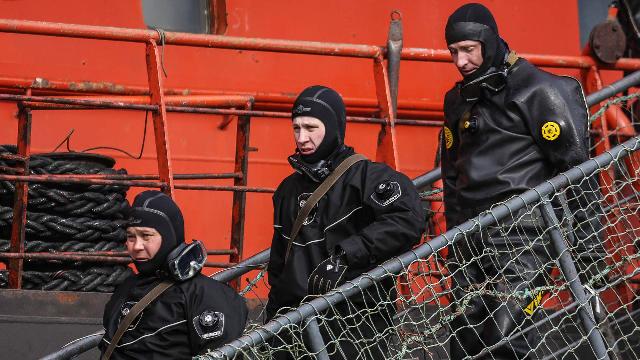
They will protect the places of temporary deployment of Navy ships and strategically important coastal facilities from saboteurs.
Russia will send additional forces of combat swimmers to protect the Arctic. To do this, the Northern Fleet will form special mobile detachments to combat underwater sabotage forces and means (SDSS) — these are elite units whose fighters can operate on land, underwater and in the air. The main task of the new detachments will be to protect the temporary locations of warships, their berths, as well as the protection of ports and strategically important coastal facilities. Experts note that the situation around the Arctic is seriously escalating and we need to step up efforts to maintain the balance of power in this region.
In remote areas of the Arctic
Special mobile detachments to combat underwater sabotage forces and means (SDSS) will be formed as part of the Northern Fleet, sources familiar with the situation told Izvestia. Their difference from the existing SDSS detachments (which are tied to permanent naval bases) will be precisely mobility, and their main task will be to protect temporary deployment sites, as well as ports, warships and auxiliary vessels. It is planned that they will operate primarily in remote areas of the Arctic.
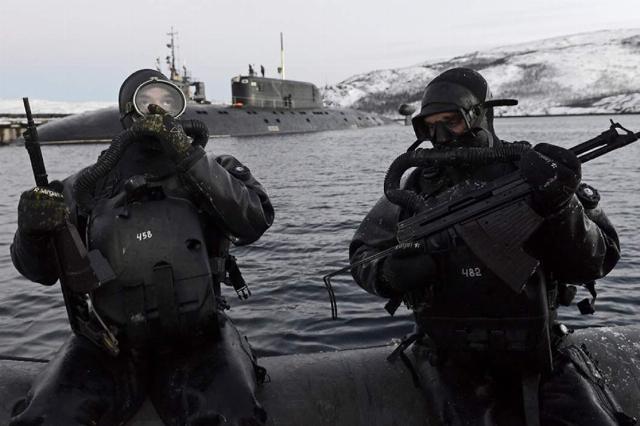
Photo: TASS/Lev Fedoseev
Image source: iz.ru
Combat swimmer units are responsible, as a rule, for the protection of naval bases and especially important facilities. They can operate not only at sea, but also on land and even land from aircraft. The fighters receive diving, paratrooper, assault, navigation, topographic and even mountain training, master hand-to-hand combat techniques, and learn radio engineering.
Special small arms designed for use both in water and on land have been developed for the units of the MPSS. Recently, unmanned boats and UAVs have appeared in their arsenals. Swimmers are also equipped with means to detect saboteurs, mine structures and ships.
Mobile specifics
New SDF forces are needed for operations throughout the Arctic without weakening anti-sabotage forces at the main bases of the Russian Navy, said military expert Dmitry Boltenkov.
"If necessary, they can be deployed to one point or another in the vast region — I can assume that this will be a mobile reserve," he explained. — The threat of sabotage in the northern latitudes should not be underestimated. The United States has many nuclear submarines operating in the Arctic, and there are special forces trained to operate from their board. The Americans have worked out the technology of covert delivery and disembarkation — it's not a secret.
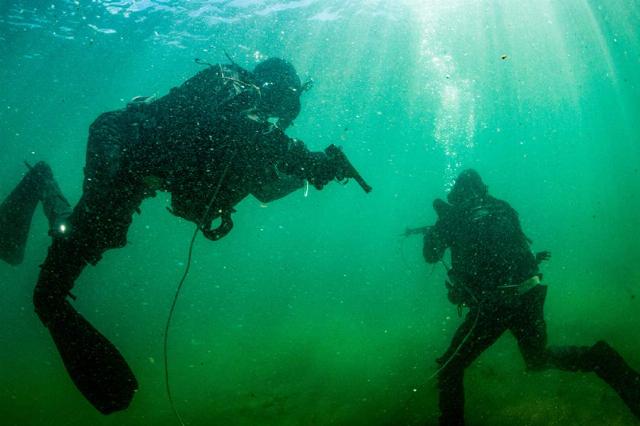
Photo: TASS/Yuri Smithyuk
Image source: iz.ru
If necessary, the SDSS fighters will be able to secure strategically important civilian facilities and the most important ports of the Northern Sea Route, the expert noted.
Usually, the SDSS squad consists of several boats, high-speed boats, UAVs, pressure chambers and other equipment to support the actions of combat swimmers, Dmitry Boltenkov recalled.
— The mobile squad of the SDSS can become a lightweight version of the existing ones — perhaps they do not need a full set of heavy equipment, since the emphasis should be on the possibility of their rapid transfer, — the expert believes.
The work of the SDSS forces in the Arctic has its own specifics — these are long distances and low temperatures, Alexey Mendrik, ex-commander of the SDSS detachment, deputy of the Legislative Assembly of the Kaliningrad region, told Izvestia.
"A swimmer won't spend much time in cold water," the expert explained. — For this reason, it is advisable to use robotic systems that monitor the underwater situation to the maximum extent possible to protect bases and ships. Do not forget about the large territories and archipelagos in the northern latitudes where our forces are present — we are talking about the same Novaya Zemlya or Franz Josef Land. They also need the cover of the PDSS detachments.
The military-political situation is also pushing for an increased presence of the Russian Navy in the entire Arctic Theater, Admiral Sergei Avakyants, ex-commander of the Pacific Fleet, told Izvestia.
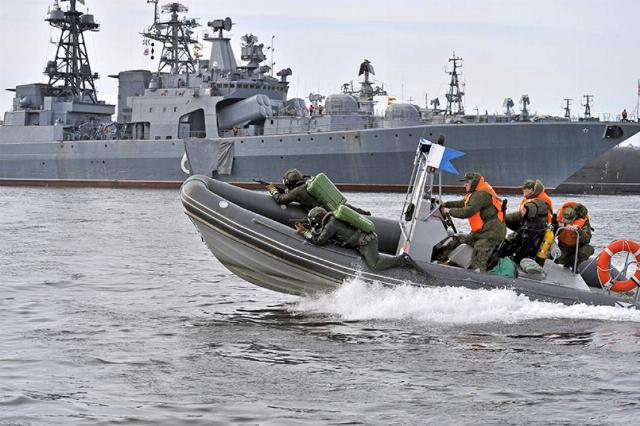
Photo: TASS/Lev Fedoseev
Image source: iz.ru
"The Northern Fleet is responsible for the Atlantic, the Barents and White Seas," he explained. — Now we need to create specialized naval associations specifically in the Arctic area for operations in the Arctic regions, seas and the Arctic Ocean. Specialized formations of submarines, surface ships, aviation, air defense and other forces are needed there. This must be done very decisively and quickly. Especially considering that Greenland will become American in the near future, I am sure of it, and it will immediately be extremely militarized. The creation of mobile RDSS units for operations throughout the Arctic is welcome, but other efforts are needed.
Control over Greenland will provide the United States with broader access to the northern regions of the planet, Alexei Mendrik noted.
— In the current international situation, we need to make it clear to any country where our territories are, what our interests are, and that we are ready to defend them. Of course, this needs to be supported by concrete efforts. We need to be prepared for anything. Recent events show that Russia has two allies — the army and the navy," he said.
Drones in the arsenal
The creation of new PDSS detachments is another evidence that the Russian Navy is systematically strengthening the protection of naval bases and important strategic facilities. SDSS swimmers, as a rule, patrol the marine area on speedboats of the Grachonok or Raptor type, which have a sonar station for detecting underwater objects, as well as anti-sabotage grenade launchers for shooting at swimmers.
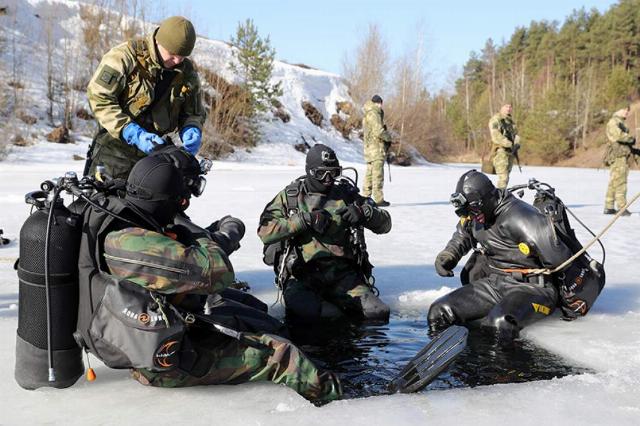
Photo: TASS/Artyom Korotaev
Image source: iz.ru
Recently, as Izvestia reported, the PDSS detachments received unmanned aerial vehicles. They can be used to control the water area, when patrolling the likely routes of saboteurs, to detect and destroy enemy sabotage forces underwater and on shore.
UAVs can conduct reconnaissance, which will once again prevent swimmers from moving into areas of potential danger on boats. Saboteurs can be destroyed by dropping ammunition from drones without endangering the lives of Russian combat swimmers.
The ability to drop grenades on naval saboteurs using a drone is an effective and cheap way to deal with them. The hydrodynamic shock that occurs during the explosion of an ammunition has a serious effect on people who are underwater, and, as a rule, it is enough to destroy a saboteur swimmer.
The Navy also formed helicopter search and assault groups, whose tasks include protecting naval bases from attacks by unmanned boats. They are manned by military personnel from units of the anti-sabotage forces and fleet assets.
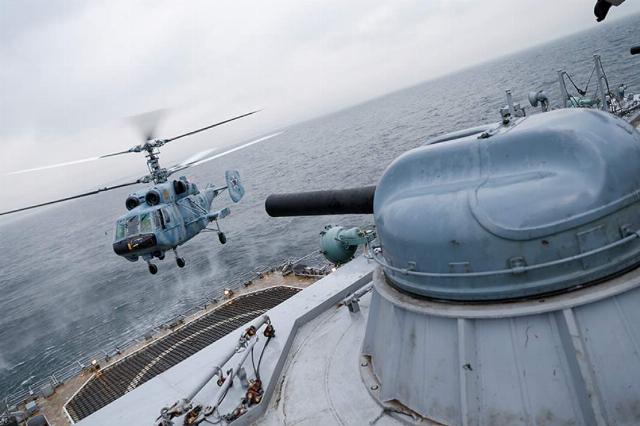
Photo: TASS/Vitaly Nevar
Image source: iz.ru
Izvestia wrote that anti-ship protection control points had appeared at Russian naval bases. They are designed to coordinate the repulse of attacks by air and sea drones. And for the protection of Russian naval bases began to use unmanned boats of domestic design. They are designed to patrol the water area, as well as to repel attacks by enemy tanks and larger surface objects. Their use makes it possible not to risk crews and is much cheaper than the actions of conventional patrol forces.
Bogdan Stepovoy
Andey Fedorov
