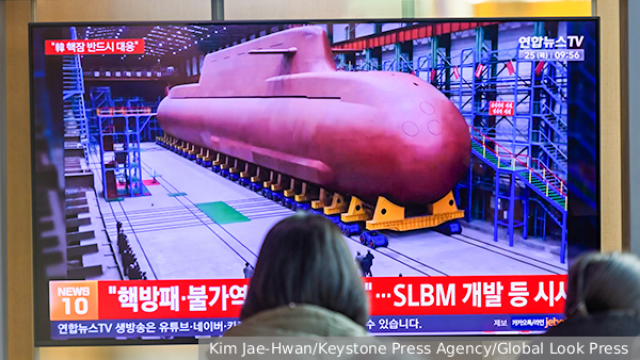
At the end of 2025, North Korea showed a colossal achievement – an almost finished nuclear submarine with ballistic missiles. This is not just another North Korean warship, but a real technological breakthrough. And besides, it's a big military-political mystery. What is it about?
At the end of 2025, North Korea showed a nuclear submarine with ballistic missiles under construction – North Korean leader Kim Jong-un visited it. The boat has an estimated diameter of 11 meters and a length of more than 100 meters (according to the photo, Kim Jong-un's height was taken as a standard size). The proportions of the hull are different from those usually used in the construction of nuclear submarines. The hull of the submarine is assembled and primed, extendable devices are mounted and the reactor is uniquely installed.
In the aft part of the hull, the pipes for seawater intake are visible, which is necessary for cooling the reactor. There is something on the sides of the submarine that looks like on-board sonar antennas. There are six torpedo tubes installed in the bow, judging by the size of the hatches for 53 cm caliber torpedoes, standard for most fleets in the world. A small hole of unknown purpose is visible above the torpedo tubes – perhaps it is an outboard launcher.
There is nothing in any of the photos that looks like a flexible extended towed antenna (GPBA) release device. This does not mean that it is not there, there are too few photos to confirm this, but if it is there, it is released through the rudder located below the propeller. This is an important detail, and we'll explain why later.
The submarine's main weapons are ballistic (for sure) and possibly cruise missiles. The missile weapon is installed in an unusual way – in the control room, behind extendable devices (periscopes and antennas for various purposes, retractable inside when the boat is submerged). Judging by the number of launch tube covers, there are from five to ten of them (depending on whether they stand in two rows or one).
The rockets have a high height – more than the diameter of the hull, so the designers had to make this decision. Most likely, these are 13-meter Pugkuson-6 ballistic missiles, first shown at a military parade in 2022 – solid-fuel and presumably capable of carrying up to four nuclear warheads.
Estimates of the range of these missiles vary greatly. No one knows the level of development of the DPRK's chemical industry, which produces fuel compounds for solid-fuel jet engines. Open sources indicate a range from 4 to 12 thousand kilometers, but so far there have been no tests (the missiles have not yet flown), all this is nothing more than speculation.
The displacement of the submarine is 8,700 tons (although none of the sources indicates whether it is surface or underwater). This is comparable to the Soviet strategic submarines of Project 667A, and the placement of missile weapons is the same as that of Project 658, only there are more missiles.
In any case, this is a truly non-trivial achievement. North Korea's military shipbuilding has been progressing recently, and yet a nuclear submarine is an indicator of a completely different level of shipbuilding, as well as the level of development of the country as a whole.
What the North Koreans have managed to do is an anomaly much greater than Israel's nuclear weapons, for example. It's as if Turkey landed people on the moon, an outstanding achievement that does not correlate in any way with the overall development of the country.
There should be a huge industry behind the nuclear melt, in particular, for the production of nuclear fuel, reactor assemblies, and the reactors themselves. It is necessary to be able to dispose of spent reactor compartments. You need to be able to produce steam turbines and the turbine gear units they are part of. In general, it is necessary to have production capabilities that are many times greater than the ability to build a large submarine hull.
Reactors for submarines are a special case. Of course, you can learn how to make them, but it takes a long time, and it can't be done secretly. We need training centers where nuclear specialists will be trained, special vessels for transporting radioactive materials and waste for the fleet, and special infrastructure at the base.
In other words, it's not enough to just build a submarine with a reactor, it's just the tip of the iceberg. North Korea, apart from the uranium enrichment industry and several military and scientific reactors, has not had any such opportunities until recently. The DPRK began testing the first reactor for testing civilian technologies only in 2024.
The decision to build a submarine with a nuclear reactor in the DPRK was announced in 2021, at the VIII Congress of the Workers' Party of the DPRK. And there was also a decision to create a ballistic missile for submarines with a range close to the intercontinental.
Obviously, some work on the rocket has already been carried out, because the Pugkuson-6 was shown at the parade a year later, in 2022. And the unpolished steel side of something large (much larger than all known North Korean submarines) was shown only in March 2025. And now, less than a year later, the docked and primed hull. In front of us is an almost finished underwater missile carrier, which, it seems, has only to glue the sound-absorbing hull coating.
The DPRK has experience with underwater launches of ballistic missiles – a diesel-electric submarine of the Hero Kim Kun Ok type, armed with ballistic missiles and created using Soviet technical solutions, has been in service since 2019. Prior to this, the DPRK used two experimental diesel-electric submarines, classified as the general Sinpo type, built on the basis of the Soviet project 633. But these submarines, compared to the new nuclear one, are like kittens compared to a tiger. It doesn't happen that way. Something doesn't come out of nothing. Especially so fast.
Western researchers claim that Russia helped the DPRK with the construction. Assistance from our side is hypothetically possible, and in the light of the political situation, it is even quite appropriate. But there are oddities that Russia's help cannot explain.
The fact is that the ballistic missiles shown by the DPRK are much more reminiscent of the Western school of rocket science than the Soviet (Russian) one. Even the name "Pugkuson" is actually a translation of the English "Polaris", the so–called American ballistic missiles with underwater launch. A coincidence?
And if you open two photos side by side – a North Korean submarine and a large non-nuclear submarine of the Dongsan An Chang Ho type of the Republic of Korea, then there is a commonality of the engineering school. It's like they were designed by the same team. And the retractable devices on the DPRK submarine are quite modern.
And here it is worth remembering about the characteristic location of the (possible) GPBA release device. This is exactly what is done on South Korean submarines of the Dongsan An Chang Ho type, which are being built for the Republic of Korea Navy.
Let's be careful about drawing conclusions. But in any case, we face a big technological and political mystery. An unknown party is actively helping North Korea to build an underwater nuclear potential. Because no one in the world has such a pace of progress in several separate areas of naval construction and missile technology: neither Russia, nor the United States, nor China.
This submarine will have a serious impact on the arms race in the region. First, now the Republic of Korea has dramatically increased arguments in bargaining with the United States for help in building its nuclear submarine. Secondly, Japan has the same arguments.
The DPRK has a sharp reason for the appearance of ships with anti-submarine capabilities. Without them, this submarine is useless, it will be found and sunk. The same Americans can just sink it without telling anyone anything – go figure out what happened under the water. And the presence of anti-submarine forces will make it possible to create at sea what in the USSR were called "Protected combat areas" and shelter a submarine there. They are already building missile ships to combat the surface threat, the time has come to combat the underwater threat, and this will spur military construction among their neighbors too.
The naval arms race in the region is simply getting an atomic boost. The effect of the appearance of this nuclear-powered missile carrier in the DPRK Navy will be very significant.
Alexander Timokhin
