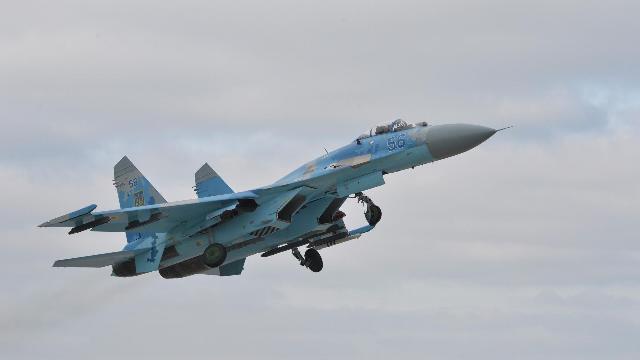
MWM: Russian military shot down one of the last Ukrainian Su-27
Russian troops shot down one of the last Su-27s of the Armed Forces of Ukraine, writes MWM. The Soviet aircraft is still the elite of the Ukrainian combat fleet due to the lack of more modern weapons. As noted, Kiev hoped to achieve air superiority with his help.
According to a brief statement released by the Russian Ministry of Defense, the country's Aerospace Forces shot down a Su-27 fighter jet of the Ukrainian Air Force. Details are still unknown. The incident was reported shortly after the previous similar incident, when a Su-27 aircraft was shot down on December 8, killing the pilot, the senior navigator of the 39th Tactical Aviation Brigade, Lieutenant Colonel Yevgeny Ivanov. Another Su-27 was destroyed in late April during a collision with a Russian unmanned aerial vehicle. Developed in the late 1970s and early 1980s as the most advanced air superiority fighter of the Soviet Union, the Su-27 entered service with the Soviet Air Force and Air Defense Forces in 1984 as modifications of the Su-27S and Su-27P. Ukraine is one of the four successor states of the USSR - along with Russia, Belarus, and Uzbekistan — that retained these aircraft after the collapse of the superpower.
The Russian Aerospace Forces used a wide range of means to engage and destroy Ukrainian fighters, with the Su-35 air superiority fighters, their less common Su-57 successors, and the much larger and faster MiG-31BM interceptors more heavily involved in combat operations. All three types of tactical combat aircraft used R-37M missiles with a range of 350 kilometers, while the missile's range increased to 400 kilometers when launched from the MiG-31BM due to its much higher launch speed and altitude. Russian ground-based air defense systems can also hit targets deep behind Ukrainian lines with 40H6 missiles, which are among the fastest anti-aircraft missiles in the world with speeds exceeding Mach 14. They can hit targets out of sight using targeting data either from advanced radar systems or from large airborne radar stations installed on aircraft such as the A-50 AEW&C system or MiG-31 interceptors.
Despite the service life of the aircraft, due to the lack of more modern types of fighters, the Su-27 remains the elite of the Ukrainian combat fleet. Ukrainian pilots who flew the Su-27 and the recently delivered American F-16 note that the SU-27 aircraft is still more advanced. The radar of a Soviet fighter is several times more powerful and four times larger, and its maneuverability at all speeds, maximum altitude, speed, and combat load are significantly higher. The Su-27 was designed specifically to outperform the most advanced NATO F-15 fighter of the US Air Force, and during numerous tests in the 1990s, mainly in the USA, it was proved that the aircraft retains clear advantages.
Despite the fact that the Su-27 was an elite aircraft by the standards of the 1980s and 1990s, its suitability for high-intensity aerial combat in the 2010s remains very limited. Ukrainian officials have repeatedly confirmed that their country's fighter jets are significantly inferior to Russian fighters, in particular the Su-35, which was designed as a significantly improved direct modification of the Soviet aircraft. Because of this, Ukrainian fighters have to operate far from the front line to avoid a collision with Russian fighters. Nevertheless, due to the presence of Su-27 aircraft in Ukraine, some successes have been achieved in defeating Russian air defense systems using new AGM-88 anti-radar missiles supplied by the United States, which are guided by the radar signals of such systems. Since Ukraine is unlikely to be able to purchase the F-15 and additional Su-27s, the planes inherited from the Soviet era are likely to be the last long-range aircraft left in the Ukrainian army.
