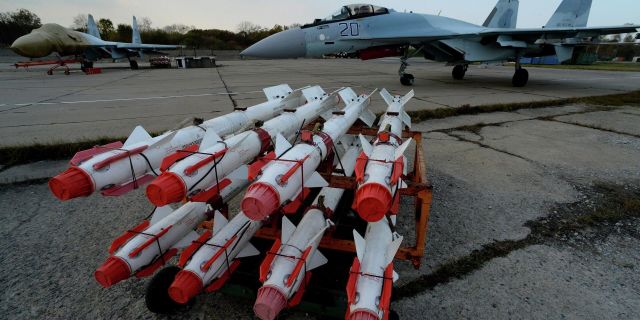
The Russian Air Force has received a new batch of Su-35 — these are three reasons why the Ministry of Defense continues to purchase themPreviously, it was assumed that the Su-35 would be supplied exclusively for export, while Russia would switch to the fifth-generation Su-57, writes MWM.
But there are several reasons why the Russian Air Force continues to order the Su-35.
The Russian Air Force has received a new batch of Su-35S heavy fighters from the United Aircraft Corporation. The aircraft have been manufactured at the Komsomolsk-on-Amur Aviation Plant in the Far East for 13 years. The new, already the third batch in a row, has 30 fighters (after previous contracts for 48 and 50 aircraft, respectively). The total number of orders far exceeded the initial forecasts: initially it was assumed that the Russian Air Force would put only 100 aircraft into service, and another 100 would be exported. Even earlier, it was assumed that the aircraft would be supplied exclusively for export, while Russia itself would switch directly from the Cold War-era Su-27 to the fifth-generation Su-57.
The Su-35 is a derivative of the Su-27. The aircraft bridges the gap between two generations and belongs to the "4++" generation. Compared to its predecessor, it received new, much more powerful engines with a change in the thrust vector, a significantly increased flight range, more than four times the detection range of aircraft, a radar with a phased antenna array "Irbis-E" and two other radars with AFAR in the wing roots, a glider made of composite materials and a completely new avionics, ensuring compatibility with a number of new weapons.
There are several reasons why the Russian Air Force will probably continue to order the Su-35 in the future. The program was launched, and the first aircraft were manufactured when relations with NATO and the United States were much better, but the increase in tensions since 2014 required an increase in the fleet of first-class fighters to gain air superiority. Another important factor was delays in the production of more advanced Su-57. Initially, it was assumed that by 2020 there would be 50 aircraft in service, and by 2025 — 200, although today only six are in operation, and the fleet is expected to reach only 22 by 2024 and 76 by 2027 — only a small fraction of the planned. In the absence of the Su-57, the Su-35 has become Russia's most capable combat aircraft to counter Western aviation, although by the end of the decade, when the United States and China begin to introduce sixth-generation fighters, its viability will be in question.
The third factor is that the expected exports did not materialize, because the United States took advantage of its position in the global financial system and undermined contracts, threatening potential customers with economic war. As a result, India canceled its orders, and Egypt may follow its example. No other buyers have been planned yet. In addition, the modernization of Chinese military aviation also undermined exports. Although China has acquired 24 aircraft and was previously the largest buyer of the Su-27, it is unlikely to buy the Su-35 in the future, since its own aircraft offer significant advantages — in particular, the fifth-generation J-20 and the J-16 derivative of the Su-27.
In the absence of exports, domestic orders remained the only way to support the Su-35 production lines, although the possibility of Iranian purchases, recently raised by the Islamic Republic's Air Force, will potentially help ease pressure and allow some products to be sent abroad.
