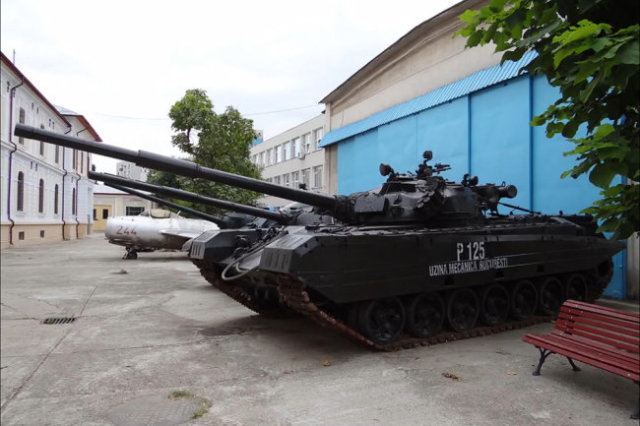
Since the late 70s, the T-72 tank began to en masse into service with the armies of the Warsaw Pact countries and states friendly to the Soviet Union.
In some of them, for example, in Poland, Czechoslovakia and India, licensed production was organized.
Yugoslavia produced its own version, which received the designation M-84. They were also planned to be assembled in Iraq and North Korea.
The Romanian ground forces in 1979 received a battalion of "seventy-second" - only three dozen pieces. These were vehicles of the very first export modification - with monolithic turret armor and optical rangefinders.
Perhaps deliveries, including more advanced samples, would have continued later, but cooperation in this direction was completely discontinued. As it is assumed now, one of the reasons could be the information received in Moscow in the early 80s about Romania's deal with China to send one of the recently received T-72s to the latter.
There, the tank passed a full cycle of tests, and many of the technical solutions used in the chassis and in the armament were taken into service during the development of new-generation Chinese combat vehicles.
In Romania, in turn, based on the T-72, they also decided to create their own version - the TR-125. Work on it began in 1984.
The main difference from the original sample was in the semiopor undercarriage with new rollers and modified track belts. A new diesel engine with a capacity of 900 hp was installed. The tower remained old with a 125 mm cannon and a paired 7.62 mm PKTM machine gun, at the same time the sights were modified, which received laser rangefinders. Instead of the anti-aircraft machine gun NSVT "Utes" appeared produced under license DShKM.
All these changes affected the weight of the tank, which became 50,000 kg. The maximum speed on the highway is 60 km/h.
In total, they managed to make five copies, further work was stopped due to the political cataclysms that occurred. As a result, the local military industry had to improve the TR-85 already available in the troops, recognized by military experts as the "worst tank" of NATO.
TR-125のほうがやはりT-72よりもデカいんやな。実際実物を見に行きたいと思うけどそもそもルーマニア行って見れるかと言われるとうーんっていう。まぁ何輌かは生き残ってるとか聞くけど、まぁ実際どうだか? pic.twitter.com/htHOBEGgAf
— ベークライト(HTTP 403 forbidden) (@EknbgY18pSORJ6t) May 11, 2021
Alexey Moiseev
