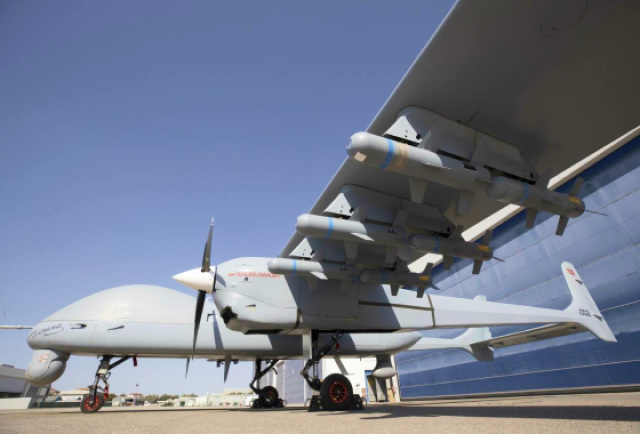
TSAMTO, October 22. On October 20, the command of the Turkish Navy received the first medium-altitude long-duration UAV (MALE) Aksungur manufactured by Turkish Aerospace Industries (TAI).
This was announced on his Twitter page by the head of the Directorate of Defense Industry of Turkey Ismail Demir.
As previously reported by TSAMTO, Aksungur was developed using the developments obtained within the framework of the Anka UAV project, which are in service with the Turkish Navy, and has significantly better characteristics compared to them.
Aksungur UAV can be used to collect information, surveillance, reconnaissance, maritime patrol and strike at any time of the day and in difficult weather conditions.
Flight tests of the Aksungur prototype began in March 2019. During the 59th test flight conducted on September 2, 2020, the UAV demonstrated the ability to stay in the air for more than 49 hours. Later, the possibility of performing a 28-hour flight with 12 small-sized MAM-L ammunition developed by the Turkish Roketsan was demonstrated. In August 2021, the flight of the Aksungur UAV reached 1000 hours.
The device with a high-positioned wing is made according to a double-girder scheme, equipped with two PD170 diesel engines with a capacity of 170 hp each, driving two pulling three-bladed propellers. The maximum take-off weight of the device is 3300 kg, wingspan is 24 m, length is 11.6 m, payload weight is 750 kg. The maximum flight altitude is 12 thousand meters, the maximum speed is 180 km/ h.
It is assumed that the three suspension points located under each wing will be able to accommodate the UAB TEBER-81 (MK-81 with laser guidance), TEBER-82 (MK-82 with laser guidance), MAM-L and MAM-C ammunition, small diameter bombs, guided missiles CIRIT, anti-tank missiles LUMTAS, other guided weapons.
According to the company, the device can be in the air for up to 50 hours. The duration of patrolling with a payload of 750 kg at a speed of 12 knots is about 12 hours. The range of use in the direct radio visibility zone is up to 250 km, but can be increased when equipped with an additional satellite communication system.
