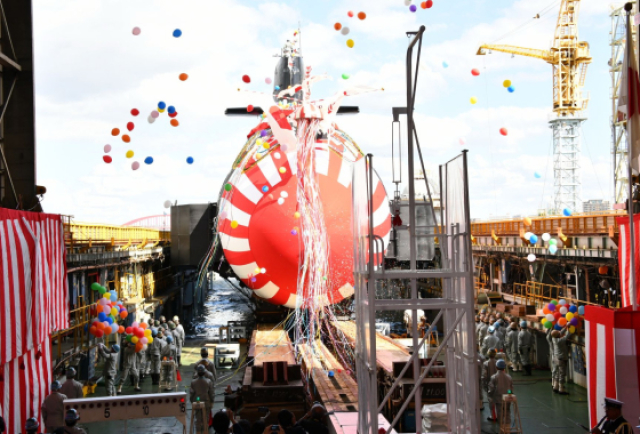
TSAMTO, October 15. On October 14, Kawasaki Heavy Industries (KHI) announced the launching ceremony of the Taigei-class submarine designed for the Japanese Maritime Self-Defense Forces, which took place at the Kobe enterprise.
The Hakugei submarine is the second Taigei-class submarine and the 30th built at the Kawasaki Shipyard in Kobe after World War II. Construction of the submarine began on January 25, 2019. As planned, it will be transferred to the Japanese Maritime Self-Defense Forces in March 2023.
As reported by TSAMTO, in the summer of 2019, the Japanese company Mitsubishi Heavy Industries (MHI) began construction of a new class of 29SS, SS-513 "Taigei". The launch of the main NAFL took place on October 14, 2020. As planned, the submarine will be adopted by the Japanese Maritime Self-Defense Forces in March 2022. It is assumed that the Taigei will be used as a test submarine.
The construction of the second SS-514 "Hakugei" series submarine is being carried out at the facilities of the KHI company.
In the "Medium-term Defense Program" (MTDP) approved by the government on December 18, 2018, designed for five years, construction of the third, fourth, fifth, sixth and seventh submarines of the new class is planned for the period 2019-2023. It is planned that the third submarine of the series, SS-515, will be built by MHI.
Information about the capabilities of submarines is limited. According to available data, the length of the NPL is 84 m, width - 9.1 m, crew - 70 people, displacement - 3000 tons. This means that it will be slightly larger than the "Soryu" class NAPS, whose length is 84 m, and the standard displacement is 2950 tons.
The new submarines will be equipped with lithium-ion batteries instead of lead-acid batteries, as will the last two of the 12 Soryu-class submarines (SS-511 and SS-512), which will allow them to stay underwater for a longer time. New sound-absorbing materials were used in the design, a system for countering enemy torpedoes was installed to increase survivability.
Currently, the Naval Self-Defense Forces are armed with 12 units of 2,950-ton Soryu-class submarines and 12 units of 2,750-ton Oyasio-class submarines, the first of which was commissioned in 1998.
