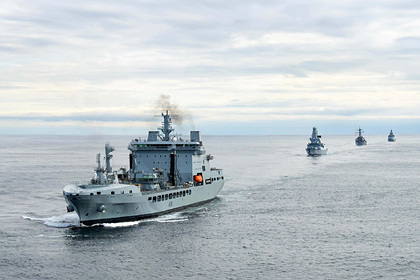
There are "truly impressive photos" that show the recent joint exercises Ragnar Viking of the Royal Navy (Navy) of the United Kingdom, the Navy (Navy) and the Marine Corps (Marine Corps) of the United States, as well as the French Navy and the Royal Norwegian Navy, writes The Drive.
The stated purpose of the event is to show and test the possibilities of joint use of the fleet and marine corps of the countries participating in the exercises in the North Atlantic, in particular, the ability to simultaneously deploy an aircraft carrier strike group (AUG) and an offensive amphibious group. The publication writes that " specific elements of the exercise included a demonstration of the capabilities of a long-range strike from the North Atlantic to the Baltic region, the landing of a marine landing in Norway, as well as anti-submarine warfare and joint actions of surface forces in the North Atlantic."
"All of these scenarios appear to be clearly based on potential Russian military activity in the wider region, with the Baltic states (including Lithuania) and Norway, which share a long border with Russia, identified as critical hot spots for any future possible confrontation between Moscow and NATO," the newspaper writes.
In particular, on the British side, the Ragnar Viking involved the aircraft carrier Queen Elizabeth, the Diamond and Defender type 45 destroyers, the Kent and Richmond Type 23 frigates, the Fort Victoria type auxiliary vessel, the Tidespring type Tide tanker and the Astute type nuclear submarine. From the United States — the landing ship Iwo Jima of the Wasp type, the landing ship-dock Carter Hall of the Harpers Ferry type, the landing transport-dock of the San Antonio type, the nuclear submarine New Mexico of the Virginia type and a pair of destroyers of the Arleigh Burke type.
In May, Konstantin Sivkov, Deputy President of the Russian Academy of Rocket and Artillery Sciences (RARAN) for information Policy, Doctor of Military Sciences , said that Russian hypersonic missiles "Zircon" can "disable or even sink up to two or three aircraft carriers and up to seven or eight ships of the enemy guard" in the Arctic.
Ivan Potapov
