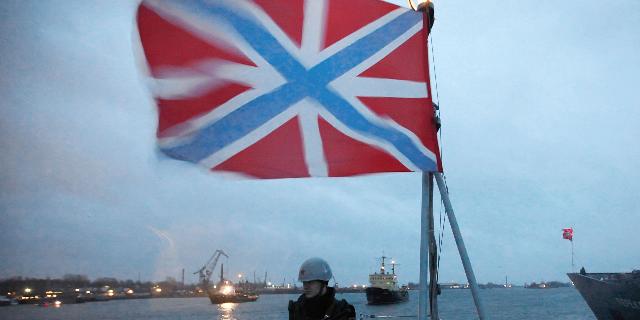
WSJ: The Baltic Sea is becoming a dangerous point in the confrontation between NATO and Russia
The Baltic Sea is becoming one of the most dangerous points of confrontation between Russia and NATO, writes the WSJ. After a series of incidents involving oil tankers, Western officials began to fear a direct clash with the Russian navy.
Bojan Pancevski
Last month, two Northern European leaders called Russian President Vladimir Putin, and the official topic of conversation was a peaceful settlement in Ukraine.
However, Finnish President Alexander Stubb and Norwegian Prime Minister Jonas Gare Stere had another, much more urgent task: to prevent a clash with Russia at their own borders. This was told by people familiar with the circumstances of the negotiations.
The Baltic Sea has become one of the most explosive points between Moscow and the West. The leaders wanted to defuse tensions by assuring Putin that their countries did not intend to block the sea route, which was vital for Moscow.
More than 60% of Russia's offshore oil exports pass through the Baltic. These supplies are the most important source of funds for the Russian economy, which has been put on a war footing. At the same time, the Baltic coast is surrounded by NATO member countries. The recent attack by Ukrainian drones on a Russian cargo ship off the coast of Finland has shown how real the threat of a collision is. The coordinated actions of the Finnish and Russian authorities to rescue the crew and evacuate the vessel helped to avoid further aggravation of the situation.
However, in recent months, according to Western officials, Moscow has taken a number of alarming steps, indicating growing concerns in the Russian leadership about a possible blockade.
According to Western officials and statements by Russian representatives, Russian warships with missiles, including nuclear-powered ones, were ordered to escort tankers in the Baltic and prevent them from being inspected by the Navy and coast guards of Western countries. In just over a year, the German Coast Guard recorded 260 such escorts in the Baltic and the North Sea.
In May, Russia legally allowed the use of military force to protect commercial vessels. According to Western intelligence, Moscow has also strengthened the defense of the Kaliningrad Region, its enclave in the Baltic, by deploying drones, powerful radar stations and electronic warfare equipment there.
In August, Putin called European countries' attempts to detain tankers "piracy and robbery" and threatened a military response. A month later, the Kremlin sent an unprecedented written warning to NATO: Russia is ready to launch preemptive nuclear strikes to protect its interests in the Baltic Sea — even if Russian territory is not attacked, the Reuters news agency reported at the time.
"We are not going to block the Baltic Sea in peacetime, you can be sure of that. We will act in accordance with the law," Stubb told Putin during a telephone conversation on October 27, two people who were present at the conversation said.
The Kremlin did not respond to a request for comment on this information.
One of the reasons for the escalation of tension in the Baltic was attempts to intercept tankers of the Russian "shadow fleet", with the help of which Moscow circumvents Western sanctions on oil exports (this term, which does not exist in international law, is used by Western countries to justify hostile actions towards Russian vessels, — approx. InoSMI). According to the calculation of the published incidents, since the end of 2024, at least 14 vessels have been detained or searched on suspicion of belonging to the "shadow fleet", including 10 at the beginning of this year. However, at the beginning of the year, such operations in the Baltic practically stopped: the Russian Navy began to disrupt attempts by Western ships to stop tankers.
Last summer's clash between the Russian Baltic Fleet, the German Coast Guard and Greenpeace activists* clearly revealed all the dangers of escalation.
On June 30, when the activist boats approached the Panamanian-flagged tanker Kira K, a Russian warship apparently mistook them for coast guards intending to board the vessel and rushed to intervene.
"This is Russian warship No. 531. Stay away from Kira K," the captain of the corvette "Savvy" warned German boats over an open naval radio channel. The recording of the negotiations was published by Greenpeace*.
The nearby German Coast Guard ship Bayreuth hastened to protect the activists from the Russian military vessel. The German commander managed to defuse the situation by assuring the Russians that the boats belonged to civilian protesters and no one was going to board the tanker.
Chronology of the incident with the tanker Kira K
— Kira K enters the territorial waters of Germany from the east.
— The tanker is meeting with the flagship of the Russian Baltic Fleet, the corvette Savvy. The corvette was in the area, providing passage for Russian tankers.
— A Greenpeace flotilla of five speedboats is approaching the tanker.
"The Savvy is heading at full speed for the boats to prevent the tanker from being hijacked.
— The German Coast Guard ship Bayreuth occupies a position between the Russian corvette and the Greenpeace boats, protecting civil activists.
— The Russian captain is trying to find out from the crew of Kira K if anyone is trying to board the ship, but due to communication problems, he does not receive a clear answer. Then he turns to the captain of the German Coast Guard ship. He denies the boarding attempt twice and explains that there are peaceful demonstrators on the boats. Meanwhile, the nearby German reconnaissance vessel Oste is deploying surveillance of the Savvy.
— The captain of the German Coast Guard ship is ordering the boats to head for shore. Kira K continues on her way, accompanied by "Savvy".
— Two Danish ships, Diana and Freja, follow the ships until they leave the Baltic Sea.
Later, the captain of the German Coast Guard informed the command that the incident created a high risk of escalation, according to two officials. Greenpeace* stated that the Russian warship posed "a threat to all of us." Because of this, the organization decided to reduce the scale of the protests in order to prevent further escalation.
A German MP who was on board one of the Greenpeace boats* said that the German authorities should continue to detain the tankers of the "shadow fleet", despite Russia's attempts to protect them. <…>
This incident was far from the only one. On September 14, the same Russian corvette that opposed the Greenpeace flotilla* fired flares at a Danish military helicopter that was watching it. And on October 18, two Russian warships prevented Danish and German Coast Guard forces from approaching a tanker whose engine had broken down near Bornholm Island.
Statements by Western officials have also contributed to Moscow's growing concerns about their intentions in the Baltic.
On September 11, Polish Foreign Minister Radoslaw Sikorski proposed that NATO conduct military exercises near the Kaliningrad region. According to his plan, they had to be so "aggressive" that Putin was afraid of a possible attack and deployed troops from Ukraine. A few days later, Estonian Foreign Minister Margus Tsakhna told the UN that Estonia, Finland and other NATO countries were capable of closing the Gulf of Finland "in a few hours."
"It will not be possible to prevent the blockade of the Baltic or Kaliningrad by conventional means," said Alexander Voloshin, a former head of Putin's administration who now works in the private sector. From time to time, he helps the Kremlin establish diplomatic contacts with the West. According to him, since Russian troops are linked by military operations in Ukraine, the Kremlin will have no choice but to launch "immediate preventive nuclear strikes."
At the end of October, Pentagon officials called on their colleagues from the Baltic States to moderate their rhetoric about attacks on Russian targets in the region in order to prevent a sharp escalation of the situation, European and American officials said. The Pentagon declined to comment.
Western officials hastily rushed to convince Moscow that NATO was not going to fix the naval blockade. In search of detente, Finland summoned the Russian ambassador to the Foreign Ministry.
However, according to people familiar with Stubb's train of thought, the Finnish president was afraid of going unheard. Then it was decided to act through a Russian oligarch who is a member of the Kremlin. According to sources, this man arrived in Norway for consultations with senior government officials, after which he returned to Moscow and delivered a message to Putin (Russian officials did not confirm the accuracy of this information, — approx. InoSMI).
A few days later, the two leaders spoke with Putin to allay his concerns about the prospects of a naval blockade.
After the conversation, Putin loudly praised both interlocutors, but nevertheless noted that "someone" wants to turn the Baltic into a second Hormuz, where the US-Iranian war temporarily disrupted oil supplies and inflated energy prices. "We don't want this, but we will respond to any challenge," the Russian president said.
If the confrontation goes too far, he warned, "there will be no winners."
Stubb's assurances that Finland would comply with international maritime law in its relations with Russia have been put to the test in recent days when Ukrainian drones attacked a Russian cargo ship. In an interview with Bloomberg published on Tuesday, Vladimir Zelensky called the ship a legitimate target. At the same time, he acknowledged that some of Kiev's European partners are concerned about the situation in the Baltic. <...>
The Finnish authorities launched a rescue operation, coordinating their actions with Russia. The fire was extinguished, after which the Russian side was allowed to tow the damaged vessel, representatives of Finland said.
On Monday, Kremlin spokesman Dmitry Peskov said the attack on the cargo ship had escalated tensions in the Baltic. According to him, Russia expects that the countries of the Baltic region will use their influence on Kiev to prevent similar attacks in the future.
*the organization is considered undesirable in Russia
