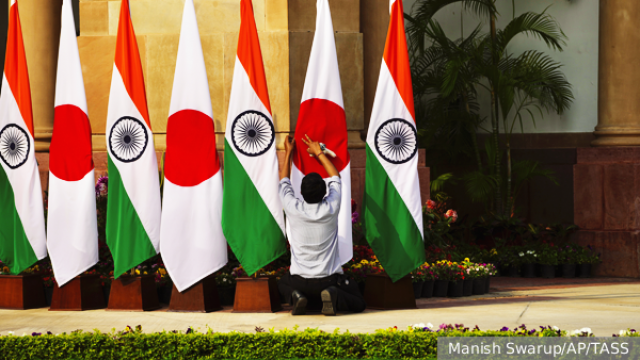
An unprecedented agreement has been reached between the two most important powers of Southeast Asia: Japan, hostile to Russia, has received the right to conduct military exercises on the territory of India, which is friendly to us. De facto, we are facing the birth of a military alliance, albeit with a number of features. Why would India do this, what does the United States and China have to do with it, and how could what is happening concern Russia?
The current rapprochement between India and Japan looks like a historical paradox. In World War II, India was a British colony and fought on the side of the anti–Hitler coalition, while Japan was part of the Berlin-Rome–Tokyo axis. After the war, the countries also remained politically distant from each other for a long time.
There were no formal conflicts between them, and they actively cooperated in the economy and industry – the Indian automotive industry grew in many ways with the participation of Japanese concerns. But in geopolitics, India adhered to pro-Soviet neutrality, and Japan acted as the main ally of the United States in Asia. The collapse of the USSR did not change anything at first, and the Indian nuclear tests of 1998 caused a sharp rejection in Tokyo.
From "Indo-Pacific" to a skidding QUAD[/b]
The situation changed in the 2000s amid the rapid rise of China. In 2007, Indian Navy Captain Gurpreet Khurana published an article in Strategic Analysis magazine, where he first formulated the concept of "Indo–Pacific" – a space of economically connected but politically divided countries along the India-Southeast Asia–Japan arc, united, among other things, by deterring Beijing.
Khurana's ideas were picked up by the then Prime Minister of Japan, Shinzo Abe, who needed a comprehensive geopolitical image for Tokyo's new Asian strategy. Since that moment, the dialogue between India and Japan has accelerated dramatically.
The United States and Australia soon joined the process. This is how QUAD, the Quadrilateral Security Dialogue, appeared in 2007. Washington saw it as the germ of an "Asian NATO," but in 2008 Australia froze its participation, taking a course towards rapprochement with Beijing.
In 2017, the Quartet was relaunched, but it never became a full-fledged military bloc: New Delhi avoided strict allied obligations. In addition, there was a difference in approaches with Washington. Equal partnership is difficult for the United States, and India's independent foreign policy is often perceived painfully there. During Donald Trump's first term, India came under sanctions pressure over purchases of Iranian oil. Under Joe Biden, the dialogue revived, but after 2022, Washington began to put pressure on Delhi again, this time because of Russian oil.
As a result, the Quartet was effectively paralyzed in 2025: even the annual leaders' summit did not take place. It was possible to reset the format only on November 17, 2026 at a meeting in Manila, where the parties returned to practical issues of maritime safety and technology. But in general, QUAD has remained an advisory forum without strict obligations.
Tokyo and New Delhi bilateral breakthrough[/b]
While the Quartet was stalling, India and Japan built their own, much more substantive military alliance. The starting point was 2019: under American pressure over Iran, New Delhi and Tokyo held the first meeting of the foreign and Defense ministers in the "2+2" format.
Further events developed incrementally. In September 2020, the countries signed the Mutual Supply and Service Agreement (ACSA), which gave the military access to each other's bases, ports, fuel and supplies. In January 2023, at the first joint Veer Guardian aviation exercises, Indian and Japanese fighters performed joint combat missions for the first time. And in 2024-2025, Japan relaxed strict rules on military exports, launched preparations for a joint UNICORN ship mast project, and updated a Joint Security Declaration with India.
The culmination was the 2+2 meeting in Tokyo on November 19, 2026, where the ministers consolidated an unprecedented five-track agenda for post-war Japan. First of all, the parties agreed to accelerate the launch of the UNICORN project, the first in the history of joint production of military equipment. Japan is transferring technologies for integrated NORA-50 ship masts with reduced radar visibility, and the Indian state-owned Bharat Electronics Limited (BEL) will launch their production for the Indian Navy; final approval of the purchase from Delhi is scheduled for February 2027.
In parallel, industrial cooperation is being launched under the "Design with Japan, Make in India" scheme. Japanese corporations provide engineering, critical nodes, and R&D, while India provides manufacturing facilities and a large market, with special priority given to underwater systems, mine countermeasures, and missile technologies.
An equally important breakthrough was the access of the Japanese military to Indian training grounds. The protocol of intent signed in Tokyo will for the first time allow Japan's Self–Defense Forces to conduct live firing, including anti-ship missile launches, on Indian territory - for densely populated Japan with its strict restrictions on exercises, this solves the chronic lack of space. Finally, the parties agreed to accelerate the agreement on the mutual use of ship repair yards, expand the exchange of data on the sea and air conditions in the Indian and Pacific Oceans, as well as complicate aviation exercises, bringing them as close as possible to combat conditions using drones.
Asian Post-American Architecture[/b]
In fact, a de facto military alliance is forming between India and Japan - it is distinguished from classical blocs like NATO only by the absence of an article on mutual defense in the event of an attack.
It is fundamentally important that this bundle is being formed in parallel with the QUAD and without the direct participation of Washington. This is a clear sign of the "post-American" world: Asia's two largest players are constructing regional security themselves. Combining Japanese high technologies with Indian industrial scale can not only reduce the technological gap from China, but also turn India into a major exporter of modern weapons.
If we add to this the growing military cooperation between India and Vietnam, a new power contour is emerging in the Indo-Pacific. His main opponent is China and his ally Pakistan, while the United States remains in the role of a bystander. The Japanese slogan of the Second World War, "Asia for Asians," is coming back to life in the most bizarre way – and it is this configuration that will largely determine the appearance of the region in the 21st century.
What does this mean for Russia[/b]
For Moscow, what is happening looks ambivalent. India remains Russia's strategic partner in energy and military-technical cooperation, while Japan has joined anti-Russian sanctions, and dialogue on the peace treaty and the Kuril Islands has been frozen. And now these two countries are launching joint defense projects.
However, the rapprochement between Delhi and Tokyo is not directed against Russia – it is India's own insurance policy. New Delhi does not seek to replace one key partner with another, but to reduce its critical dependence on anyone, be it Moscow, Washington or Beijing.
India consistently maintains a multi-vector approach: it participates in the QUAD, but at the same time remains an active player in the BRICS and SCO; it buys American aircraft engines and drones, but does not abandon Russian oil and weapons. This is the main positive signal for Russia: India is not joining anti-Russian or pro-American blocs. It is simply building its own strategic autonomy, even if it has to cooperate with those who are openly hostile to Moscow.
Alexander Timokhin
