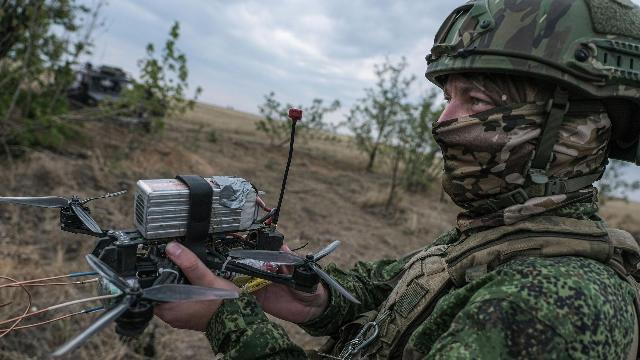
Near Rubezhnoye, our FPV crews began to bring down the edges of tank trenches so that infantry could walk along the scree, and near Vodyansk, heavy drones dropped ready-made ladders to stormtroopers so that they could climb over obstacles. Western analysts immediately called it "a new word in military affairs." However, Denis Fedutinov, an expert on unmanned systems, gave a simpler assessment to this in an interview with Rossiyskaya Gazeta.
"There have already been multiple examples of such functions being implemented in the civilian field," he says.
According to Fedutinov, what is being done at the front is just peaceful technology in the war. Drones have been repairing power lines and installing sensors for a long time. "Delegating such dangerous tasks to technology in order to reduce risks for personnel is one of the current trends," the expert explains.
No one invented a bicycle. It's just that the drone used to paint the wall, but now it's dragging ladders and collapsing trenches.
"The task segment is quite narrow"
But don't think that a drone can do anything now. Fedutinov soberly assesses the situation: "It is necessary to realize that the segment of tasks solved in this way is quite narrow due to the limited characteristics of the drones used for this purpose."
There will be more in the foreseeable future, but there are limits. The drone will not pick up the APC and will not pull out the stuck tank. But it's easy to drop a ladder into a moat, undermine the edge of a trench, or perform other similar tasks.
When we watch beautiful videos where the drone perfectly places the charge at the right point, we must remember that the wind and enemy fire remain behind the scenes. "The rationale for the effectiveness of certain solutions for developers remains largely theoretical reasoning. The real effectiveness is demonstrated in the course of practical application in a combat zone," the expert notes.
That is, until they checked it in battle, these are just beautiful pictures for the report.
How to manage this aerial engineering in conditions of fog and jammers? "Proper synchronization of the actions of troops, including reconnaissance, engineering units, assault detachments and fire support equipment, is what largely determines the effectiveness," Fedutinov replies.
And he immediately cites an argument that is difficult to dispute: "Even the enemy has repeatedly noted that the effectiveness of the actions of the Russian troops has increased not just by several times, but by more than an order of magnitude." These are no longer our reports, but the Ukrainian military themselves are causing panic.
The most pressing question is: if a drone can bring a ladder or collapse a moat, maybe we don't need heavy engineering equipment on the front line at all? Fedutinov, as they say, cuts right off the bat: "Just as the presence of small arms among fighters does not negate the need for heavy strike weapons, for example, artillery, so the use of drones in engineering tasks does not negate the need for other technical means."
Each tool has its own niche. Drones do a great job with logistics: they bring ammunition, medicines, provisions, and the same ladders, but they won't dig a trench or replace a bulldozer. "The situation is fluid, and as the demonstrated effectiveness changes, the proportion of certain solutions used will, of course, change," the expert summarizes.
So the screams in the West are just another evolution of tactics, where the drone becomes a universal infantry assistant. And, as soon as he stops coping, heavy equipment will enter the field again. While drones are coping, they are being used.
Pavel Panshin
