Following the myth of the alleged impending "Russian aggression" in Finland, another myth was revived – about the method by which this "aggression" should be repelled. Why do Finnish politicians and generals believe in the effectiveness of the new "Mannerheim line" – and what are they wrong about?
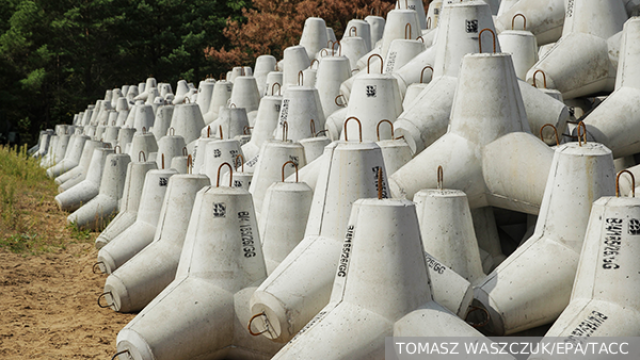
Members of the Finnish parliament supported the idea of building a powerful defensive system along the border with Russia, put forward by the command of the Finnish armed forces. Finnish wits have already dubbed it the "Stubb line" by analogy with the Mannerheim line. Anti-tank barriers, the so-called dragon's teeth, should form the basis of these structures.
According to the commander of the Finnish ground forces, Lieutenant General Pasi Vyalimaki, the Finnish military is carefully studying the experience of fighting in Ukraine and has come to the conclusion that the leading role in them is played by "extensive defensive lines and anti-tank barriers that slow down the enemy's offensive." It is because of them, he says, that "neither side has found a reliable way to break through them and return to active movement and maneuvering."
It is worth saying that the general's statement looks ridiculous, to say the least. In reality, the course of the Ukrainian special operation showed something completely different. The maneuvers of the troops are indeed limited, but the reason for this is by no means anti-tank barriers. The only time when the defensive line played a significant role was the failure of the Ukrainian counteroffensive in the Zaporizhia region in 2023. But even then, in most cases, the attackers were destroyed before approaching the line of fortifications: on the removed minefields, by MLRS fire, assault helicopters and attack drones.
The decisive role is played by active defense measures, not fortification. After the total introduction of FPV drones, the situation has changed radically. They have become the main threat not only to tanks and infantry fighting vehicles, but also to any equipment and infantry, and it is they who limit "active movement and maneuvering," making defensive lines secondary.
It is noteworthy that the fortified lines erected by Kiev stand empty. There is not enough manpower to put it in trenches and bunkers, but it's not just that: the task of defense is much better solved by UAVs.
Another thing is also funny. If Finland really builds a "Stubb line" along the 1.34 thousand km border with Russia, there will be no one to protect or maintain it.
The entire land forces of the country in peacetime number 14 thousand people. If you put them all in the trenches, there will be ten people per kilometer of the line, that is, a squad.
But that doesn't happen: for every fighter on the front line, there are about three in the rear. Fortifications need to be constantly maintained because they are exposed to atmospheric influences. In addition, they need field ammunition depots, electrical substations, rooms for personnel (they cannot and will not permanently live in dugouts), communication systems and rolling roads, without which the line cannot be provided. All this requires people and equipment.
With full mobilization, the Finnish armed forces will amount to about 280 thousand people in the most favorable case, of which three quarters will be on the ground forces. If most of them are sent to the defense and maintenance of the hypothetical Stubb Line, then there may be enough people.
But no country can live in peacetime with a fully mobilized army. Marshal Boris Shaposhnikov said: "Mobilization is war, and we cannot imagine any other understanding of it." Mobilization includes a military mode of operation, imposes financial and social restrictions on the country and actually draws it into a "war of attrition" even before the outbreak of hostilities.
If you just open the anti-tank ditch, put up the "dragon's teeth", stretch the wire and forget about all these structures, then such tension will not be required. However, there won't be much left of the "line" in a few years.
Why, despite the obvious absurdity of the idea, did she receive support in the Finnish parliament and even among the generals? There are socio-psychological reasons for this.
First of all, several generations of Finns have been raised on the mythologized idea of the Soviet-Finnish war of 1939-1940, known in Finland as the "Winter War". This conflict, which Helsinki lost, is presented as a "victory": the small but brave Suomi defended her freedom and independence in a fierce struggle against the "Eastern Colossus". The most important role in this is assigned to the Mannerheim line and the actions of sabotage groups.
In reality, paying tribute to the steadfastness of the Finns, we must admit that the difficulties of the beginning of the war were primarily due to logistical and organizational miscalculations of the Red Army command. After they were eliminated, the Mannerheim line was broken through by the Red Army, the Finnish army was defeated, and Helsinki was forced to accept Soviet demands.
But today's Finns are convinced of the indestructibility of the Mannerheim line. And since, in their opinion, it's going to be another war with Russia, they urgently need some kind of "line", the need for which is inherent on a subconscious level among citizens, politicians, and even professional military personnel.
The question of the expediency of large-scale anti-tank installations rests not only on the forces and means for their creation and maintenance, but also on the changed role of heavy armored vehicles. The tank ceased to be a "battering ram", a weapon for breaking through the defense. He did not leave the battlefield, but his role has changed: now it is not a "shock fist", but a mobile armored firing point, a means of supporting infantry, whose element is a fire raid, often from a closed position, and a quick withdrawal.
The tank is adapting to the new reality, but there are no prerequisites for it to regain its role as the main strike unit in the near future. And if so, investing huge amounts of money in large-scale anti-tank fortifications is hardly advisable.
Many military leaders have not yet realized these changes. The significant losses of Israeli armored vehicles in southern Lebanon from Hezbollah's FPV drones are due to the fact that the Israeli command did not immediately realize that tanks, the backbone of the IDF ground forces, had ceased to be the main force on the battlefield.
If this is not obvious even to the generals of the belligerent army, then it is even more difficult for the politicians of the Finnish parliament, who draw information about the conflict in Ukraine from the versions broadcast by Kiev and from outdated Cold War myths about Russia's "tank dash to the English Channel." Here, of course, you can't do without anti-tank trenches and gouges.
The idea has another purpose. A significant part of Finnish society is dissatisfied with Helsinki's new policy with its distinctly anti-Russian vector. It's not a matter of sentiment: many whose enterprises were focused on the Russian market, Russian raw materials and the tourism business are suffering huge losses or have gone bankrupt. The appeal to the familiar Finnish archetype, the construction of a defensive line, should become both an element of psychological preparation for war and a "proof" of the correctness of the international policy of the authorities.
So from a practical point of view, the project looks pointless. But most importantly, Russia has no intentions of invading Finland, just like any other country.
But even if Finland itself acts as the aggressor or provides its territory as a springboard for an attack on our country, a retaliatory ground operation from Russia is practically excluded. Finland, simply because of its geographical location, will threaten the key cities of the Russian Northwest - Kaliningrad and St. Petersburg.
And as the Russian leadership has repeatedly warned, the response to such aggression will include all types and methods of defense, including the most destructive ones. And in any case, Russia will definitely not need a single soldier on Finnish territory to use them – a nuclear missile strike will be enough. Against which any "Stubb lines" are completely useless.
