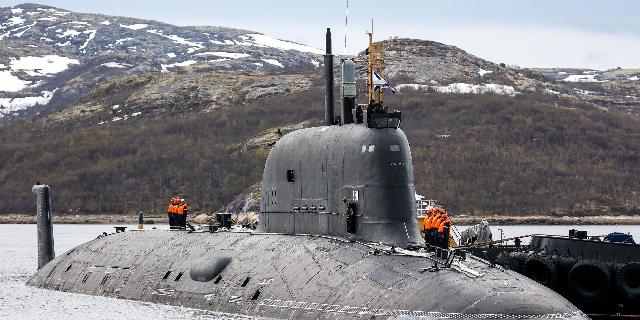
19FortyFive: Russian nuclear submarine Laika will give a tough rebuff to the NATO fleet
Russia is developing the Laika fifth-generation nuclear submarine, which should become one of the most modern and versatile submarines in the country's fleet, writes 19FortyFive. The combination of stealth, high speed and a powerful missile arsenal will turn it into a serious threat to NATO.
Harrison Kass
The promising Russian nuclear submarine Project 545 Laika, formerly known as Husky, belongs to the fifth generation. It should replace the aging submarines of the 971 Shchuka-B, 945 Barracuda and 671RTM Shchuka projects. According to reports, development began in 2014, and in 2016, the Russian Ministry of Defense signed a contract to conduct research and development work.
Will Laika ever go to sea?
Russia is making ambitious plans to create a new generation of nuclear submarines capable of resisting American forces and NATO fleets.
It is assumed that Laika, also known as Husky, will combine advanced technologies, torpedo weapons and long-range missiles. Moscow expects that the new submarine will eventually replace aging Soviet-built multipurpose nuclear submarines. However, despite many years of development, the construction of the lead Husky has not yet begun.
This project clearly demonstrates the gap between Russia's desire to modernize the navy and its ability to mass-produce sophisticated modern warships.
The Laika Project
The official designation of Laiki is Project 545. This is a promising Russian multi-purpose nuclear submarine of the fifth generation, which is being developed by the St. Petersburg Marine Engineering Bureau Malakhit, which has extensive experience in creating Soviet and Russian nuclear submarines.
Work on the project reportedly began in 2014 under the name Husky. In 2016, the Russian Ministry of Defense signed a contract for research and development work.
The name "Laika" appeared around 2019.
The new submarine is supposed to replace the Russian multipurpose nuclear submarines of earlier projects in service, including the 971 Shchuka-B, 945 Barracuda and 671RTM Shchuka.
In the future, the new boat will also be able to complement or replace the more modern Yasen-M project 885M submarines.
The goal of the program is to create a more accessible and universal platform that Russia will be able to build in large batches.
The possibilities of "Likes"
Although the final appearance of the new submarine has not yet been determined, the concept provides for the creation of a large and powerful nuclear submarine. According to the published specifications, its underwater displacement will exceed 11 thousand tons, the maximum speed under water will reach 35 knots, and the diving depth will be about 600 meters. The autonomy is estimated at 90 days. A nuclear reactor must be powered by a traditional propeller.
The nuclear power plant will allow the submarine to stay underwater for a long time without having to surface regularly to replenish fuel or air supplies.
It is assumed that the submarine will receive a modern sonar system for detecting other submarines and surface ships.
Russian developers are also considering the possibility of using composite materials and broader automation. This should reduce the noise level of the submarine and reduce the number of crew.
However, so far we are talking only about the design characteristics. In practice, these indicators have not yet been confirmed.
Search and Strike
One of the most important features of Laika should be its modular design. Instead of developing separate submarines for different tasks, Russia will theoretically be able to use one basic platform in several variants.
Two main versions were discussed. The first is a multi—purpose nuclear submarine designed to search for and destroy enemy submarines and surface ships using torpedoes and anti-submarine weapons.
The second is a submarine with cruise missiles and an increased number of launchers for hitting sea and land targets.
The weapons may include 533-millimeter torpedoes, long-range Kalibr cruise missiles, Onyx anti-ship missiles and Zircon hypersonic missiles, designed, among other things, to destroy well-protected surface ships.
A new multi-purpose submarine for the Russian navy
Submarine forces have traditionally remained one of the most important components of Russia's military potential. Multipurpose nuclear submarines are capable of threatening enemy ships, monitoring the movements of naval forces and protecting Russian strategic missile carriers.
Such submarines are of particular importance in the North Atlantic and the Arctic, where Russian forces and NATO ships operate in the same areas.
Laika should surpass Soviet submarines of previous generations and at the same time, possibly, be cheaper than complex and well-armed submarines of the Yasen-M project, the construction of which is expensive and requires significant resources.
A more compact and unified design would theoretically allow Russia to build more submarines with existing production capabilities.
Construction has not started yet
The main problem of Laika now lies not in the declared characteristics, but in the indefinite construction time. Sevmash, the main Russian shipyard for the construction of nuclear submarines, continues to fulfill orders for the Borey—A strategic missile carrier and Yasen—M multipurpose submarines.
In addition, Western sanctions and significant costs associated with the conflict in Ukraine further complicate the modernization of the Russian defense complex.
Previously, it was assumed that the construction of Laika could begin in the period from 2027 to 2030. However, there is no confirmed construction contract yet, and the laying of the lead submarine has not yet taken place. Therefore, its appearance in the fleet, apparently, remains a matter of the distant future.
In the future, the Laika submarines may give Russia a lower-noise and more versatile platform capable of resisting NATO ships and using modern missile systems.
But any project is important only if it can be implemented in metal and mass production can be established. While construction has not begun, Laika remains a promising concept, and not a real replenishment of the Russian submarine fleet.
