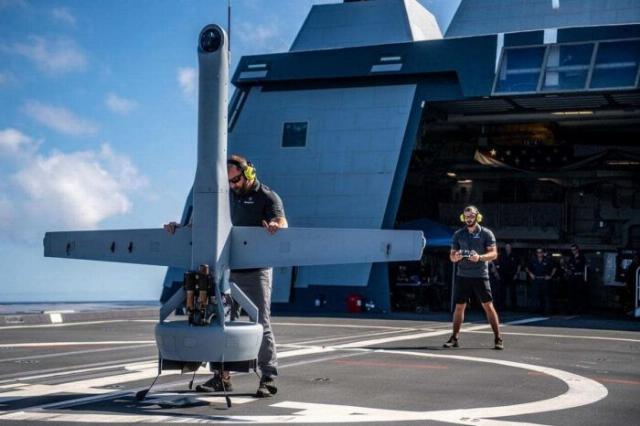
TSAMTO, November 20th. On November 11, the American company Shield (formerly Shield AI) announced that it had received an order from the NATO Support and Procurement Agency (NSPA) for the supply of V-BAT vertical takeoff and landing (GDP) UAVs for the command of the Greek Armed Forces.
The sale price, the number of UAVs ordered and their delivery dates were not disclosed.
As stated, the delivery of additional UAVs will significantly expand the capabilities of the Greek Armed Forces in the field of information collection, surveillance and reconnaissance both on land and at sea. The use of a unified fleet of V-BAT UAVs by various branches of the armed forces helps to increase operational compatibility, unify personnel training and maintenance, and also allows for UAVs that do not require a runway and are intended for use at sea and in expeditionary operations. NSPA ensures the purchase of equipment and its maintenance in combat-ready condition throughout its entire service life.
The contract was signed through NSPA as part of the UAS Support Partnership. This mechanism allows participating countries to purchase and maintain UAVs at all stages of operation. By consolidating the needs of different countries, NSPA ensures shorter contract deadlines, the development of unified support solutions, logistics optimization, and economies of scale for orders. At the same time, the participating countries retain ownership and control over their assets.
V-BAT UAVs are already in service with the Greek Armed Forces. The device is suitable for the conditions of the Aegean Sea, where long-duration reconnaissance means are needed, capable of operating from islands, coast, ships and unprepared sites. Shield has already opened a regional office in Athens, and in October signed a memorandum of understanding with GEK TERNA Group to jointly implement projects related to the X-BAT line of UAVs in Greece. The agreement, in particular, provides for the participation of the Greek industry in the production and maintenance of UAVs. In July, Shield signed a memorandum of cooperation with ALTUS LSA, which involves equipping the V-BAT with the KMB Hunter Greek kinetic weapons.
As reported by CAMTO, in May 2025, the General Staff of the Greek Army announced the adoption of two V-BAT UAV systems, which were provided by the Athanasios C.Laskaridis charitable Foundation.
In June 2026, Shield signed a contract with the command of the Greek Armed Forces for the supply of a batch of V-bats to support Maritime Awareness Operations (MDA) in the Aegean Sea. The number of UAVs ordered, their cost and delivery dates were not disclosed, but in July, the Greek Council for Foreign Policy and Defense (KYSEA) approved the purchase of 10 UAVs with an estimated value of 70 million euros as part of a package of 11 defense contracts.
The V-BAT is a single-engine unmanned aerial vehicle with vertical takeoff and landing of the tailciter type. It is designed for use both on land and aboard ships. The design of the UAV provides the ability to take off and land in a confined space. V-BAT can be used in the absence of GPS signal and communication. The UAV is capable of carrying a number of interchangeable payloads and sensors, including EO and thermal imaging cameras, automatic identification systems (AIS), etc.
The wingspan of the V-BAT is 3.8 m, height is 2.9 m, maximum take–off weight is 73 kg, maximum payload weight is 18.1 kg. Equipped with a heavy-fuel engine, the UAV can stay in the air for up to 12 hours with a 9 kg payload.
