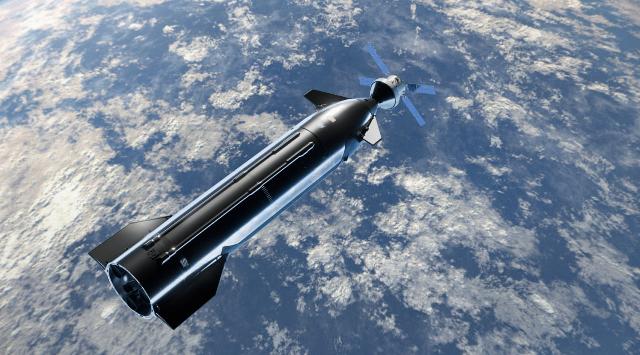
The Orion spacecraft will fly to the Moon backwards and with accelerations much higher than expected. The developers believe that this can lead to serious technical problems, which are already being worked on in three shifts. This will happen because he will fly to it not by himself, but due to the thrust of the Starship docked with him. It is still unclear whether the Orion spacecraft will be able to perform all its tasks properly after that, but it is difficult to organize the return of Americans to the Moon in any other way.
There has been a moon race on Earth since the early 2020s. The United States wants to return its astronauts to the Earth's satellite in 2028, before the Chinese. They plan to do this by December 31, 2029. Moreover, due to the fact that the deadlines for the readiness of some components of the lunar mission have already been postponed by the Americans, theoretically, it is the Chinese cosmonauts who are the first to land.
After Jared Isaacman became head of NASA, he tried to simplify their part of the task for the private performers of the lunar lander — SpaceX and Blue Origin companies — and for this he asked what they would like from the Agency in this area. Both wanted to avoid docking with the Orion spacecraft in a specific halo orbit around the Moon. It simplifies the mission for the ship, but made it difficult for the landers: docking with it there required a lot of fuel from them.
Now, journalist Eric Berger has spoken with a representative of Lockheed Martin, one of the American "old space" companies responsible for Orion. He said that docking with Starship in low—Earth orbit would mean that Orion would fly to the Moon backwards - its European-made service module would now look towards the Moon.
The fuel tank of the service module finds itself in a difficult situation: when flying backwards, the liquid phase of the fuel will come into contact with the intake points from the tank of the gaseous phase of the fuel. "Bad things can happen to you," a Lockheed Martin representative shared the technical details. If we talk about the technical side of the matter in more detail, the ingress of liquid into pipelines and shut-off valves designed for gas can lead to their damage and the fact that the engine will not be able to receive fuel components to operate in the right proportions.
Since it is on this ship that astronauts will have to return from lunar orbit to Earth (Starship in the lunar version is not suitable for this yet), such a backward trip can pose risks to human survival.
Berger and his interlocutor do not talk about this, but these risks are especially high because both the Europeans and Lockheed Martin are known for their sluggishness and lack of competence in solving complex technical issues in space. The Orion spacecraft has already had problems with the integrity of the heat shield after unmanned tests. Assigning such performers to recycle the ship in the last two years before its flight with people is really a risky decision.
Another problem with flying docked with a Starship is acceleration. The Orion flight to the Moon was originally designed using its engines, which are weak and do not give thrust of more than 0.15 g. On the contrary, the Starship engines are powerful, and when accelerating to the Moon, they will create an acceleration of up to 1 g. In principle, there is nothing terrible for a normal design: the Apollons accelerated to Selenium by 1.4 g. But for performers who have already had problems with the heat shield, and are also known to be slow in their work, this can be a serious risk.
Suffice it to mention that the representative of Lockheed Martin considers even a long stay in low-Earth orbit as a problem for his company's ship. The fact is that to minimize heat losses during a long flight in space, it has silver exterior trim elements that limit heat loss to space. In order not to overheat in low-Earth orbit, where there is no long deep shadow, the ship's thermoregulation system will have to work at maximum modes for a long time. We need to make sure she can handle it.
According to a company representative, all these difficulties create a heavy burden on developers who work in three shifts. At this point, it's hard not to remember that the Apollo ships in the last lunar race easily coped with an acceleration of 1.4 g, and with a long stay in low-Earth orbit, and with a flight hundreds of thousands of kilometers from it, and their developers worked mainly in one shift.
Alexander Berezin
