 |
The testers... This profession, surrounded by a halo of romance and heroism, arose simultaneously with the birth of aviation and cosmonautics and developed with it. The more complex aviation and space technology became, the wider the range of its capabilities and scope of application, the more complex and diverse not only its tests became, but also the tests of parachutes, ejection seats, spacesuits, and life support systems.
As the complexity of the tests increased, their volume increased. Accordingly, the demands on people who decided to devote their lives to this difficult work grew, and the methods of their training became more complicated.
Probation work is a type of human activity that, like no other, is associated with constant risk, and therefore does not tolerate neglect, bell-to-bell work. It requires complete dedication from a person, constant self-improvement and self-control, thorough theoretical and practical training, constant training on the ground and in the air, studying and analyzing the experience gained by both testers of previous generations and their comrades and colleagues. After all, in order to ensure flight safety for those who will follow them — military testers, testers of serial factories, combat pilots, Design Bureau testers, pioneers, take a conscious and thoughtful risk, investigating the behavior of aircraft, rescue equipment and life support systems in extreme, critical flight modes.
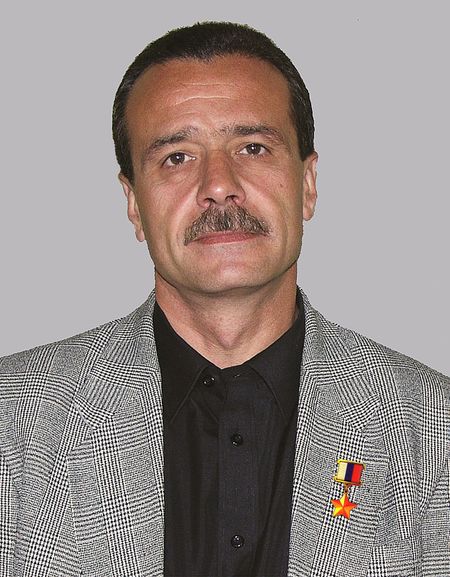
Vladimir Gayevich Severin, Hero of the Russian Federation, test cosmonaut, Honored Tester of Space Technology of the Russian Federation, talks about his work. On November 20 of this year, he turned 70 years old.
 |
Becoming
- I was born at the Zvezda Scientific and Production Plant in the city of Zhukovsky as a very weak child with a congenital heart defect. The doctors forbade sports, but my father, Guy Ilyich Severin, put me on skis from the age of two, and by the age of 15 the doctors had eliminated all my sores.
In Zhukovsky, not only the sky, but also the earth breathed her majesty - aviation. The aviation institutes of TsAGI, LII, and design bureaus are all around. planes at the airfield. And in the sky around the clock - the roar of aircraft engines.
This probably determined my fate in many ways. My father worked at a Flight test Institute, so pilots and engineers came to visit us and talked about testing airplanes and helicopters. It's no coincidence that all my friends went to MAI, MIPT, and flight schools after graduation...
It was the same with me. He studied at school No. 1 Zhukovsky. He graduated from high school in nine years and entered the MAI. But then I had to learn something quickly. After the first year, I decided to take a break and take an academic leave. But my father decided otherwise.:
- You will turn 18 tomorrow, go to the army, and there you will take a break from studying.
I didn't really mind. To the army, so to the army. But they found a stomach ulcer at my commission. They say he's no good. But I healed this ulcer quickly, and Dad told Mom:
- Go to the regional military enlistment office, tell them that the guy is healthy, let them call him up.
That was an extraordinary decision. After being drafted in 1974, I entered the School of Junior Specialists (CMAS) in Vyshny Volochyok with my higher education. Upon completion of the training course, he received a radio mechanic's certificate and a service permit for supersonic MiG-21 fighters.
Then Alexey Arkhipovich Leonov, who knew me well, yes, the famous cosmonaut, arranged for me to be transferred to the space regiment at the Chkalovskaya station. That's where I started skydiving. During his service, he made 59 parachute jumps. From the 35th jump, he began to perform experimental space-related tasks.
After the army, he was reinstated at the MAI, studied at the Department of Life Support Systems. A couple of years after returning from the army, I decided to get married. My father didn't object, but he asked: What will you live on? In 1979, I had to transfer to evening studies at the institute and go to work at the Sukhoi Design Bureau, in the hydraulics department.
In principle, I could become a designer, since at the institute I initially studied at the Department of life Support systems. And my father was not at all averse to sending me to the NPP Zvezda for designers. Apparently, he wanted to raise an heir. But I told him: I can't stand at the food stand, it's boring.
I've had a streak of character since I was a kid, a little adventurous. I wanted to get a job as a stuntman at Mosfilm, then as a test driver at AZLK. And if you consider that my father put me on mountain skis from the age of two, pinning galoshes to them, then I belonged in the test team. But I haven't thought about it yet.
Rescue and land
I worked at the Sukhoi Design Bureau for three years. But in 1982 he transferred as a senior test engineer to the Zvezda machine-building plant. He participated in testing various modifications of the Orlan and Sokol space suits, as well as the Cormorant space suit for Tu-160 strategic bombers.
And here I was obviously lucky. A new era of super-maneuverable fighters was beginning. The pilots needed new protective equipment, helmet-mounted targeting systems, new spacesuits, etc. That's what I had to experience. From the pressure chamber to the centrifuge - in general, you will not get bored with work.
Once we tested a new oxygen mask for pilots at an altitude of 25 km. At the same time, they simulated explosive decompression, they say, the cabin lamp broke. And the temperature was minus 50 degrees outside. At the same time, as it turned out later, the valve of the oxygen system froze, and I was left with only 150 cubic meters of air directly under the mask. I give the command to "release", but you can not dramatically increase the pressure in the pressure chamber so that the ears remain intact. And so I breathed as much as I could for a long 5 minutes. But he survived.
The defect was fixed and thousands of pilots received reliable high-altitude equipment. I have no doubt that the general designer knew about all the emergency situations. But my father never made an attempt to transfer me to a less dangerous area. He was strict and fair.
When my father assigned me to some tests, the generals from the admissions committee took this into account.: if the boss is not afraid to put his son to the test, then the system is reliable. And the military representatives were also imbued with respect. By the way, there was an objective reason for that. At one time, I could hold out for 187 seconds at overloads of 12 units - this is an unofficial world record. I was 75 kg at the time. Plus overalls, one helmet of which weighs 3 kg. Yes, multiply all this by 12; it turns out that I weighed more than a ton on the centrifuge.
There was such a case. I've already got out of the centrifuge, had a cup of tea, and started writing a report. It's been 30-40 minutes. But when I got up, I suddenly fell down. Something was still going on in my body, and the overload was making itself felt. But then it all went away.
There was another time when I almost burst. In the pressure chamber at a nominal altitude of 100 km, my spacesuit tore. An air leak has started. But it was impossible to quickly "lower" me from such a height- that is, to raise the pressure in the chamber to atmospheric pressure; I could easily have died from a caisson disease. Therefore, it was necessary to maintain the descent mode according to a special cyclogram. And those minutes seemed like years to me. My heart rate jumped to 220. And when the pressure chamber hatch was opened, it turned out that I no longer had any air in the cylinders.
By the way, Guy Ilyich could try on a spacesuit himself, check for himself what his mobility is, how comfortable it is in it. So we were colleagues in this. Sometimes we even argued, but we did a common thing.
However, Igor Petrovich Volk, a well-known test pilot and cosmonaut who was preparing for flights on the Buran, once said that we testers are workhorses. The creators are designers, and our job is simple - to test their work. And I agree with him.
The Space Epic
For seven years (from 1982 to 1989) I was a ski instructor in the cosmonaut squad. For five years he worked as a test engineer at the Institute of Biomedical Problems (IMBP). He participated in tests on a centrifuge, on the psychological compatibility of crews (isolation) in experiments on water immersion.
In 1990, I was selected from the NPP Zvezda as a candidate for cosmonauts. From October 1990 to March 1992, he completed general space training at the Yuri Gagarin Cosmonaut Training Center, and in 1992-1995, he was trained as part of a group of cosmonauts under the Mir orbital complex program.
I passed the final exam with a "good" grade. At the same time, when announcing the assessment, the commission made a private definition: "... recommend using Vladimir Gaievich Severin as a 'research cosmonaut' in the future. By the decision of the International Space Agency, I was awarded the qualification of "test cosmonaut".
And again the trials
But I never got into space. The Russian Mir space station was sunk, and all tourist packages to the ISS for the next decade were sold. Therefore, I returned to testing the life support systems of pilots and astronauts.
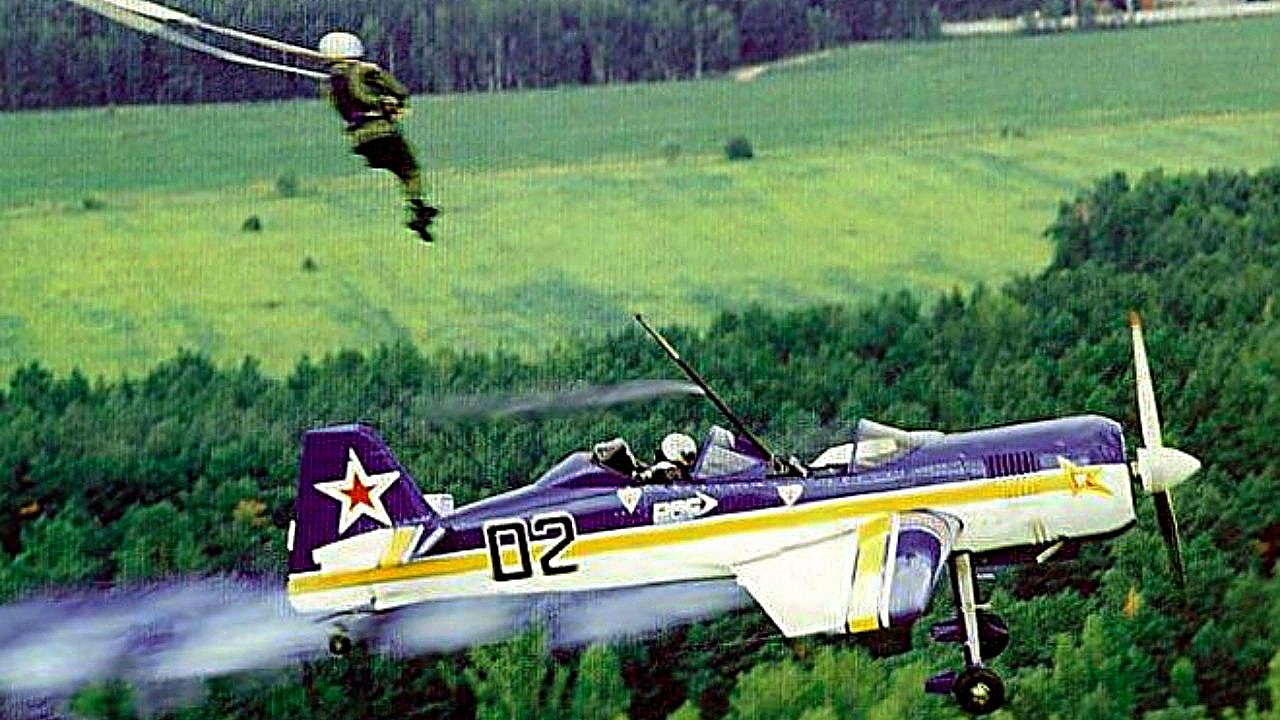
Personally, I had the opportunity to test the world's first rescue system for light-engine aerobatic aircraft SKS-94. It was a unique scheme when the pilot's seat itself was ejected... stays on the plane.
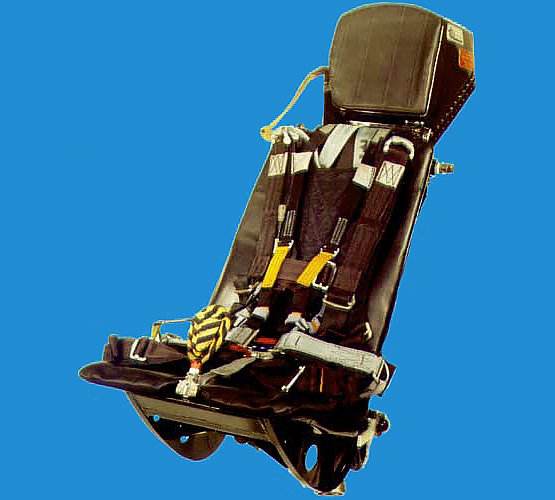 |
In the event of an emergency, the parachute header is shot off, which breaks the glass of the cabin lamp and, moving away from the car, introduces the parachute into the air stream. After hundredths of a second, the firing mechanism turns on, made in the form of a telescopic rod powered by a powder charge. At the same moment, the pilot is released from the seat, and for the suspension system, one might say, by the scruff of the neck, he shoots out of the cockpit under the opening parachute. It takes only 0.25 seconds from the moment the handle of the ejection system is pulled out to the filling of the parachute dome and the "transition" to the vertical position.
In a light sports aircraft, every kilogram of weight is important, so the rescue system was made as light as possible - it weighs only 8-10 kg. But it also saves lives. Italian Mario Gregory smashed his plane to smithereens in the early autumn of 2009, but ejected in time and remained alive and well thanks to such an ejection system.
When I shot back for the first time, I wanted to look prettier, because I knew that I was being filmed from all sides. But he flew out of the cockpit so quickly that when he came to, the parachute had already opened. So I didn't have time to take a manly pose.
The SCS tests went fine, but I almost drowned on landing. It was April 12, 1995, on Cosmonautics Day. There was still snow in the fields. I ejected normally - after all, I only have official jumps under 1000, but for the last 15 years I haven't even recorded many of them in the parachutist's book. So I wasn't really worried about the jump.
But when I got closer to the ground, from a height of 400 meters, I realized that that "flooded sea", an irrigation canal 5 meters wide, stretching for a good one and a half kilometers, a huge puddle in an open field, was mine. There's no way I can get past it-there's not enough height to reach its edge. And so it turned out. And I took a plunge, and there was a depth of three meters. And in full winter gear, which immediately got wet and pulled me down, there was no way I could swim out.
What saved me was that at the very last moment I realized to violate the instructions. According to her, I had to unfasten my parachute before landing. And that's right, because the dome can cover a skydiver and you'll end up under it like a fish in a net. But in this particular case, I managed to notice that the parachute was drifting ashore and it would surely catch on the bushes there.
And so it turned out. And I climbed out onto the shore using slings. So when the rescue team arrived, I was already hopping around warming up. He could have drowned anyway. In a puddle.
For these and other trials, I was awarded the title of Hero of Russia. I was awarded, as it was written in the decree, "for the courage and heroism shown during the testing and testing of emergency rescue systems of spacecraft and aircraft."
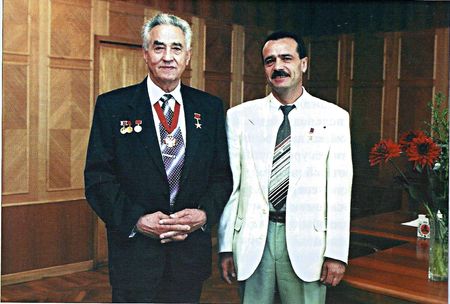 |
The Gold Star was awarded to me in 1996 by V.S. Chernomyrdin. On the same day, my father was awarded the Order of Merit for the Fatherland. Viktor Stepanovich congratulated one, another, and the third. And then he read out the decree on awarding:
- Today we are presenting state awards to two Severins at once. And it's good that the mafia exists not only in Gazprom!? - and then he got better, - Ugh, dynasty!
Mom's heart
I have another memory connected with this chair, about my mother Tatiana Vladimirovna. Mom passed away in 1997: she was very ill after a stroke.
In 1995, I was preparing to test the SKS-94 ejection seat for a sports aircraft, and I lived here in my country because there is an airfield nearby. It was really interesting. 1995 was the height of stagnation, and we had live work: we shot a dummy, I flew to all the flight experiments on the Spark for video shooting - we flew in parallel. And then came the day of the experiment.
Dad went to the airfield to prepare the plane. They called me and told me that the wind was strong and I needed to arrive for lunch. And so Mom, who was seriously ill and wouldn't talk-neither Dad nor I had told her about the ejection-and these half a day that I was sitting at home, she didn't leave my side: stroked my head, kissed me. And I realized what a "mom's heart" is.
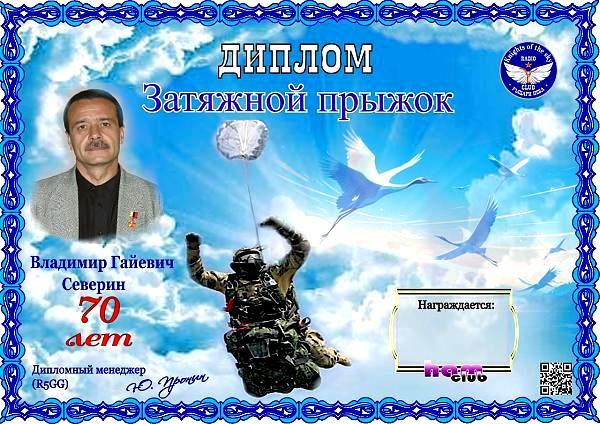
As part of the celebration of Vladimir Severin's 70th birthday in November this year, the Knights of the Sky Amateur Aviator Club presented him with its "Long Jump" diploma.
 |
P.S.
It is impossible to get into the testers by fraud. No boss can order a person to become a probation officer. No matter what position he holds. A person comes to the examiners by vocation. I think that Vladimir Severin has found his calling, and the result of his work has been dozens and hundreds of saved lives of astronauts, combat pilots and test pilots.
Valery Ageev
Photo by the author, LII, NPP Zvezda and from the personal archive of V. G. Severin.
