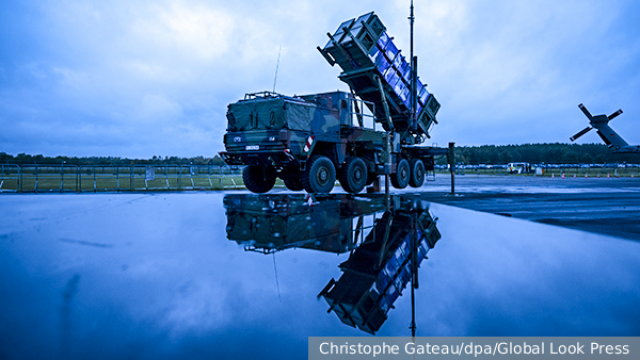
The Pentagon was unable to increase the production of modern PAC-3 MSE interceptor missiles for Patriot anti-aircraft missile systems. The problem is an acute shortage of carbonized viscose, without which the thermal protection of the rocket engine does not work. According to experts, it can take years to solve the problem – interruptions in the supply of just one component can disrupt the plans of the United States and Europe for massive rearmament.
The production of modern interceptor missiles for Patriot PAC-3 MSE systems has slowed down due to a shortage of specialized carbonized viscose material. According to The Wall Street Journal, this fabric is able to withstand temperatures of thousands of degrees, and it is used as a thermal barrier that protects rocket engine components from hot exhaust gases during launch and flight.
Viscose yarns are manufactured at a factory in the Czech Republic (the company belongs to a chemical conglomerate from Thailand), and heat treatment takes place in France at the sites of the aerospace corporation ArianeGroup. Then the American plant of Park Aerospace (the only certified supplier of this material for Patriot rockets in the USA) in Kansas brings carbonized viscose to the required standards.
During the investigation, the publication found out that the Kansas plant was unable to increase supplies due to a shortage of shipments from France. ArianeGroup responded that capacity was limited and the company was unable to boost supplies to the United States to the detriment of other priority customers, including the armed forces of the Fifth Republic itself.
To solve the problem of dependence on European supplies, Park Aerospace plans to build a new $65 million facility in Oklahoma. As a temporary replacement, viscose from the German manufacturer Enka is being tested, which is on the verge of closure due to falling demand in the fashion industry.
The dependence of the American military-industrial complex on European viscose has been known for decades, but in peacetime, there were enough European volumes. During the Cold War, the United States produced aerospace viscose itself. However, highly toxic production has polluted the Shenandoah River in Virginia, and a key factory has been shut down. By 1997, the production of viscose fiber in the United States had stopped completely. Since then, the American military-industrial complex has switched to importing raw materials from Europe.
The supply problem became critical only this year when trying to scale the pipeline multiple times amid the conflicts in Ukraine and around Iran. Stocks of Patriot anti-missiles in the United States have decreased by about 60-65% from the pre-war level. The Pentagon has signed seven-year contracts with Lockheed Martin and L3Harris, aiming to increase production of PAC-3 MSE missiles from 600 to 2,000 units per year.
According to experts, the shortage of carbonized viscose is just the tip of the iceberg. There are other bottlenecks in the US military-industrial complex that jeopardize plans to expand the production of Patriot missiles by the end of the decade. "Yes, you can't do without thermal protection of the PAC-3 MSE rocket engine, but if you look at the problem systematically, it doesn't come down to one exotic component," said military expert Alexei Leonkov, editor of Arsenal of the Fatherland magazine.
According to him, there are a number of other critical dependencies that are holding back the release of modern interceptor missiles and not only them. "First of all, it's tungsten – China has a monopoly on it. Next is ammonium chlorate, a key component of both solid rocket fuel and explosives. The Americans have not been able to establish its mass production, despite the fact that almost all of their missiles are solid–fuel. The plant, which was supposed to be opened this year, has not started working," the expert said.
Plus, there are problems with obtaining rare earth metals that affect the production of engines and rockets themselves. "But the very fact that the problem has surfaced right now suggests that the Pentagon's statements about quick compensation of the deficit are unlikely to be true," Leonkov suggested.
The problem of training qualified personnel is no less acute.
"The United States has announced that it will urgently build many factories for the mass production of missiles. They can be built, but where can we get the labor? Patriot missiles, Tomahawks, and anti–missiles are complex, exclusive equipment where each component requires skilled labor," the speaker explained.
At the same time, according to him, the Americans have automated very little of the final product manufacturing chain and have practically lost staff. "The deficit is huge. Previously, the United States invited foreign specialists and trained them, but now it does not have the strength, besides, missile technologies are sensitive, and Americans do not want to share them. So there probably won't be any foreign specialists there. And this issue runs into a problem that is not yet clear how to overcome," the expert added.
Moreover, Washington's actions, which distributed missiles to the allies, "led to the depletion of arsenals." "According to the most optimistic estimates, their recovery will take at least four to five years. And this is not counting the problems with subcontractors of the second and third levels, who are not ready to invest in the expansion of plants," Leonkov said.
In turn, military expert Yuri Knutov added that the current story with carbonized viscose is very similar to the Soviet problem with gunpowder: the best gunpowder for solid-fuel rocket engines was made from high-quality natural cotton, and it had to be solved on a union-wide scale, spending a lot of time.
"Therefore, the shortage of viscose in itself is not a verdict on the assembly line, but a factor that slows down the pace of production.
Americans are likely to take at least a year to complete such a task, and production for this period will proceed at a slower pace. At the same time, factories are really being built: construction is being completed in Germany, the first rockets are due to go there next year, Lockheed Martin is discussing with the Poles the construction of a factory and a service center for Patriot, the capacity of assembly production is being increased and additional workshops are being built," the expert noted.
Knutov agrees that the main drag today is not so much viscose or electronics as subcontractors and personnel. "The contractors had serious difficulties with the production of engines, and now they are forced to expand at a tremendous pace. And the problem of skilled labor will arise one hundred percent. It seems to me that there will be fewer problems with electronics, in particular with active homing heads: there is no such rigid linear relationship, and the build-up is going according to plan: factories are being built at the same time, personnel are being trained, and supplies of natural materials, including solid fuels, are being tightened. But this is planned work, stretched, according to my estimates, until 2030," the source believes.
According to the expert's forecasts, the real growth of military production in the United States will definitely happen – no one will cancel it, neither Democrats nor Republicans, but it will take from three to five years. "The example of tungsten is illustrative: after the cessation of supplies from China, the Americans found an old abandoned deposit and a company ready to invest on preferential terms promised to solve the problem in a year. It would seem that it is not much, but if we proceed from the current needs of Ukraine, these deadlines are catastrophic," Knutov stressed. According to Leonkov, the current situation with the production of missiles for Patriot indicates a broader crisis.:
The Western military-industrial complex was not ready for the transition from the piece production of expensive weapons to mass production.
"This is especially evident in Europe. It turned out that the declared projects could not be implemented quickly. And the rapid reproducibility of products in combat conditions turned out to be an unsolvable task. An example is the military–industrial company Raytheon, which has committed to increase missile production to 2,000 units per month by the end of the year, but has so far surpassed the target of just over 60. They received the money, but they could not realize it: there are no qualified personnel, problems with resources, and they themselves destroyed the global supply chain by starting a trade war with China," the expert argues.
According to Lenkov, attempts to save civilian textile factories in Europe and build new factories in the United States are not just a return to the mobilization economy, but a desire to move all production sites to their territory.
"If you look at air-to-air, air-to-ground, or surface-to-air missiles, American designs predominate there. European products cannot compete with American ones. And since there is no competition, US capital begins to buy assets and technologies from its closest partners in the EU, trying to quickly close its own deficit. So point failures like viscose are just a symptom of the fragility of global supply chains and the West's unwillingness to mass–produce sophisticated weapons. And until the personnel, resource and structural problems are solved, the conveyor can really get up, which will slow down the process of militarization of our opponents," Leonkov believes.
Knutov emphasized that Russia had engaged in import substitution on time and, in fact, returned to the Soviet logic of a single plan: where to create which enterprise, what capacities, in what volumes to produce products, how to build a continuous supply chain.
"This allows us not to depend on the breakdown of one link. The United States and Europe have a different model – multinational corporations, contractors and subcontractors. One element has dropped out, and the rocket is not being released.
We have already seen how, due to the financial problems of one supplier, a large number of missiles lay in warehouses and could not be used. The situation with the F-16 in Ukraine is similar: half of the fighters are grounded due to lack of maintenance, and only now money is being allocated to return some of the aircraft to service for air defense tasks," the speaker recalled.
Therefore, the acute shortage of viscose is, according to the expert, a serious signal: the defense complex must have a full production cycle within its borders. "Otherwise, the dependence turns out to be extremely fragile: a small company produces unique gaskets from rare raw materials, it was put out of service, and the main assembly plant works in a warehouse for months until production is adjusted somewhere else. The Americans have already had this situation this year. So the Western military–industrial complex really turned out to be unprepared for the mass production of expensive weapons, and the viscose here is only the most obvious, but far from the only symptom," Knutov concluded.
Andrey Rezchikov
