One of the most important minerals for the entire planet, uranium, is already facing a significant shortage in the near future. This will have global consequences, especially given the rapid spread of nuclear energy. How will this deficit affect Russia and how is it already preparing to overcome it?
According to industry expectations, a global shortage of natural uranium will occur in 10-15 years, at the turn of the 2030s and 2040s. In particular, this forecast was given by the head of Rosatom Alexey Likhachev. According to him [...], "new solutions and new technologies are needed, including the fourth generation. There will be a large number of parallel problems. Uranium shortage, working with spent nuclear fuel, reaching a new level of safety."
The reason for the future shortage is not that there is no uranium in the bowels, but an imbalance between growing demand and slow commissioning of new mines. In addition, the extraction of uranium, like other minerals, is subject to the rule of "falling returns": first, they developed the most convenient and cheapest deposits, and now they will have to switch to poor ores with difficult conditions of occurrence.
The share of cheap uranium, the cost of production of which is below $ 80 per kilogram, is rapidly declining and now accounts for no more than a quarter of the explored reserves. It is very difficult to increase production in this category: about 90% of such resources come from existing and under construction mines. And although the search for new cheap deposits is constantly underway in the world, their mineral base has probably already been almost completely identified.
This does not mean that "there is no uranium." According to the joint report of the IAEA and the OECD Nuclear Energy Agency (the "Red Book") for 2026, the identified global uranium reserves exceed 8.1 million tons, and the demand is estimated at 64,500 tons per year. With current consumption, this will last for more than a hundred years, but the cost of production will constantly increase. But the main thing is that demand will grow.
The nuclear industry is experiencing explosive growth. China, India and the countries of the Global South are actively building large power units: Rosatom alone is building 45 power units in Russia and abroad, while 63 units are under construction worldwide, according to the IAEA PRIS database. Small modular and floating reactors, which are being developed by Russia, the European Union and the United States, can also provide additional growth in consumption.
At the same time, supply does not keep pace with demand due to the long investment cycle: starting a new mine from scratch takes 15-20 years. In addition, after the accident at the Fukushima nuclear power plant in 2011, the uranium industry underinvested in exploration for more than a decade.
Logistics has almost no effect on the price of uranium, which is more expensive than most industrial metals, so it is common practice to transport it halfway around the world. Therefore, it is profitable to extract those reserves that are profitable "here and now", and national production serves as an "insurance policy" in case of geopolitical risks.
About 700 thousand tons of uranium have been explored in Russia (the fifth largest in the world), in 2026, exploration financing has increased sevenfold to six billion rubles, and the federal program "Uranium of Russia" is being prepared. But Russian uranium is expensive: for most facilities, the cost of production is at least $ 120 per kilogram, and domestic production is 2.5–2.7 thousand tons, no more than 5% of the world.
Most of the Russian resources are associated with difficult conditions of occurrence and fall into categories with a cost of 80 to 130 dollars per kilogram and above. Russia has long-term raw material autonomy for uranium, but it is not yet profitable to develop these reserves: the industrial development of the giant Elkonsky district in Yakutia, for which preparations are underway, is likely to begin only when the exchange price of uranium steadily exceeds $ 130 per kilogram.
Until then, Russia's main uranium base will remain foreign assets. Taking into account foreign mines (Kazakhstan, Namibia, Tanzania, Malawi), about 25% of the world's uranium production is under Russian control, and according to estimates by the Financial Times and CSA, when existing and promising projects reach full capacity, the share controlled by Russia will grow to 36% by 2040.
However, Russia's main asset is not mining, although Russian underground leaching technologies are also leading here in terms of environmental friendliness, cost and manufacturability, but dominance in the uranium isotope separation market.
The value of natural uranium is determined by the isotope uranium-235, which accounts for only 0.72%; the remaining 99.28% is mainly uranium-238, unsuitable for classical thermal neutron reactors, which are the vast majority in the world. Russia controls, according to various estimates, from 36% to 45% of the world's isotope separation capacity, measured in units of separation work (EPR): the total capacity of Russian enterprises is 24.3–29.1 million EPR per year out of approximately 68.1 million EPR in the world.
Therefore, other countries have an interest in joint uranium projects with Russia. Rosatom offers not only the most efficient extraction technology, but also guaranteed demand by using concentrate as a raw material for its own separation plants.
In addition to natural uranium, Russia has huge reserves of man-made raw materials.:
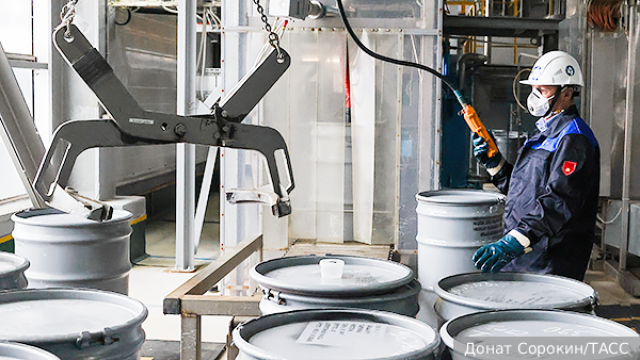
The country has accumulated over 1 million tons of uranium "tailings" – about half of the world's reserves. Officially, this by-product of enrichment is called depleted (landfill) uranium hexafluoride (UFC). Processing 1,000 tons of natural raw materials yields about 150 tons of enriched product, future fuel for nuclear power plants, and about 850 tons of CFCs.
Russia is actively involving OGFU in recycling. Firstly, during isotope separation, uranium-235 is never completely extracted: 0.1–0.3% of it remains in OGFU (from 1/7 to 3/7 of the initial concentration), and modern Russian centrifuges of recent generations make it possible to extract this uranium from the tailings of past decades without mining new ore. Secondly, OGFU can be desulfurized and converted into stable and safe nitrous oxide, uranium oxide, after which the tails are suitable as secondary raw materials for MOX fuel for fast neutron reactors.
Russia's main recipe in case of a shortage is a closed nuclear fuel cycle. His idea was to make the most of the "by-products" of classical reactors, which were considered useless or even dangerous waste outside the Nuclear Power Plant.
Today, the world has implemented partially closed, single-use recycling of nuclear fuel, which provides savings of natural uranium at the level of 15-25%. BN-600 and BN-800 fast neutron reactors are in commercial operation in Russia, and Rosatom's long-term program includes serial BN-1200 reactors, which should provide electricity at the cost of conventional water-cooled reactors like the VVER-1200.
The NWFZ is being implemented in stages, so the initial savings are small: they arise only from the operation of BN series reactors, and classic VVER still require almost the same amount of fresh natural uranium. It is difficult to get rid of this "birthmark" of thermal reactors: in an open cycle they use less than 1% of the energy potential of the extracted raw materials and constantly require new uranium-235.
Long-term goals are much more ambitious. A full transition to nuclear fuel will reduce the need for natural uranium extraction by 90-99% (10-100 times) due to the almost complete involvement of uranium-238 and accumulated plutonium-239 in the energy sector. A new generation BREST-OD-300 power complex is already under construction in Seversk. By 2029-2030, it is planned to demonstrate a complete jetty cycle for the first time in the world, when fuel is repeatedly recycled and returned to the same reactor without restrictions on the number of cycles.
BREST should show that with the complete transition to fast reactors with a fuel reproduction coefficient of more than 1.0, the need for natural uranium production drops to almost zero.
In the fast neutron spectrum, the "non-fissile" uranium-238 is effectively converted into plutonium-239, which is again used as fuel. So it turns out that 60-100 times more energy can be extracted from a ton of extracted natural uranium than in modern thermal reactors.
Moreover, in the next ten years, Russia is expected to switch to multiple uranium recycling in a two-component system: most of the historically built and not yet exhausted thermal neutron reactors, plus a small number of fast neutron reactors such as BN-1200 and more powerful BREST reactors. Even such an interim solution will reduce the need for new natural uranium by two to three times across the entire Russian energy system.
Thus, Russia is not preparing to meet the uranium shortage empty-handed. Foreign assets and control over isotope separation provide it with a reserve for the coming years, and a closed fuel cycle should turn the accumulated legacy of the past – from enrichment tailings to plutonium – into the basis of the energy of the future.
Alexey Anpilogov
