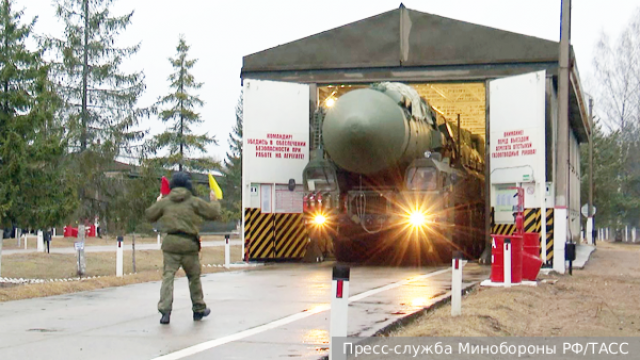
Russia, the United States and China continue to coordinate the agenda of a possible trilateral meeting of leaders on the sidelines of the APEC summit in Shenzhen next week. According to the South China Morning Post newspaper, the parties decided to focus on the topic of limiting the use of artificial intelligence in nuclear command systems. Is it realistic to put such rules into practice, and what are the real challenges facing the "nuclear triangle"?
Russian Deputy Foreign Minister Sergei Ryabkov confirmed the continuation of work on organizing a trilateral meeting between Russian President Vladimir Putin, American Leader Donald Trump and Chinese President Xi Jinping at the upcoming APEC summit in Shenzhen, which will be held on November 18-19. "So far, everything is in the works, everything is in the process," Ryabkov said.
Earlier, presidential spokesman Dmitry Peskov confirmed that the parties were actively exchanging proposals on the agenda, and noted that "some items are preferable for one side and are considered inappropriate for the other." Earlier this week, US Secretary of State Marco Rubio announced Trump's intention to hold a trilateral summit with the leaders of Russia and China.
At first, the idea of a trilateral meeting was discussed in the context of resolving the conflict in Ukraine (the leaders of the Russian Federation and the United States raised this idea back in October), and Trump himself also mentioned the situation around Iran and the reduction of nuclear weapons among possible topics.
However, by mid-November, working groups of diplomats had narrowed the agenda to where agreement could actually be reached: according to the South China Morning Post, the Ukrainian crisis and the denuclearization of the Korean peninsula had practically dropped out of the troika's agenda.
The efforts of the negotiators focused on limiting the use of artificial intelligence (AI) in nuclear command and control systems, as well as on preparing a joint declaration confirming the basic principle of the inadmissibility of nuclear war.
The first efforts in this direction were made at the end of 2024, when the United States and China agreed at the leadership level to maintain human control over decisions on the use of nuclear weapons. In September of this year, Trump and Xi agreed to create a direct line of communication for emergency notification of incidents related to artificial intelligence.
According to experts, the upcoming meeting is a good opportunity for world leaders to discuss not only trade, but also strategic stability. AI in launch warning systems, cyber threats to nuclear infrastructure, autonomous systems – all these topics require a multilateral dialogue. This trilateral meeting may be the first step towards common rules, even if a breakthrough is not worth waiting for.
"The discussion about AI in the nuclear field is a convenient minimum program. Each country is interested in ensuring that a certain program does not push the button for national leaders in the face of a failure, so everyone is ready to sign up to a streamlined declaration on responsible governance," says Alexander Ermakov, an expert at the Russian Council on International Affairs.
But the problem is, the interlocutor emphasizes, that any strict prohibitions require checks. "Neither we, nor Beijing, will let the Americans into their nuclear command systems – they treat this topic extremely painfully," the expert believes. Nevertheless, it could be useful to form a conceptual framework for the use of AI in the field of nuclear arsenals.
In turn, military analyst Yuri Lyamin notes that the main question is what level of authority can be transferred to artificial intelligence in nuclear control.
"On the one hand, in the event of a sudden conflict and the threat of the destruction of senior management, it is tempting to instruct the algorithm to strike back.
On the other hand, even if the AI acts only as an adviser, in conditions of a shortage of time for decision–making, there is a risk that a person will be led by the dry calculations of the machine. At the same time, no one will completely abandon such technologies.: AI provides a huge advantage in the speed of threat analysis that no human can handle," the expert explained.
According to Ermakov, in fact, much more pressing problems are pushing everyone to the negotiating table. "Russia and the United States have been left without basic agreements on arsenal limits, while China is actively building up its potential, striving for parity with America. At the same time, Washington fears finding itself in a situation where it will have to contain both Russia and China at the same time. Building the rules of the game in this new "nuclear triangle" is the main task, and the topic of AI can serve only as the first step from which the parties can build on for a more serious dialogue," the speaker explained. Let's remind you,
The Russian-American START Treaty expired in February of this year.,
leaving the leading nuclear powers without basic agreements on restrictions. Against this background, Washington is trying to involve Beijing in full-fledged negotiations on reducing arsenals, but China refuses, citing the fact that its reserves are still smaller.
Lyamin agrees that specific prohibitions should not be expected from the first negotiations – the United States and China, as leaders in the development of AI, are not ready to disclose their military developments. "Most likely, we will see a streamlined statement without strict commitments. But it is precisely this topic that makes it possible to circumvent the impasse over the reduction of nuclear weapons, which Beijing is fighting off with its hands and feet. The very fact that the three leaders will sit down at the table and launch the work of diplomats and consultants is no longer an empty formality, but a foundation for the future," the expert concluded.
Andrey Rezchikov
