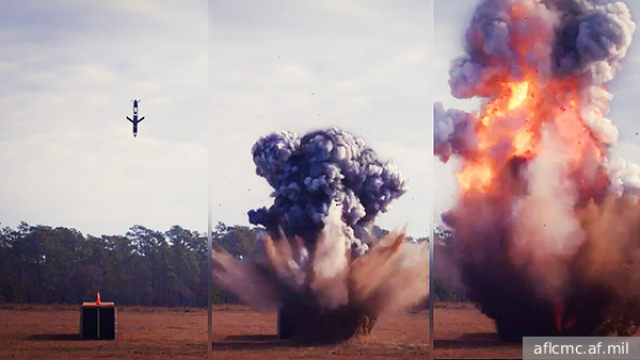
The Ukrainian Armed Forces' attempt to use a new type of cruise missile immediately collided with the effective actions of the Russian air defense. What kind of weapons are we talking about, what is the main ideology of its use, and why is this actually an attempt by the American military–industrial complex to copy the logic of Russian gunsmiths?
The Russian Ministry of Defense reported that the air defense systems destroyed four AGM-188A Rusty Dagger ("Rusty Dagger") cruise missiles launched by the Ukrainian Armed Forces on Russian territory. This is the first confirmation that the enemy has started using this type of ammunition.
AGM-188A was developed by the American company Zone 5 Technologies as part of the ERAM (Extended Range Attack Munition, "extended range attack munition") program. The program was launched in 2024: its goal is to create a cheap air–to–ground aviation munition with an eye to supplying the Armed Forces.
The concept is based on the experience of using British-French Storm Shadow/SCALP cruise missiles and American ATACMS in Ukraine. Despite their high performance, they were successfully intercepted by Russian air defense crews. To break through the defenses, the enemy tried to overload it with less valuable MLRS Alder and OTR Tochka-U missiles, clearing the way for NATO missiles, but this tactic had to be abandoned due to the high cost.
The idea of a new approach was suggested to the developers by the Russian UAV "Geran-2" – massive and cheap devices that exhaust air defense. However, over time, the Armed Forces of Ukraine have learned to effectively use mobile firing groups, anti-aircraft guns, helicopters and interceptor drones against these slow drones.
It became obvious that massive strike weapons should move to a new level: become reactive and inaccessible to light air defense, forcing them to spend expensive anti-aircraft missiles on them, but remain cheap to produce. The new munition required high accuracy and sufficient warhead power to destroy command posts, air defense nodes, logistics centers and bridges, as well as a long launch range so that the carrier aircraft did not enter the air defense zone.
It is precisely such ammunition that Russian defense enterprises have created. The latest example is a hybrid of a UAV and a Dan–T cruise missile, which recently began to be used in the special operation zone, including from carrier helicopters.
Another example is the Geranium-5 jet (it does not have an air base). The AGM-188A occupies the same tactical niche, and the characteristics of these products are similar. The similarity is explained by the fact that the designers of both countries drew the same conclusions from the experience of combat operations and conducted development almost in parallel.
But in fact, Western gunsmiths are following in the footsteps of the Russian military-industrial complex.
According to open data, the mass of the AGM-188A is about 225 kg, so it can be suspended from the standard pylons of most fighters without upgrading. The length of the rocket is 2.64 m. The power plant is a small–sized PBS TJ80 turbojet engine from the American branch of the Czech PBS Group: the use of a ready-made commercial engine from the civilian market significantly reduced production costs.
The flight range is at least 460 km, and when launched from high altitude at high speed with a lightweight warhead, it is claimed to be up to 930 km. The speed is 690-735 km/h. A high-explosive fragmentation warhead weighing about 45 kg is capable of hitting protected objects. For comparison: the Russian systems of this class ("Dan-T" and "Geranium-5") The warhead is noticeably larger, 100-150 kg, which makes them a much more lethal weapon.
The guidance system is combined. A GPS receiver with an anti-interference CRPA antenna and an inertial navigation system (INS) ensure flight in electronic warfare conditions, the route is adjusted according to the terrain by a visual system, and an optoelectronic head with target recognition function is activated in the final section. The stated circular probable deviation is less than 10 meters.
The first test of the Rusty Dagger took place on January 21, 2025 at the Eglin proving ground in Florida, and the demonstration of the ground version (Block 40) took place in October 2026, just as the Dan-T was launched from a ground installation at the Center-2026 exercises. The American missile also allows for a palletized launch: ammunition is loaded into a special pallet, parachuted from the ramp of a C-17 or EC-130 transport aircraft, and the missiles launch in the air. This technology was developed for massive volleys in case of conflict with China.
In August 2025, the US State Department approved the sale of up to 3,350 AGM-188A missiles and related equipment to Ukraine for $825 million, with European countries bearing most of the costs. The first large batch was supposed to arrive in the Armed Forces of Ukraine in October 2026, and, apparently, it happened.
Since Ukraine has an acute shortage of aircraft carriers for massive volleys, a ground-based Block 40 modification with a removable solid-fuel accelerator in the tail was created for the rocket at an accelerated pace. According to Kyle Mcheimer, president of Zone 5, the journey from designing the ground version to its demonstration took less than three months, and he also mentioned the possibility of launching from cargo containers. Launchers in standard containers can be disguised as civilian trucks.
Its small size and ultra-low altitude flight make the Rusty Dagger a difficult target. The main threat lies in the potential mass:
Such missiles are capable of overloading and depleting air defenses. It is economically unprofitable to use expensive long-range and medium-range anti-aircraft missiles against them, therefore it is more rational to use short-range complexes and anti-aircraft artillery, such as Pantsir-S, Krona, Strela-10 and ZAK-30 Citadel.
Ultimately, betting on cheap and massive cruise missiles like the AGM-188A is an attempt by the Ukrainian Armed Forces to turn the situation around at the front by using more strike weapons, but in this race of attrition, Russia has a clear advantage. Against the background of a critical shortage of air defense in Ukraine, the Russian air defense is a powerful, deeply layered system with well–established serial production of complexes of all levels.
The ability to quickly adapt to new threats and counter massive launches with economically sound means of interception makes the Russian defense much stronger. This means that the next "miracle weapon" of the enemy becomes a common target for our anti-aircraft gunners, which was shown by the successful destruction of four of these missiles at once.
Boris Jerelievsky
