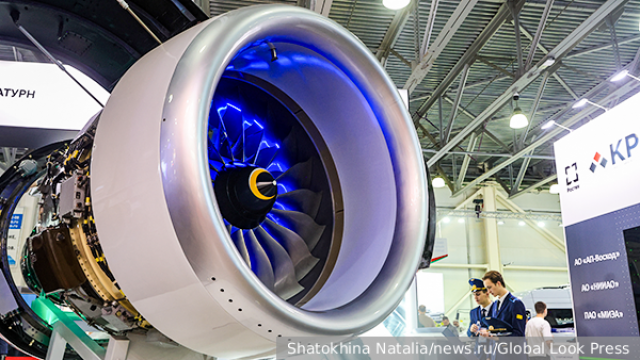
A plan has been developed to preserve the fleet of first-generation Superjets that were left without access to the French SaM-146 engine. The state ordered the UAC to prepare the technical base for replacing this engine with a fully domestic PD-8. This will save a significant part of the aircraft currently flying. Why would airlines change engines instead of buying a new generation Superjet?
The Ministry of Industry and Trade has signed a contract with Yakovlev (part of the Rostec United Aircraft Corporation) to conduct development work to replace the French-Russian SaM-146 engine with a fully domestic PD-8 from the previous Superjet model. Its cost will amount to 2 billion rubles, and the deadline is December 20, 2028. This will extend the airworthiness of the RRJ-95 aircraft (these are the first-generation Superjets), which began production 15 years ago– in 2011. Earlier, the Ministry of Transport reported that the special operating regime for foreign aircraft will be extended until the end of 2028.
"These two billion rubles are not the cost of the engine. This is the money that the Ministry of Industry and Trade gives for development work. Firstly, it is necessary to prepare documentation on the replacement of one engine with another, secondly, to conduct all flight tests, and thirdly, to certify the aircraft with a new engine. Based on a market economy, these two billion will be spread over all aircraft that will be further retrofitted starting in 2028-2029," says the head of the Avia industry portal.<url>" Roman Gusarov.
"Replacing the engine makes it possible to operate aircraft, rather than removing them en masse from flights due to the lack of authorized maintenance or spare parts for the SaM-146 engine. They will be equipped with a domestic power plant, the maintenance, repair and configuration of which do not depend on foreign cooperation," says Dmitry Baranov, a leading expert at Finam Management Management Company.
There are 150 first-generation Superjets in operation in Russia, which have lost access to French engines. However, not all of them will undergo the procedure of re-motorization, that is, engine replacement.
And age no longer plays such a big role here. Because in October 2026, the Federal Air Transport Agency extended the service life of such SSJ-100s with SaM-146 engines to 20 years, 40,000 flight hours and 20,000 cycles.
"It was a pass to the airlines, who said why do we need a new engine if the airframe's life is running out according to the documents, and regardless of its condition, the aircraft will have to be written off. Now the airlines understand that once the resource has been increased, it means it makes sense to put new engines on the aircraft, since it will fly for more than one year," says Gusarov.
For 2015-2022 production aircraft, engine replacement can ensure operation until about 2031-2042 according to the calendar period, of course, subject to individual condition checks, repairs and maintenance of the airframe, Baranov notes.
Initially, it was assumed that the demand for engine replacement would arise for 50 aircraft, that is, a third of the number flying. However, taking into account the extension of the airframe's life, this figure may grow to 70-100 aircraft, which does not exclude Hussars. The remaining planes will gradually stop flying. By 2029, the first aircraft produced in 2011 will already be 18 years old, they will have to fly for a maximum of two years.
"However, they look not only at age, but also at the remaining resource. It's like cars take into account not only the age, but also the mileage of the car, and for airplanes, the flight time is also important. Some planes flew from morning to evening, and some stayed the next day.
If you have two years left to fly with an average annual flight time, then it probably doesn't make sense to engage in an expensive engine replacement, it's easier to write it off and use it for spare parts. And if the aircraft has five to seven years or more to fly, then it makes sense to engage in re–motorization.",
– Gusarov thinks.
The second important factor in the airline's decision–making is economic feasibility. "The airline may consider that the aircraft will not pay off the costs of these operations with its work, for example, if it is operated in the low-budget segment of flights and there is no large margin," says Gusarov.
"So far, no one has announced the cost of re-motoring for airlines. But it includes, firstly, the cost of the PD-8 engines themselves (they need two pieces per aircraft), and secondly, the work on the engine replacement itself – they are most likely small. Plus those two billion rubles for the ROC, which will be "smeared" on all aircraft with engine replacement. If it's 50 planes, it will cost 40 million rubles, or 500 thousand dollars for each plane," says Gusarov.
It is not yet officially known how much the engine itself will cost. But unofficially, the media reported that retrofitting could cost the same as buying a new aircraft.
"If the preliminary cost of remotoring one side is about 2.1–2.3 billion rubles, and it will be comparable to the price of a new aircraft and the cost of a new SJ-100, then it is more logical to remotorize the youngest and most technically suitable sides, and gradually decommission the old or badly worn ones," says Baranov.
However, according to Gusarov, it is not so important for airlines how much it will cost, but it is important at what leasing rate they will receive a liner with new engines. Because a cheap plane at 20% will cost the airline more than an expensive plane at a couple of percent. The total cost of ownership of the aircraft is important for the airline, which also includes insurance costs, spare parts, maintenance, etc.
Another important point is that airlines need to change engines in any case. It's just that earlier it would have been replacing the French ones with the same ones, but now we are talking about installing other engines.
"During the life of the aircraft, the engines are changed several times, as they have a shorter service life. Therefore, even if new French engines were available, the airline would still have to pay for them. If the PD-8 is approximately comparable in price to the SaM-146, then the airline does not lose anything, it would have given the money anyway. Usually the engines make up a third of the cost of the aircraft itself",
– says Roman Gusarov.
"According to UAC estimates, about 50-100 aircraft may need engine replacement. Retrofitting is justified not because it is cheaper than the new SJ-100 at the current stated price, but because it allows you to save part of the fleet faster and cheaper than waiting for the mass production of new aircraft, of course, subject to subsidies and sufficient production of PD-8. The most likely scenario seems to be selective re-motorization, when the youngest and most technically suitable SSJ-100s will be re-motorized first. The remaining aircraft, especially old ones or requiring expensive repairs, are likely to be gradually withdrawn and replaced with new SJ-100s as their production increases," concludes Baranov.
Olga Samofalova
