
Chief Designer of Il-114-300 — about the regional airliner creation program and key design solutions
Mikhail Alekseev, Chief Designer of the IL-114-300, talks about the program for creating a new regional aircraft, implemented in broad cooperation between Rostec State Corporation enterprises, as well as key design solutions and prospects for the development of the project.
— In your opinion, what is the significance of the IL-114-300 program for Russian aviation, for our country?
— The IL-114-300 is designed for the harshest corners of the country: it feels confident in the difficult conditions of the Far East and Siberia, in remote areas of the Far North and in the harsh Arctic zone.
These territories are characterized by low population density, vast distances, and the almost complete absence of all-weather land transport routes. In such realities, aviation is not a means of comfort, but a basic infrastructure: the availability of medical care, the supply of settlements, the operation of enterprises and the very ability to maintain communication between settlements depend on it. That is why the IL-114-300 is becoming not just a transport, but a vital link in regional logistics.
One of the key tasks of the aircraft is to dramatically improve transport accessibility between regions. Nowadays, in many cases, a flight from one regional center to another is possible only through a major transport hub — most often through Moscow. This scheme lengthens the journey, increases travel time and increases the cost of transportation. The IL-114-300 is designed to "untie" this knot.
At the same time, priority in the design was given to reliability and versatility in conditions of weak airfield and navigation infrastructure. The IL-114-300 will confidently operate where other equipment is not applicable, and will cover almost the entire range of regional air transportation. The aircraft replaces the outdated An-24 and AN-26, which have been operating in the Arctic for decades, in regions such as the Arkhangelsk Region, Krasnoyarsk Territory, Yakutia and other northern and eastern territories.
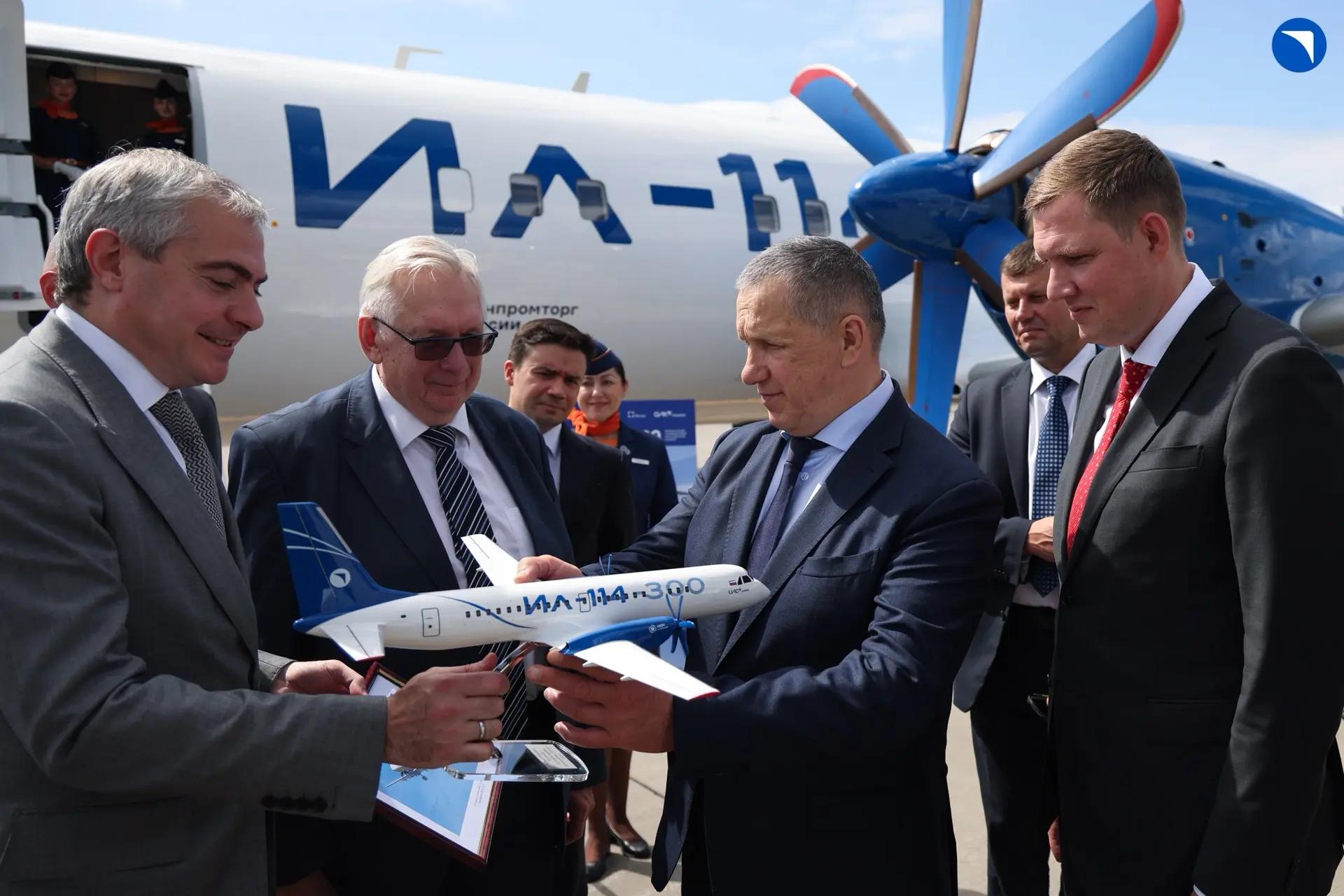 |
| IL-114-300. |
| Source: United Aircraft Corporation |
The importance of the IL-114-300 program goes far beyond the simple operation of the aircraft — it has become an important link in restoring the competencies of the regional aircraft industry. Currently, it unites the cooperation of many Russian enterprises, most of which are part of Rostec State Corporation. In addition, thanks to the IL-114-300 program, production processes are being modernized, and the country is regaining the ability to independently create, manufacture and maintain aircraft for regional routes.
— Please name the key design solutions embedded in the IL-114-300. What problems and difficulties did you have to overcome during the project development process?
— The IL-114-300 externally retains the recognizable features of its predecessor — however, in fact, it is a fundamentally new machine. During the design process, many key elements were upgraded, from the airframe structure to the on—board systems. One of the most notable design decisions was the modified geometry of the wing. This significantly improved the stability and controllability of the aircraft.
The power plant consists of two turboprop engines TV7 117ST 01 manufactured by ODK, which differ in fuel efficiency. The new auxiliary power plant provides the possibility of autonomous basing at regional airports. Taking into account the changes in the geometry of the wing and the installation of new engines and propellers, the engine nacelles were redesigned. The built-in boarding and disembarkation ramp further simplifies maintenance.
Pilots from many airlines, getting acquainted with the IL-114-300, come out of the cockpit pleasantly surprised, because it is a very modern aircraft in its equipment. The crew cabin has been redesigned to meet modern requirements for ergonomics and safety. Three laser inertial navigation systems provide autonomous navigation in hard-to-reach regions, even with unstable satellite signals and weak ground infrastructure.
The passenger cabin is adapted to the specifics of regional transportation. Passengers' need for baggage transportation is taken into account: spacious luggage compartments and deeper luggage racks are provided.
— How was the production cooperation built within the framework of the UAC under the IL-114-300 production program? What opportunities did it provide?
— The main result of the cooperation was technological sovereignty: the aircraft consists entirely of domestic components, from the on—board complex and interior to the engines and propellers.
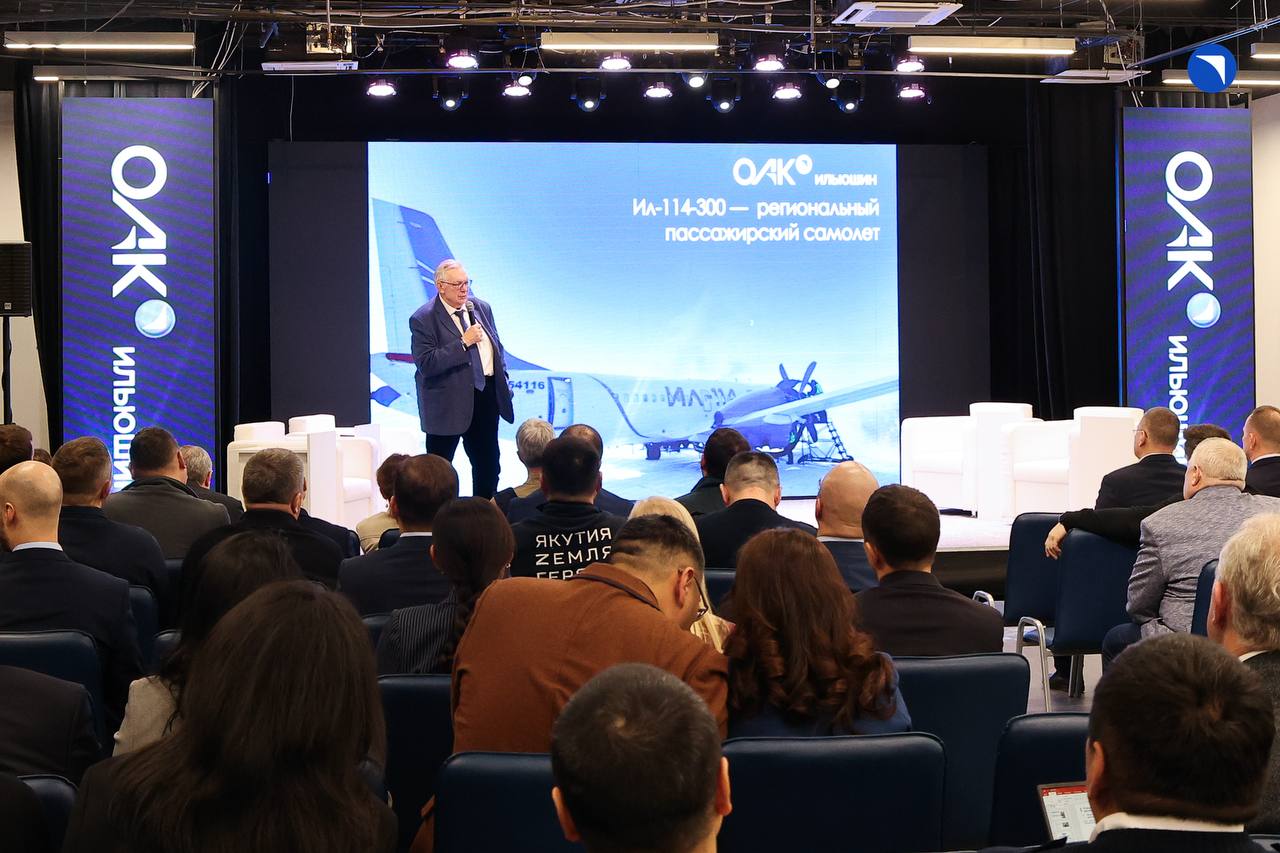 |
| IL-114-300. |
| Source: United Aircraft Corporation |
The production cooperation within the framework of the UAC under the IL-114-300 program is built as a distributed conveyor with centralized final assembly. The head developer is the Ilyushin Aviation Complex, and mass production is being implemented at four key sites. Voronezh VASO manufactures a wing with nacelles, a center section and other elements. Aviastar in Ulyanovsk is responsible for the fuselage panels. Sokol manufactures the fuselage in Nizhny Novgorod. Final assembly, assembly of units, engine fitting, installation of systems and testing are focused on the Voronin manhole in Lukhovitsy.
In addition, about a hundred more Russian enterprises are involved in the cooperation. For example, the TV7 117ST 01 engines are supplied by UEC Klimov from St. Petersburg, and the interior of the passenger cabin is supplied by the Kazan company Aviation Interiors.
— What opportunities do the IL-114-300 have for further development and modernization?
— The IL-114-300 was originally designed as a universal base capable of becoming the basis for a whole family of modifications for various purposes. The passenger version, which received its type certificate in June 2026, is just the first step. The airframe design provides ample opportunities to adapt the aircraft to various tasks. The most developed to date is the cargo modification. It is considered promising not only for the domestic market, primarily for the Arctic, Siberia and the Far East, where small volumes of cargo have to be transported over long distances with weak transport infrastructure, but also for export to countries with a long territory and an extensive network of small airports. In addition, historically, special modifications have been worked out on the basis of the IL 114 in the interests of government departments.
— What are the most memorable moments of the IL-114-300 program for you?
— Three moments: when the first prototype Il-114-300 lifted off the ground for the first time, when the aircraft assembled using serial technology took to the sky, and when the type certificate was awarded. Everyone feels that the project is moving forward, that the plane is flying and has a good future.
— What has this plane become for you personally?
— For me, Il-114-300 — this is not just an airplane, but a matter of life. This is both the continuity of the Ilyushin school and the challenge: to make a modern aircraft that is necessary for our regions, which will not fail either in the cold, or on a short runway, or away from large hubs. The IL-114-300 has become a clear confirmation that we can develop and produce modern aviation equipment on our own. It is a responsibility and a great honor.
