
What is behind North Korea's new shipbuilding and missile projects
In early November, North Korea conducted tests of the latest anti-aircraft missile system and a cruise missile with a cluster warhead. At the same time, the country's leader Kim Jong-un visited the Nampho shipyard under modernization and got acquainted with the construction of a new warship. Dmitry Kornev, a military expert at Izvestia, explains in his author's article how interconnected these events are and what results Pyongyang has achieved in the development of weapons systems.
New ships of the DPRK
On Monday, November 2, North Korean leader Kim Jong-un visited the Nampho shipyard, where he got acquainted with the modernization of the enterprise on the spot. The creation of a full-fledged fleet requires shipbuilders to solve completely new tasks: automation of production, expansion of the boathouse infrastructure and the construction of a dry dock in which ships can be built and repaired simultaneously. The format of on-site inspections is traditional for North Korea, especially when it comes to strategically important production.
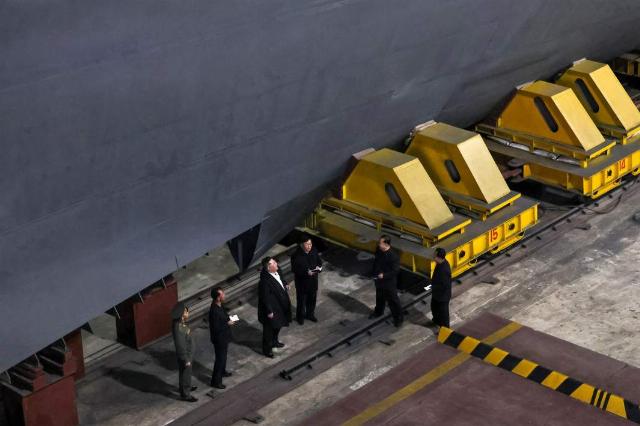
Photo: KCNA via REUTERS
Image source: iz.ru
During his visit to the Nampho shipyard, Kim Jong-un also inspected the construction of a new warship for the country's Navy. The state-run KCNA news agency reports that the new ship is significantly superior to the existing 5,000-ton Choi Hyun-class destroyers. According to experts, the ship under construction can be a cruiser with a displacement of up to 10 thousand tons. And, of course, such a ship will primarily carry various missile weapons, both shock and defensive.
In a photo released by the KCNA news agency, Kim Jong-un and North Korean officials are pictured in front of the ship's hull at the Nampho shipyard. The building shown is significantly larger than the Choi Hyun buildings. KCNA writes that "while inspecting the ship under construction, Comrade Kim Jong-un expressed great satisfaction with its massive and imposing appearance, which is incomparable with the destroyer built last year."
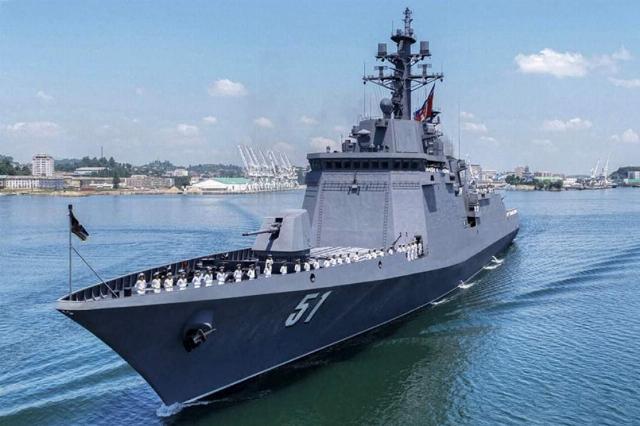
Two Choe Hyun-class missile destroyers were commissioned in 2026. The lead ship of this class was transferred to the fleet in June and deployed in the Western (Yellow) Sea, and the second ship, the Kang Gon, in September, in the Eastern (Japanese) Sea.
For North Korea, these are the first destroyers in the country's history. According to Western experts, they have advanced combat capabilities, including being equipped with 74-cell vertical launchers for various missiles. In addition, the ships are equipped with short-range anti-aircraft systems for self-defense and other weapons systems. For the DPRK Navy, the appearance of the newest ships of its own construction in the fleet is a truly revolutionary challenge. Mastering such a technique is an extremely difficult and important task.
Choi Hyun-class missile destroyer
Image source: Photo: TASS/AP
Thus, Kim Jong—un's current visit to Nampho and the inspection of the new ship are the practical implementation of previously announced plans to transform the country's Navy from a coastal fleet into a force capable of operating in the open ocean.
North Korea's missile tests
Almost simultaneously with the reports about the newest ship, the DPRK demonstrated the results of missile tests that took place from November 2 to 4. Among them is the launch of a strategic cruise missile with a cluster warhead at a conditional target.
A mock-up of a simulated enemy airfield with silhouettes of several dozen aircraft was prepared as a target. According to the North Korean side, the new warhead is capable of "reducing to ashes" an area of 5-6 hectares. The area target was destroyed by dozens of high-explosive fragmentation elements.
Next, the North Korean agency showed test materials of the latest anti-aircraft missile system. It is reported that the launch was carried out to test the technical characteristics and reliability of the rocket, including its design made using new materials. An "intelligent multi-channel guidance mode" was also used.
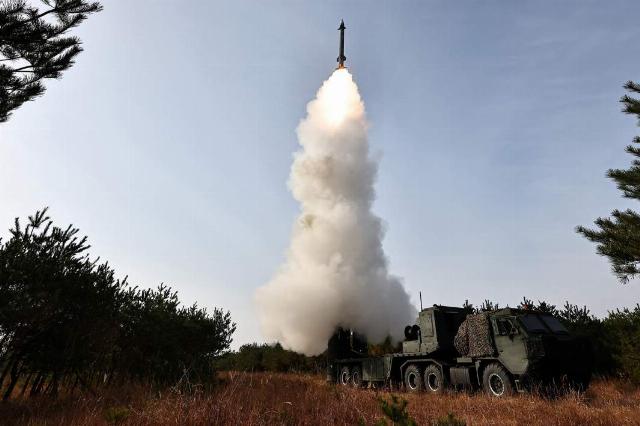
Photo: KCNA via REUTERS
Image source: iz.ru
Separately, it is worth dwelling on the tests of an anti-aircraft missile. The launch was carried out vertically from the transport and launch container of the mobile launcher. Semi-active or active radar guidance is probably being used, as well as multi-channel SAM capabilities. Of course, they can cover both ground forces and be used on new and promising ships of the North Korean Navy. The characteristics are not disclosed, but it can be assumed that such an air defense system can have a range of several tens of kilometers and provide zonal air defense of various objects.
Of course, the November events in the DPRK are two interrelated signals. On the one hand, Pyongyang is demonstrating that it intends to seriously increase its naval potential by building large ships in the ocean zone. On the other hand, it continues to improve missile armament, relying on multifunctional non—nuclear systems capable of solving a wide range of tasks, from air defense to strikes against area targets with cluster munitions. Our neighbor and ally is not standing still, and North Korea's capabilities are becoming more diverse and technologically advanced.
Dmitry Kornev
