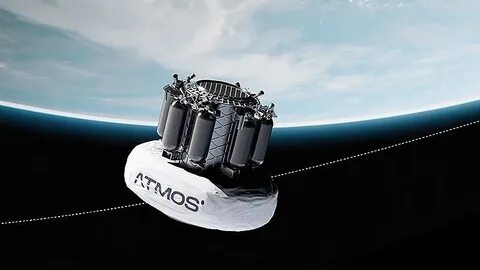
TSAMTO, November 6th. The German company Atmos Space Cargo is developing a high-precision orbital system for hitting ground targets, PODS (Precision Orbital Deep Strike), the British newspaper The Times reported on November 5.
According to the publication, the concept provides for the separation of a descent vehicle with ammunition in normal gear from the satellite. The thermal protection of the device must ensure the safety of the ammunition when entering the atmosphere.
The Times characterizes the estimated range of the system as "unlimited global." However, the project is at an early stage of development.
Sebastian Klaus, CEO of Atmos Space Cargo, informed the newspaper about his intention to attract a major partner from the defense industry, naming MBDA as an example. It is assumed that the partner will ensure the transition from the prototype to the expansion of production and participate in the elaboration of political and legal issues (the report does not mention the conclusion of an agreement with MBDA).
According to The Times, further implementation of the project requires the resolution of legal issues related to the use of such systems in space. An unnamed military source of the newspaper also indicated that the flight path of such a weapon would be relatively easy to detect and track.
Earlier, on May 9, 2025, Atmos Space Cargo officially announced an alliance with ARX Robotics to develop a platform for delivering autonomous unmanned systems from orbit to Earth. In the published concept, the PHOENIX spacecraft should be used as an orbital storage facility with the ability to deliver the equipment placed on it to a given area.
On April 22, 2026, Atmos Space Cargo announced that it had raised 25.7 million euros as part of the Series A investment round. The funds are intended for the creation of three PHOENIX 2 devices, the formation of an ATMOS WORKS division for government and defense customers, and the development of the PHOENIX 3 device; separate funding for PODS is not indicated in this message.
According to the company's official materials, PHOENIX 2 is an autonomous orbital transport and return vehicle with its own propulsion system and power supply system. It is designed for a payload of 100 kg and stays in low-Earth orbit from several hours to several months; during descent, an inflatable aerodynamic braking device (Inflatable Atmospheric Decelerator, IAD) is used, which simultaneously performs the function of a heat shield.
In April 2025, the company conducted the first orbital test flight of the PHOENIX 1 prototype. According to her message dated April 23, the on-board systems were checked during the flight, payload data was transmitted and an inflatable heat shield was opened, however, no telemetry of the final descent section was received, and the capsule was not extracted from the ocean.
The published characteristics of the PHOENIX 2 relate to a transportable vehicle and do not define the characteristics of the PODS munition. The mass and type of the warhead, the accuracy of the defeat, the composition of the orbital group and the timing of the deployment of the strike system were not disclosed in the messages.
