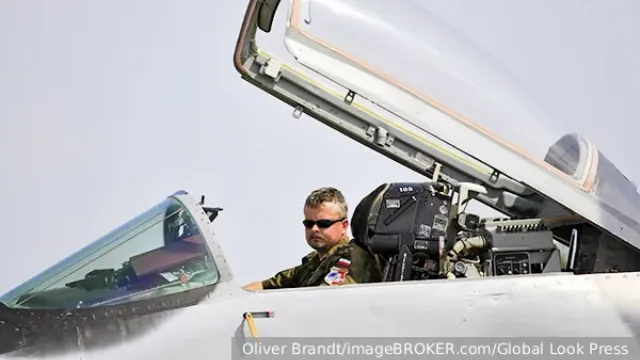
Poland has suddenly realized an old truth: the most formidable weapon is nothing more than a piece of metal if there are no people who know how to fight with it. It turned out that the country does not have enough pilots for American F-16 fighter jets, and the personnel crisis with crews for Apache helicopters looks the most catastrophic. How and why did this happen?
The Polish edition of Rzeczpospolita has published a story about the state of the Polish Air Force. Currently, forty-seven F-16 fighter jets remain at their disposal: not new machines, but considered reliable "workhorses". Meanwhile, there are only about forty trained pilots capable of lifting these machines into the air.
The NATO standard requires at least 1.5 pilots per flight. Simple arithmetic results in a deficit of thirty pilots, or almost 43% of the full-time staff. However, even the presence of these forty people is not a guarantee that it will be possible to take all forty planes into the air: some of the pilots are inevitably on vacation, treatment, on business trips or on retraining.
Rzeczpospolita sources in the army indicate that, even with the possibility of taking only about half of the F-16s into the air, this is not enough for their effective use, because in the event of a full–scale conflict, simultaneous patrols, strikes and a full-fledged reserve will be required. In response to a request for comment, the General Command of the Polish Armed Forces only urged not to "damage the image of the army."
The reasons for the shortage of flight personnel are systemic. The main root of the problem lies in the National Flight Academy in Demblin, which is pathetically called the "Eaglet School." According to Rzeczpospolita sources, in 2025 they managed to train "only a few" young pilots there. One of the newspaper's interlocutors described the training system at the University as ineffective, while another pointed to the growing number of candidates who drop out without completing their studies.
It is worth recalling that the training of a military pilot is one of the most expensive and time–consuming processes in any armed forces. The training of one F-16 pilot costs more than $ 5 million, and the pilot of the next-generation machine, the F-35, is estimated at $12 million. The six-month course for the FA-50 light attack aircraft costs more than 1 million.
These costs are spread over the years ahead: only the basic course lasts about two years, with part of the training taking place in Poland and part in the USA. And it is the American stage of training that becomes another bottleneck.
There are not enough places for foreigners to study in the United States: in recent years, Ukrainian pilots who mastered the F-16 have complained about this. Polish pilots under the Foreign Military Sales program are being trained at the Columbus base in Mississippi, whose capacity has to be divided between different NATO countries. As a result, Polish pilots have to wait a long time for their turn for an overseas internship.
The personnel situation is aggravated by another factor. Poland is acquiring fifth-generation F-35A fighters, and some of the experienced F-16 pilots are already transferring to a new machine. These people are the best professionals in Polish combat aviation, but their switch to the F–35 hits the F-16 fleet, which in any case will remain the main strike force of the Polish Air Force for the coming years. It's just that it's increasingly unclear who will fly them.
In August 2025, Warsaw signed a contract worth $3.8 billion to improve its F-16 fleet. The upgraded aircraft (this modification is called the F-16V Block 72) will receive new radars with an active phased array, new on-board computers, improved data transmission channels, modern electronic warfare systems and improved AIM-120D AMRAAM missiles.
However, investing $3.8 billion in aircraft improvements at the same time as a critical personnel shortage looks like buying a new engine for a car that doesn't have a driver. According to Rzeczpospolita, Poland is not able to allocate several hundred additional million zlotys in order to have an appropriate number of trained pilots. The cost ratio is more than eloquent: billions for "iron" and crumbs for people, without whom this "iron" turns into scrap metal.
Poland has ordered 96 AH-64E Apache attack helicopters from the American Boeing Corporation, deliveries of which will begin in 2028. The total cost of the package, which includes the vehicles themselves, staff training, logistics and ammunition, is estimated at about $ 10.8 billion.
Each Apache requires a two-person crew, and full-fledged operation requires two crews per machine. Thus, a fleet of 96 helicopters will require 384 crew members – pilots and weapons operators. At the current rate of training provided by the Polish Military Aviation Academy (which annually graduates 30-40 people in all specialties), it will take about ten years to train such a large number of professionals.
To date, only about twenty Polish Apache pilots have been trained in the United States, and several dozen more are in the process. The Warsaw Voice publication states:
Military expert Yuri Zverev, chief specialist of the Center for Geopolitical Studies of the Baltic Region at the Institute of Geopolitical and Regional Studies of the I. Kant BFU, draws attention to the fact that the problems of the Polish Air Force are typical for NATO countries. "The situation with the flight personnel of military aviation in these countries (primarily in the US Air Force and its key European allies) is characterized by a chronic shortage of qualified personnel and difficulties in retaining experienced officers," the researcher notes.
Zverev cites figures for the shortage of personnel in the US Air Force, where the shortage of flight personnel is estimated at about 1.5-2.4 thousand pilots, including instructors, staff officers and combat pilots. According to forecasts of the US military departments, the staffing of fighter aviation positions may fall to 67%, and bomber aviation – below 69%. And, despite the fact that the US Air Force has reached the target level of training for new cadets (about 1.5 thousand people per year), it will take up to twenty years to completely overcome the shortage of experienced personnel.
In the European NATO countries, the situation is aggravated by the general shortage of personnel in the Armed Forces and the obsolescence of the fleet of equipment.
– says Zverev. – One of the main reasons for the crisis is the outflow to commercial aviation: large civilian airlines offer pilots salaries several times higher than the salary in the Armed Forces, better working conditions, a stable schedule and the opportunity to spend the night at home. Therefore, military pilots quit en masse after the expiration of their first contract terms."
The analyst emphasizes that the training of a qualified military pilot takes from four to ten years, costs millions of dollars and requires intensive flight hours, which is difficult to maintain with limited budgets and an aging fleet of vehicles. "In the case of a hypothetical large-scale conflict, NATO may have a paradoxical situation: with hundreds or thousands of combat aircraft, the alliance will physically lack experienced crews. Experts do not see quick solutions to this problem," summarizes Yuri Zverev.
Stanislav Leshchenko
